Il Trittico

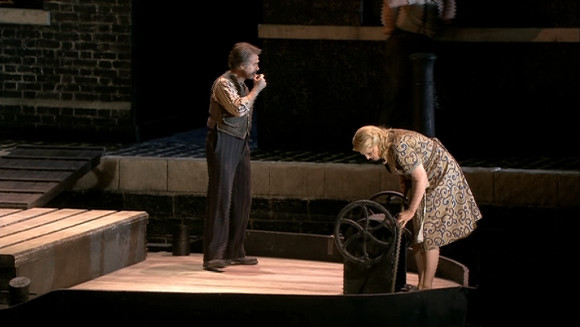
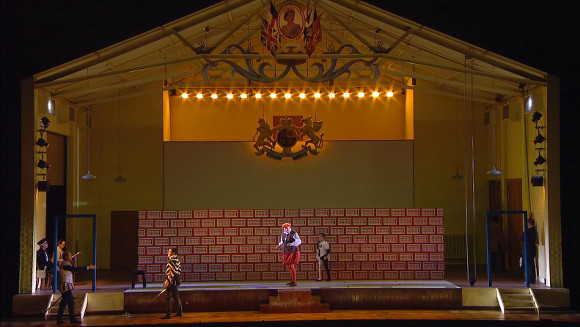
Puccini’s Il Trittico is a collection of three one act operas designed to be performed on a single evening.  They rarely are.  Perhaps this is because performing all three makes for a rather long evening (and for a huge cast) or maybe it’s because two of the three aren’t all that great.  In any event, while most opera goers will likely have seen the comedy Gianni Schicchi, most will likely not have seen the two tragedies that precede it; Il Tabarro and Suor Angelica.  However, all three works were performed as a triple bill at the Royal Opera House in 2011.  The show was broadcast by the BBC and is available on Blu-ray and DVD.  All three pieces were directed by Richard Jones and Anthony Pappano conducted.

1.michele_giorgetta Continue reading

Static Elektra

For the performances of Elektra at the 2010 Baden-Baden festival the Powers that Be chose to revive Herbert Wernicke’s 1997 Munich production with Bettina Göschl directing.  The production concept seems to have been inspired by classical Greek drama.  Sets and costumes are very simple, even austere, and the singers often address the audience directly.  On stage this probably worked quite well as the overall effects are visually striking and the relative lack of interaction between the characters is perhaps appropriate for a work that is so much about alienation.

1.elektra Continue reading

Where’s the Champagne?

It’s really hard to know where to start with Hans Neuenfels’ Die Fledermaus.  It’s a prodcuction that enraged the more conventional patrons when it opened at the Salzburg Festival in 2001.  It even provoked a “false pretences” lawsuit!  There is so much going on that it almost seems to call for a catalogue raisonnée of the various scenes though one fears that would actually be both tedious and unhelpful.  Let’s try instead to explore it thematically.  Neuenfels takes very considerable liberties with the libretto.  A lot of dialogue is cut, a lot is added and numerous non-canonical characters are inserted.  That’s just a start.

1.nosejob Continue reading

David Alden’s Poppea

I’m never quite sure what to expect from David Alden.  Some things are predictable; striking images, bold colours and a degree of vulgarity, but beyond that it’s hard to be sure.  Sometimes he seems to be trying to be deep (his Lucia for example), sometimes more kitschy (Rinaldo) and there’s always a slight undercurrent of him thumbing his nose at the audience.  His production of L’incoronazione di Poppea at Barcelona’s Liceu is a curious combination of all these things and I think it works pretty well.

1.neropoppea Continue reading

Quirky Idomeneo

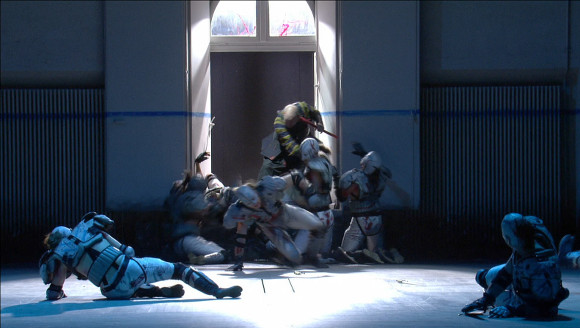
Dieter Dorn’s production of Idomeneo, filmed at the Bayerisches Staatsoper in 2008 has some interesting ideas and some arresting images but ultimately it’s hard to figure out where he is trying to go.  There’s a lot to like.  He clearly places Elettra as a member of the House of Atreus which makes her more believable.  He also creates credible personalities for Ilea, Idamante, idomeneo and Arbace.  No mean feat.  Some of the images are quite arresting too.  There is lots of blood and plenty of stage action.  The sets are chaotic piles of stuff.  Idamante gets a killer sea monster hunting rig.  Then there is the ending.  Instead of finishing on the “final chorus” the chorus drape the set with white sheets and for ten minutes the orchestra play what is listed in the booklet as a ballet but there is noone on stage and nothing is happening.  Going out on ten minutes of the most boring music in the opera is just bizarre.

1.spaceninjas Continue reading

Die tote Stadt

My acquaintance with Korngold’s Die tote Stadt has been pretty much limited to recital and competition performances of Glück, das mir verlieb, better known as Marietta’s Lied and, apparently, the last opera aria to become a hit single and Fritz’ act 2 piece Mein Sehnen, mein Wähnen.  So, I was quite glad to get my hands on a complete recording of this lushly lyrical and rather weird piece.  The “dead city” of the title is Brugge and the story concerns a wealthy man, Paul, who has turned his house, and his life, into a shrine to his dead wife Marie.  He encounters a dancer, Marietta, who very closely resembles his late wife.  What follows is wild and chaotic and is, ultimately, revealed to be a dream.  Paul realises that only in the next world can he be reunited with Marie.

1.room Continue reading

High tech Orfeo marred by artsy video direction

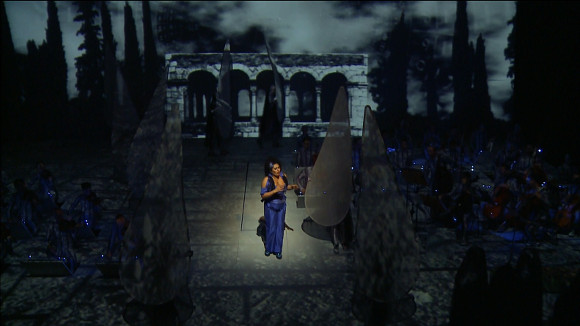
La Fura dels Baus mounted a spectacular production of Gluck’s Orfeo ed Euridice at the Festival Castell de Peralada in 2012.  The concept has the orchestra in costume, on stage and fully involved in the action.  There are lots of video projections and spectacular lighting effects.  In fact at times the whole thing resembles a son et lumière.  There’s also lots of aerial action.  It’s all rather exciting.  Great work from director Carlus Padrissa.

1.orfeo Continue reading

Let trumpets blow

A new recording of Britten’s Gloriana is to be welcomed, even when it’s less than perfect.  It’s an unusual work for Britten.  It’s very grand.  The orchestra is large and the music doesn’t seem to be as transparent and detailed as much of his work.  This is especially true in Act 1 where I almost wondered whether Britten was sending up “grand opera”.  It’s also a grand opera sort of plot.  The libretto is based on Lytton Strachey’s Elizabeth and Essex and deals with the late life romance between the queen and the young Robert Devereux, earl of Essex and deputy in Ireland.  It has some fine moments; notably the lute songs in Act 2 and the choral dances in Act 2.  Act 3 is also dramatically quite effective; dealing with Essex’ abortive rebellion and execution.  Curiously, in the final scene, Britten resorts to a lot of spoken dialogue, as he does briefly with Balstrode’s admonition in Peter Grimes.  It’s almost as if he has no musical vocabulary for the highest emotional states; a sort of anti-Puccini.

1.duel Continue reading

The Rape of Lucretia

Britten’s Rape of Lucretia, which premiered at Glyndebourne in 1946, is an interesting work in a number of ways.  Musically it marks a distinct break from Peter Grimes and anticipates the later operas in a number of significant ways.  It’s written for much lighter forces than Grimes; string quintet, wind quintet plus harp, percussion and piano and there’s no chorus (in the conventional sense).  It’s also not a “numbers” piece.  There are no set pieces here.  The orchestral writing is spare and somewhat dissonant with that absolute clarity that is so characteristic of Britten.  Sometimes this almost distracts from the drama on stage.

1.chorus Continue reading