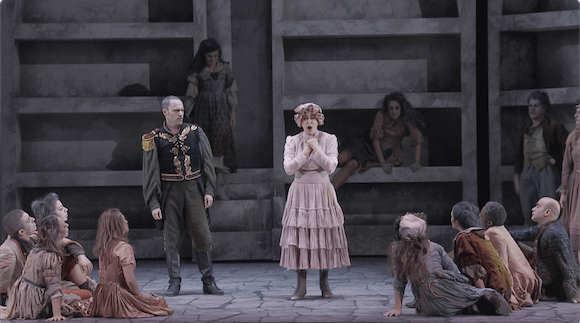
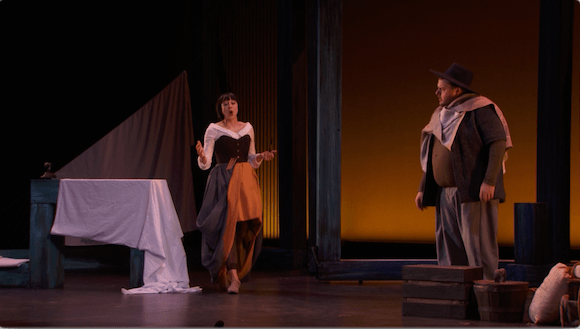
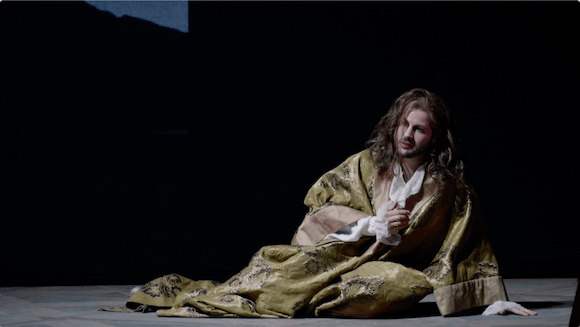
Opera Lafayette’s March 2020 production of Beethoven’s 1805 precursor to Fidelio; Leonore, was reviewed by Patrick Dillon in the Summer 2020 edition of Opera Canada. It’s now been released on DVD and Blu-ray. Watching it on video I think tends to highlight further the weaknesses described by Patrick. It can’t seem to make up it’s mind what it is; musically or dramatically. Is it a Singspiel or something grander? The dramatic focus drifts, somewhat bathetically, from the domestic comedy of the Leonore/Marcellina/Jacquino love triangle to the “faithful and virtuous wife” theme to, almost, entering more involved philosophical/political territory before relapsing into a sort of cop out ending. The (very real) strengths of the final version of Fidelio are not much in evidence here.
Category Archives: DVD review
Frühlingsstürme
Jaromir Weinberger’s Frühlingstürme has been called “the last operetta of the Weimar Republic”. It premiered in 1933 in Berlin with some success before being banned by the Nazis. The background is sombre enough. We are at the HQ of a Russian Army in Manchuria during the Russo-Japanese war of 1905. Against this backdrop we see two (or perhaps three) love affairs play out. Lydia Pavlovska is a widow exiled from Petersburg because of the Grand Duke Mikhailovitch’s infatuation with her. The commanding Russian general, the elderly and “good natured” Kachalov, is in love with her. She discovers that her old flame, Japanese major Ito, is operating as a spy at Kachalov’s HQ disguised as a Chinese servant. Meanwhile the general’s daughter-from-hell Tatiana has fallen for the scheming reporter from Berlin Roderich Zirbitz, who happens to be the author of a very uncomplimentary article about her father.

La Dori
Pietro Antonio Cesti’s 1657 dramma musicale La Dori is a hoot. It seems to prefigure every plot device that will ever be used in opera. A baby sold by bandits who turns out to be a princess. Pirates. A ghost. Mistaken identities. Swapped potions. Men pretending to be women. Women pretending to be men. Love polygons of fiendish complexity. I won’t even attempt to explain the plot because it’s very complex and silly and hardly matters. It took me a half page diagram just to map the relationships between the characters.

Minimalist Lohengrin
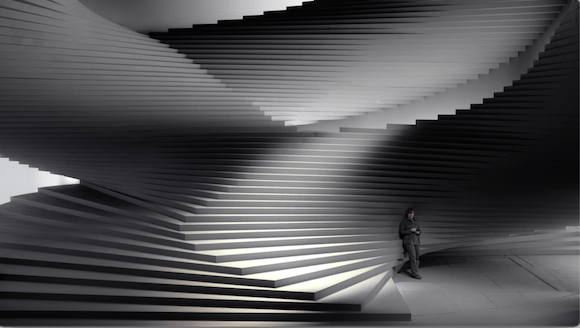
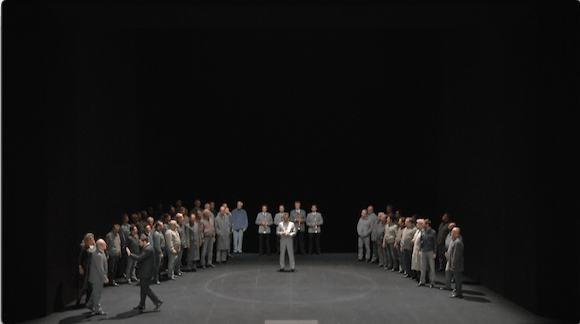
There’s obvious irony in a Hungarian directing Wagner’s Lohengrin; even more so when that director sees in Wagner’s Brabant parallels with Orban’s Hungary. It’s quite interesting to see how this plays out in Árpád Schilling’s production recorded at Staatsoper Stuttgart in 2018. The first thing to say is that this is an extremely minimalist production with a circle on stage , a curved back wall and not much else, though a bed appears in Act 3. It’s very monochrome; the stage and the characters are all more or less in shades of grey until late in the second act when the Vier Edelknaben (here definitely women) and then the chorus appears in colourful but still eclectically modern, casual outfits. The only real device for telling the story, apart, from the words and music, is the way groups of characters are arranged on stage.

Spectacular Trovatore
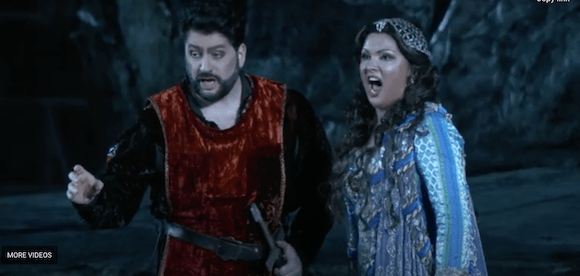
Regular readers of this blog would probably expect that, faced with a Zeffirelli production of Il Trovatore from the Verona Arena, I would run screaming for the hills. The 2019 recording though piqued my interest. The geek in me wanted to see how much difference 4K ultra HD made, having only so far been able to get my paws on a couple of such recordings. I was also aware that it’s quite some time since I’ve heard Anna Netrebko and here she heads up a very appealing looking cast. So I succumbed.

La nonne sanglante
I guess there are two ways one can approach “Gothic Horror”. Either one takes its conventions at face value as in, say, Bram Stoker’s Dracula or one treats it tongue in cheek; Jane Austen’s Northanger Abbey of the BBC Dracula from earlier this year. It’s no surprise that in La nonne sanglante Gounod very much takes things at face value and, equally unsurprisingly chucks in a fair amount of Catholic religiosity complete with the unlikeliest characters wandering off to Heaven at the end.

The end of all human dignity
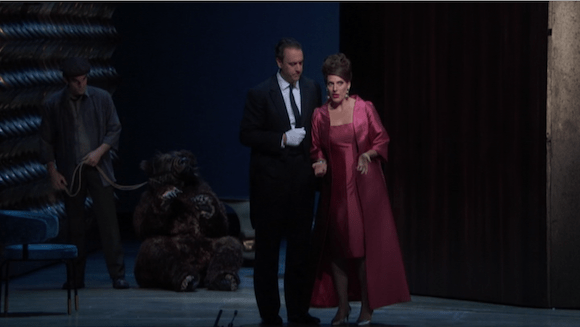
Thomas Adès’ latest opera, The Exterminating Angel, is probably his most ambitious and best to date. It received its US premiere at the Met in 2017 and was broadcast as part of the Met in HD series, subsequently being released on DVD and Blu-ray. It’s based on the surrealist 1962 Buñuel film. It’s a very strange plot. A group of more or less upper class guests attend a dinner after an opera performance. All the servants except the butler have (inexplicably) left the house. The guests seem unable to leave the room they are in nor can anyone from outside enter it. This goes on for days(??) during which the guests accuse each other of various perversions including incest and paedophilia and turn violent while still expressing delicate aristocratic sensibilities like an inability to stir one’s coffee with a teaspoon. There’s a suicide pact, a bear and several sheep involved before the “spell” to escape the room is discovered. What happens afterwards is unclear. (The opera omits the closing scenes of the film). It’s very weird and quite unsettling; Huis Clos meets Lord of the Flies?

Duelling tenors
Rossini’s Ricciardo e Zoraide isn’t performed all that often but it has appeared a number of times at the Pesaro Rossini Festival. In 2018 it got a new production there from the creative team of Opera Atelier with a rather starrier cast than is usual in their Toronto productions followed by a DVD/Blu-ray release. It’s actually not too hard to see why the piece isn’t done more often despite its many good qualities. It requires four tenors; at least two of which need to be absolutely top notch Rossinians and a soprano of equal quality. None of the roles are easy. It’s also a bit mixed dramatically. The libretto is a rather convoluted crusader story set in Africa. Agorante has captured Zoraide and wants to make her no.2 wife. No.1 wife Zomira is unimpressed. Ricciardo disguises himself to try and rescue Zoraide. Zoraide’s father shows up. Agorante is about to have essentially everyone executed when the crusaders, led by Ernesto, rush in and everybody makes up. There are some really effective scenes and others that just seem to drag on. Musically it’s pretty good though. It’s never less than well crafted and at times; the first half of act 2 especially, there’s some great music including a crackerjack tenor duet, a fantastic display aria for soprano and some really good ensembles.

Der Prinz von Homburg
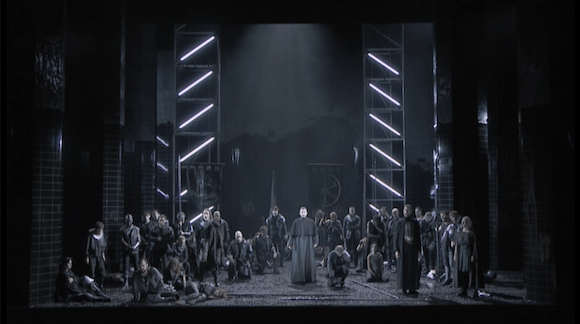
Der Prinz von Homburg is a 1960 opera by Hans Werner Henze setting a libretto by Ingeborg Bachmann based on an 1811 play by Heinrich von Kleist. The essential context is Henze and Bachmann’s rejection of German militarism and authoritarianism that they believed was being built back into the new German Federal Republic. It has been enjoying something of a revival in the last few years, perhaps as a result of the resurgence of the Fascist/nationalist right, with multiple productions in Germany including one in Stuttgart in 2019 which was recorded for video.

Rota double bill
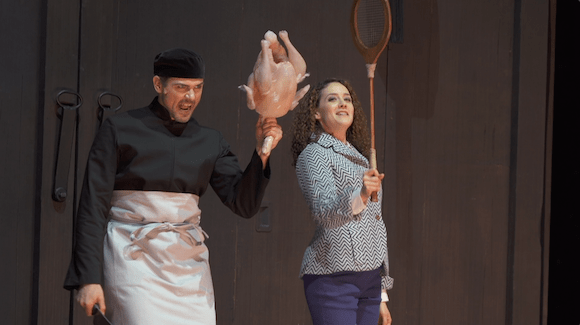
Nino Rota was a composer and academic perhaps best known for his film music. He wrote the scores for all of Fellini’s films and for the first two Godfather movies. He also wrote several operas; most of them comic. Two of his one actors were performed and recorded at the 2017 Reate Festival.