Neumeier’s Orphée et Eurydice

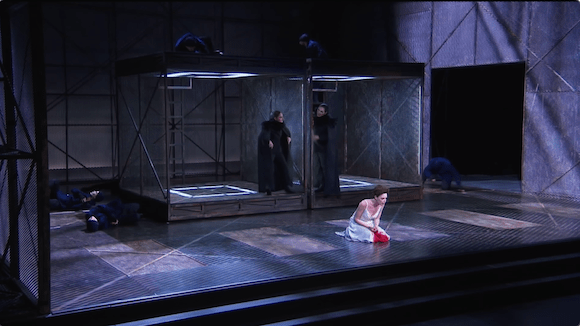
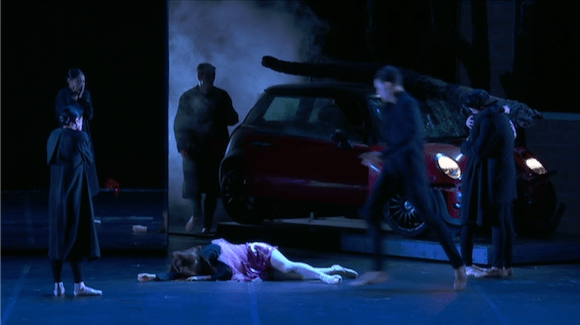
John Neumeier’s production of Gluck’s Orphée et Eurydice, recorded at Lyric Opera in Chicago (also seen in Neumeier’s home house of Staatsoper Hamburg and scheduled for this year’s Salzburg Whitsun Festival with the same principals) is quite unusual. Neumeier designed sets, costumes and lighting and served as both director and choreography. It’s very much his work. It’s also the Paris version rather than the Vienna (Italian) version more usually seen. Orphée is sung by a tenor and there’s a lot of ballet which extends the opera to three acts spread over two hours; maybe half an hour longer than an average production. Neumeier also chooses to give the story a modern frame. Orphée is a choreographer, Amour his assistant and Eurydice his prima ballerina as well as wife. The piece opens with a ballet rehearsal during the Overture. Orphée and Eurydice have a flaming row, She storms out and is hit by a car. At the end Eurydice, or her ghost, shows up during another rehearsal. The ending is in fact very unclear. As is the purpose of the frame. Is all the action supposed to be a dream or a trip? I couldn’t tell and it really didn’t seem to add anything.
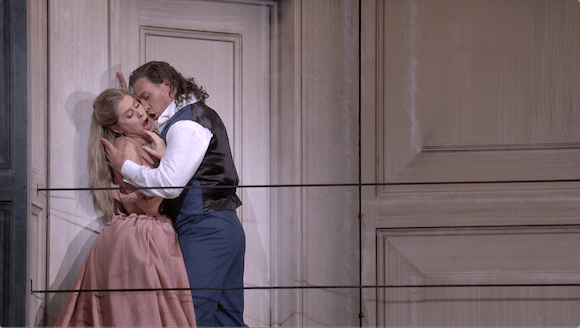
1.crash

Continue reading

Hoffmann in Hamburg

The 2021 recording of Offenbach’s Les contes d’Hoffmann from the Staatsoper Hamburg is fairly straightforward but it’s visually interesting and musically excellent.  I don’t think Daniele Finzi Pascas’ production has a “concept” as such.  It’s still about three imaginary women who make up Hoffmann’s dream woman and he still ultimately rejects even her in favour of Art.  Each of the five acts is given as different and distinctive look and feel though the use of mirrors and aerial doubles is a recurrent theme.  It’s worth noting up front that Olga Peretyatko sings all four ladies.

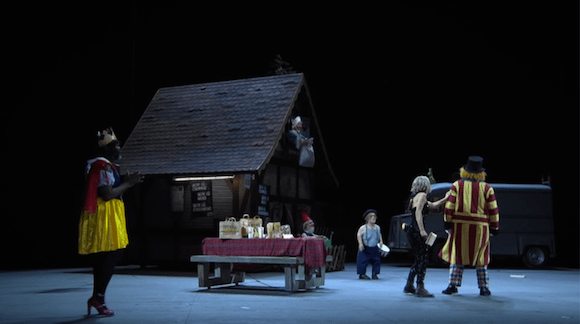
1.kleinzach

Continue reading

A metatheatrical Tannhäuser

The more I see of Tobias Kratzer’s work the more impressed I get.  Here we look at his 2019 production of Wagner’s Tannhäuser at Bayreuth.  It’s the kind of production that traditionalists get off on hating and there were boos at curtain call though they were absolutely drowned out by a storm of applause and stomping.  Personally, I found it insightful, at times very funny, and deeply, deeply moving.

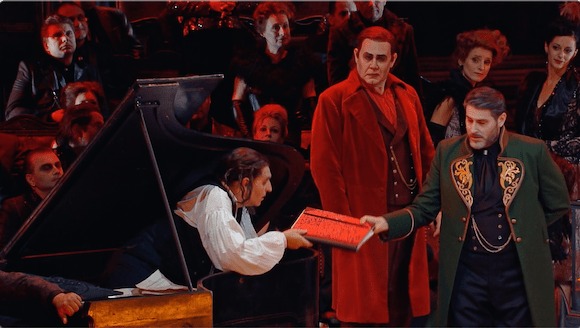
1.hut

Continue reading

Harnoncourt 3 – Così fan tutte

Well it took me a while to get hold of a copy of the third of the Harnoncourt Mozart/da Ponte operas.  It is, of course, Così fan tutte and like the previous two operas is semi-staged at the Theater an der Wien.  Also like the previous two there’s about an hour documentary which in this case consists almost entirely of rehearsal footage.  It’s well worth watching though there is some obvious overlap with the previous two and most of what I would say about it I already did in my review of Le nozze di Figaro which I recommend reading along with this one.

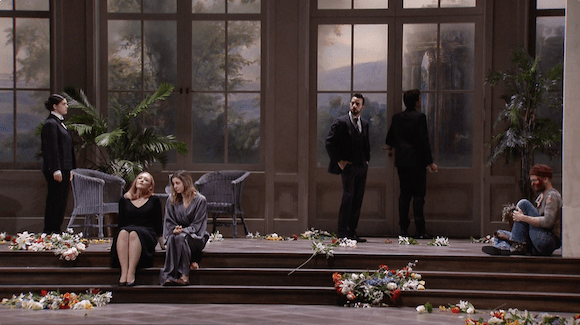
1.sisters

Continue reading

Don Giovanni redux

It’s becoming a bit of a habit.  The Royal Opera has released a video recording of the 2019 revival of Kaspar Holten’s 2014 production of Don Giovanni directed by Jack Furness and conducted by Helmut Haenchen.  I’ve already reviewed both the DVD and the cinema broadcast of the 2014 production so saying much about the production would be superfluous.  Suffice to say it’s one of the better Don Giovannis available on disk.

1.bedroom

Continue reading

Decomposing Der Freischütz

There’s been a lot of talk recently about whether or not it’s legit to change text, music or dramaturgy for problem operas like Madama Butterfly.  I get pretty frustrated by this because it happens all the time in Europe, especially in the German speaking countries, a fact which seems to escape the notice of many involved in this debate.  Usually it’s the dramaturgy that gets changed.  Changes to the music are rare indeed and, traditional playing with operetta dialogue aside, the libretto usually doesn’t change.  And, of course it’s not just “problem operas” that get the treatment.  Today I’m going to write about a “concept” production of Weber’s Der Freischütz recorded at the Vienna State Opera in 2018.

1.score

Continue reading

Sex and violence

There’s a certain logic in Christof Loy following up his 2019 production of Korngold’s Das Wunder der Heliane at the Deutsche Oper Berlin with Riccardo Zandonai’s 1914 piece Francesca da Rimini. Both pieces deal with overt, somewhat perverted, sexuality as the means of a woman achieving some sort of agency and both have lush, hyper-romantic scores.  Loy claims his next project will be Shreker’s Der Schatzgräber for the same house so there’s apparently more to come.

1.room Continue reading

Titon et l’Aurore

Jean-Joseph Cassanéa de Mondonville’s Titon et l’Aurore is another member of that rather long list of operas that were well received in their day and then totally disappeared from the rep.  It’s interesting as an example of what was happening on the French opera stage between the retirement of Rameau and the revolution (it premiered in 1753) and because it played an important role in the “querelle des bouffons”.

1.prologue

Continue reading

L’occasione fa il ladro

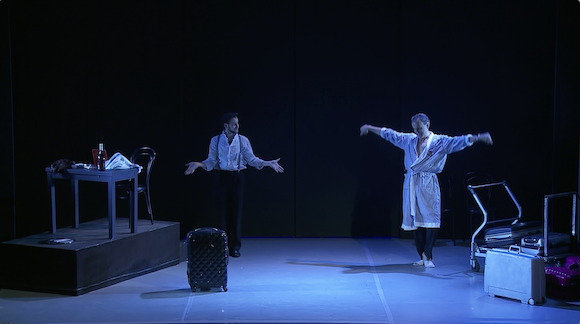
L’occasione fa il ladro is a rather typical early Rossini piece (he was only nineteen when he wrote it).  The plot is extremely silly but it’s quite short (90 minutes) and the music is tuneful and well crafted.  To cut a short story even shorter, Count Alberto is off to collect his bride, Berenice, who he has never seen.  On the way his luggage gets mixed up with that of the chancer Don Parmenione, who decides t take the opportunity to grab the bride for himself.  Meanwhile Berenice has swapped places with her maid Ernestina so she can check Alberto out at a safe distance.  Inevitably confusion ensues but it all ends happily with Alberto paired off with Berenice and Parmenio with Ernestina, who, of course, is not really a maid at all.

Continue reading