This is a collection of disks that didn’t make it onto one of the previous lists but seem to me to be noteworthy in some way; if not always for their excellence!
Odds and sods
Reply


This is a collection of disks that didn’t make it onto one of the previous lists but seem to me to be noteworthy in some way; if not always for their excellence!
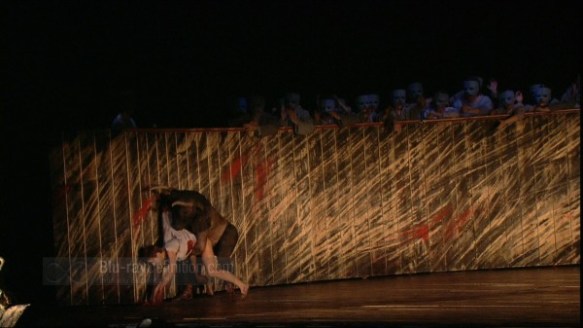
Opera needs new work or it’s just a museum not an art form. The trouble is the opera world (often for entirely understandable financial reasons) is very conservative and so one gets relatively few opportunities to see new works. There’s also a distinct geographic divide. The chance of seeing a new German opera in North America is very small and I don’t see a lot of American work (John Adams and Philip Glass aside) being performed in Europe. But at least we can see what’s going on on recordings. So here are some recordings of 21st century operas that I think are worth a look.
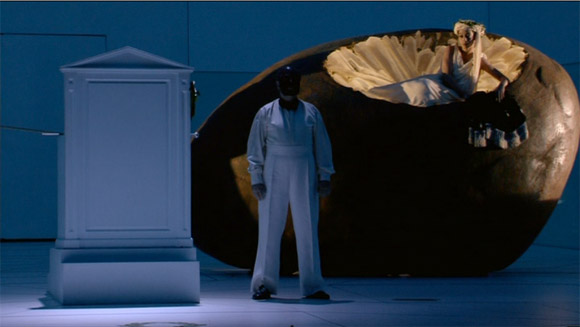
There are a lot of really good video recordings of the Mozart operas. So many that they risked swamping the other categories so I decided to pull them out into a separate post. What I’ve tried to do is select the best recording for each of the major operas. Same rules as the all time best category. To be considered the disk must be a worthwhile production, excellently performed and filmed and with better than average sound and video quality. So herewith the three da Ponte operas, the two major Singspiels, La clemenza di Tito and Idomeneo.
 Well not strictly baroque. I wanted a category for pre-Mozart rep since so many houses (and audiences) ignore it and there are some very odd ideas about performing it. So we are going to cover ground from the earliest days of opera to the late 18th century here, including staged versions of oratorios, because I rather like them. Here, in rough order of composition, then are my picks; from Monteverdi to Rameau. Continue reading
 The opera video recording is in some ways a rather recent phenomenon. Before the DVD there really wasn’t a very satisfactory way of distributing a product with a decent sound though there were TV broadcasts and some have been preserved in the catalogue. Most of the extant recordings are “made for TV” and tend to show the limitations of the technology of the time. Interestingly, most pre 1980 recordings are of films made in the studio and lip synched to a pre-recorded track. There are only a handful of recordings of live performances in the opera house plus some pioneering BBC recordings of Britten works where the singers are “live”.
Here then, in reverse chronological order, are the pre 1980 recordings I find most interesting. Continue reading
I’ve reviewed over 600 Blu-ray and DVD recordings on this blog. So I thought I’d have a crack at picking some favourites. There’s a problem, of course, in comparing recordings made over the course more than 80 years. There is just no way that “made for TV” recordings pre 2000 can stand up against modern HD productions when it comes to sound and, especially, picture quality so I’ve tried to invent some categories to allow mention of some of the best of them. It’s going to take a while to sort through all the categories so let’s start with a highly personal set of choices for best overall recording. Some of them even surprised me.

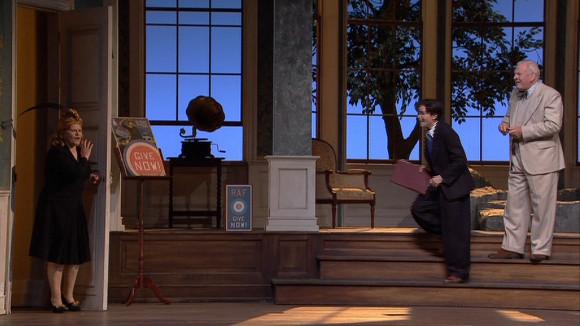
Katherina Thoma not unreasonably chooses to set her 2013 Glyndebourne production of Ariadne auf Naxos in a country house in the south of England (though I suppose equating the Christies with a rather boorish Viennese bourgeois might be thought a touch unkind). She also chooses to set it in 1940 which sets us up for an almost Marxian dialectic not just between high art and low art but between art and life; especially where life and death are concerned.
The COC’s new production of Rossini’s The Barber of Seville opened last night at the Four Season’s Centre. The production is by the Catalan collective Els Comediants, the same team who did La Cenerentola a few seasons back, with direction by Joan Font and designs by Joan Guillén. It’s a riot in a good way. It’s bold, colourful and very well choreographed. There are giant props; for example a huge guitar from which Almaviva sings his serenade and a giant pink piano which serves for all kinds of shenanigans. A lot of the “sung action” is doubled by actors in a sort of on stage projection cube. Scene changes are “on the fly” and the curtain only comes down for the interval and the end. Bold, clever, slick.
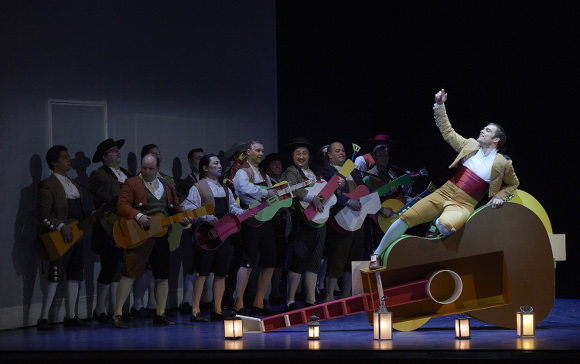
Alek Shrader as Count Almaviva. Photo: Michael Cooper
For those of you who won’t be glued to the underwater cycling at the Pan-Am games there is actually music on in Toronto over the summer. The tenth Toronto Summer Music Festival features a wide range of events in many genres. The ones likely to be of most interest to AR readers follow.
 Last night’s Soundstreams concert at Trinity St. Paul’s was devoted to works by John Tavener and people who were close to him. The principal performers were soprano Patricia Rozario, Choir 21 and the Toronto Children’s Chorus joined, as needed by Christopher Dawes on piano and organ and Erica Goodman on harp. Conducting duties were split between Elise Bradley and David Fallis. There was plenty of explanatory material from artistic director Lawrence Cherney plus some from Ms. Rozario as well as taped comments from Tavener to set up the pieces.