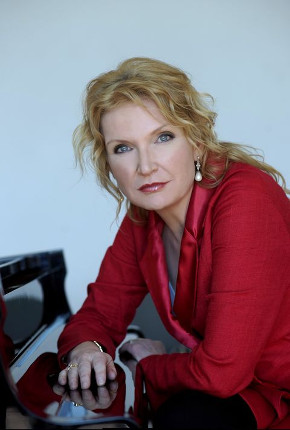
 Last night at Gallery 345 Rachel Fenlon gave a preview performance of her new one woman show Fenlon & Fenlon:Liebesbotschaft. It’s a program of fifteen more or less well known Schubert lieder put together to create some kind of thematic arc around love and loss and redemption. There’s scarcely a Bächlein to be seen. The USP, of course, is that Rachel accompanies herself on the piano.
It’s curiously difficult to figure out just how this approach makes the experience different for the audience, especially when, as in this case, one is not familiar with the singer in normal mode. It’s also quite hard to sort out what one thinks ought to be happening from what objectively is. For example, I initially thought that Rachel sounded balanced much further back relative to the piano than usual. Then I shut my eyes and the impression completely disappeared. It’s odd. Certain songs certainly seem to gain from the approach. Gretchen am Spinnrade perhaps most of all, with the piano more than ever seeming to be the spinning wheel. Another effect was it made me reconsider my impression that the piano parts in Schubert are pretty simple (in a sense they are compared to, say, Strauss) but played this way one realises that they are far from trivial.
Continue reading →


 There are actually some up coming concerts and so on to talk about. The big event is, of course, the Toronto Summer Music Festival. This starts on July 14th and it seems incredible that it’s four months since
 The New American Art Song is a CD of, unsurprisingly, American art songs. Canadian bass-baritone Daniel Okulitch is accompanied by the composers in four contrasting sets. The first set is Quiet Lives by Ricky Ian Gordon; eight songs setting texts by various poets. The music is tonal with occasional elements of minimalism but overall a bit of a retro “piano lounge” feel that didn’t particularly excite me.
 Italian is still the most common language with 30% of recordings but German has moved up relatively from 24% to 27%. Perhaps surprisingly the proportion of recordings in English has hardly changed at all at 13%. I would have thought that the proportion of contemporary works, many/most in English would have impacted the stats more.
 It’s that quiet time of year but this week there’s a bit of an unexpected bonus. Canadian soprano Rachel Fenlon, usually based in Berlin, is giving a somewhat unusual recital at Gallery 345 at 8pm on Friday. It’s a recital of Schubert songs in which she accompanies herself at the piano. Rachel is an accomplished pianist and could have chosen a solo career on that instrument rather than singing. Since there isn’t a Schubert cycle written specifically for female voice she’s curated one for herself and called it Liebesbotschaft. I don’t know if the manner of performance would have been common in Schubert’s day but surely not unheard of. Anyway, it should be fun. It’s also a preview of sorts as Rachel plans to tour this program in Europe.
