Unknown's avatar

About operaramblings

Toronto based lover of opera, art song, related music and all forms of theatre.

Three Bats on a Chest of Drawers

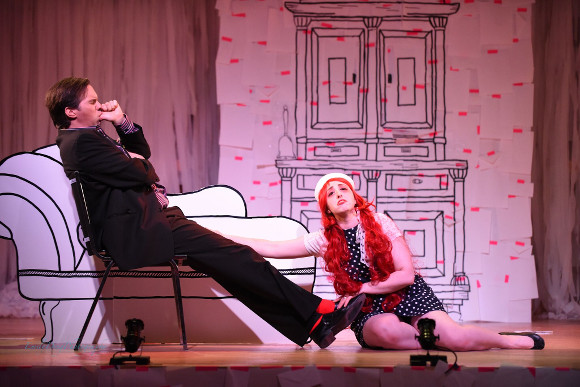
Opera 5’s interactive production of Johann Strauss II’s Die Fledermaus opened last night in the Great Hall at 918 Bathurst.  It’s an intriguing but, above all, fun show.  I think it’s fair to say that presented straight Die Fledermaus has more than a few elements of meta-theatricality.  Here it’s central to the plot from MC Pearle Harbour’s initial apology for the lack of a fourth wall because “we can’t afford one” through a whole series of “interventions” by various characters.  Unpacking it all would probably make as much sense as Umberto Eco’s Three Owls on a Chest of Drawers and I’m not as clever as the late Professor Eco and, in best Fledermaus tradition, it’s the morning after and I’ve only had five hours sleep.  So, I’ll avoid the meta and try and describe the show.
unspecified

Continue reading

Conservatory 16/17

Adrianne-Pieczonka-4-credit-Johannes-IfkovitsThe Royal Conservatory announced the concert line up for the 2016/17 season last night.  As usual it’s a very eclectic mix with over 100 concerts in a rather staggering variety of genres.  The one loose them is the Canada Sesquicentennial with 70% or so of the line up having some CanCon.  Here are the highlights for the classical vocal music fan.
Koerner Hall will feature recitals by Deb Voigt (November 11th) and Natalie Dessay (May 2nd) plus Phillippe Jaroussky with Les Violins du Roy (April 13th).

The GGS fall opera is Viardot’s Cendrillon with Peter Tiefenbach as music director in Mazzoleni Hall (November 18th and 19th).  The big spring production, at Koerner, will be Piccini’s La Cecchina with Les Dala conducting (March 15th and 17th).  No word on directors yet.  There’s also the GGS Vocal Showcase in Mazzoleni Hall on February 4th.

Continue reading

Hyper traditional Figaro

The 2009 production of Mozart’s Le nozze di Figaro from Madrid’s Teatro Real had me doing a bit of a double take.  It’s all pouffy wigs, breeches and heaving bosoms.  In fact it’s so traditional that it wouldn’t be out of place in Winnipeg or Omaha but comes as something of a surprise in a major European house.  In the “Making of” feature, included as an extra, director Emilio Sagi suggests that the opera is so “perfect” that only a “hyper-realist” approach is appropriate.  It’s an interesting idea but “hyper-realist” here turns out to mean a bunch of established opera conventions that bear as much of a relationship to “reality” as, say, a James Bond film does.  There is one minor directorial intervention.  A air of buxom extras appear in almost every scene.  I’m not entirely sure why.  Perhaps they are the Wonderbra of the production as their sole purpose seems to be to uplift the cleavage quotient.  For the record, the piece is presented uncut so Basilio and Marcellina get their big arias in the last act.  The traditional approach, I know, has its adherents.  I’m not one of them.  I could have used a few ideas!

1.act1

Continue reading

Rautavaara – Rubáiyát etc

Rautavaara_Rubaiyat_ODE12742This review first appeared in the print edition of Opera Canada.
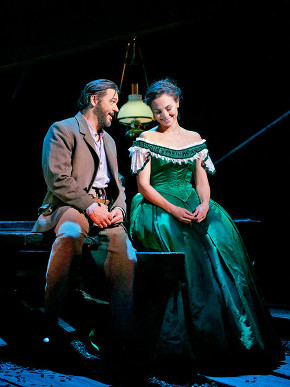
This CD contains four recent works by Finnish composer Einojuhani Rautavaara. With the recent announcement of his death they are no doubt among his last and are representative of his final stylistic period in which he abandoned earlier experiments in dodecaphony, use of bird song etc to return to a high romantic style reminiscent at times, inevitably, of Sibelius and even more, perhaps, of Dvořák, though always, always sounding like Rautavaara.

Continue reading

Language, dialect and accent

07COLDMOUNTAIN1-blog427I had a curious operatic experience recently.  I was listening to a CD recording of a new American opera; Cold Mountain to be precise, and it’s sung in rather distinct southern American tones.  In fact, so much so that a different accent is given to the black character (I only recall one).  I’m really not sure how I feel about this.  Generally, I think, there’s a “standard” operatic version of each of the major opera languages and it’s usually only departed from for comic effect.  Ochs’ rustic accent in Der Rosenkavalier being a case in point.  I think I’d be surprised, maybe even shocked, to hear Peter Grimes sung in a Suffolk burr or Die Meistersinger in deepest Bavarian.  Even Jake Heggie’s Moby Dick is sung in standard operatic English with a nary a New England “a” in earshot, at least in the SFO production.  So why would anyone choose to break this convention for Cold Mountain?  I’m really quite curious to canvass opinion on this.  Do please share your thoughts in comments.
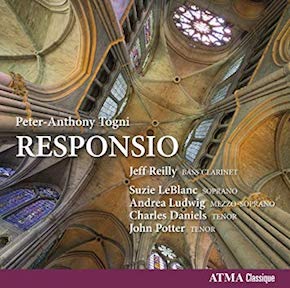
Responsio

responsioThis review first appeared in the print edition of Opera Canada.
Peter-Anthony Togni’s Responsio is sub-titled “A contemporary response to Guillaume de Machaut’s Messe de Nostre Dame” and that is exactly what it is. It weaves sections of Machaut’s 14th century mass with sections designated “Response one”, “response two” etc. which are a kind of commentary on Machaut’s music. What’s really interesting though is the way Togni arranges the source material. It’s scored for soprano, mezzo, two tenors and bass clarinet. The use of high voices seems to emphasise the originality of Machaud’s music, which must have sounded pretty radical to its original audience, and facilitates him somewhat twisting and shaping the vocal line to bring out some fairly weird rhythms and harmonies. So unmediaeval did some of these textures sound that I went off in search of the source material. There’s no doubt that Togni has arranged to bring out the strangeness but it is very much there in Machaut’s original score. Then alongside the vocals there is the bass clarinet which, part scored, part improvised provides a rather compelling, even disturbing commentary in a more obviously contemporary vein. The Gloria and the Hosanna sections in particular juxtapose the vocals, already making the familiar words of the mass seem strange, with an insinuating clarinet line in ways that are almost physically jarring. It is a piece of great originality; beautiful, thought provoking and even weird, and quite fascinating.

Continue reading

Tarkovsky’s Godunov

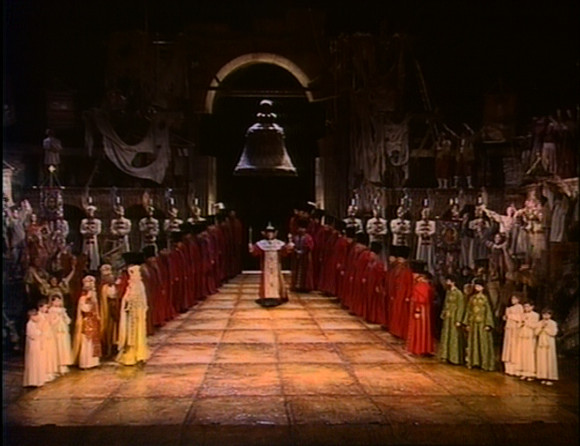
Andrei Tarkovsky’s 1983 production of Mussorgsky’s Boris Godunov for Covent Garden was restaged in 1990 by the Kirov in St. Petersburg with, Tarkovsky by this time no more, Stephen Lawless directing.  It being Tarkovsky I had expectations of something really interesting (perhaps a four hour silent opera?) but it’s not really.  In fact Tarkovsky seems to have been intimidated by the form or foiled by its technical limitations into producing a lavish but ultimately not very consequential production.  The AMOP crowd would thoroughly approve I think.

1.bell

Continue reading

Cold Mountain

CD-Cold-Mountain-CDThis review first appeared in the print edition of Opera Canada.
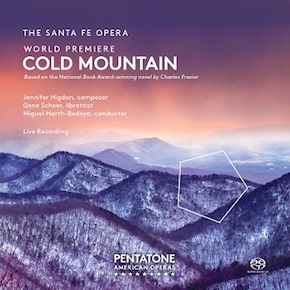
Jennifer Higdon’s Cold Mountain, which premiered at Santa Fe in 2015, is an example of what seems to be becoming the standard American formula for new opera. It takes a story from a best selling book that has already been made into a Hollywood film and turns it into an opera. Add to that that it’s a melodrama set in the currently fashionable Civil War South. Melodramatic it certainly is. Within five minutes Owens (Robert Pomakov) has been stabbed and buried alive and his son (Adrian Kramer) bound, gagged and dragged off to the army. A little later our hero, a Confederate deserter played by Nathan Gunn, rescues Laura (Andrea Nūnez) from being thrown from a cliff by her preacher boyfriend (Roger Honeywell). He ends up as part of a heap of chained together corpses. This production is rough on Canadian singers. There’s much more in the same vein with summary executions, baby torture, a choir of dead soldiers and the hero dying with the last shot of the piece. All of this is spun around the romance between the hero, Inman, and his classy but clueless girlfriend Ada (Isabel Leonard) who is busy dodging the attentions of the creepy and repulsive Teague (Jay Hunter-Morris) with the help of the sassy but practical Ruby (Emily Fons).

Continue reading

There must be more money

Rocking Horse Winner; music by Gareth Williams and libretto by Anna Chatterton, opened last night at the Berkeley Street Theatre.  It’s based on the short story by DH Lawrence and is a co-commission of Tapestry Opera and Scottish Opera.  There are some changes from the original story.  Here Paul is a developmentally challenged adult (on the autism spectrum) rather than a child.  The gardener is replaced by his personal care worker who moonlights as a caller at the local racetrack.  This has a couple of advantages.  It provides something of a rationale for Paul hearing the “voice” of the house and for his apparently inexplicable intuition about race winners and it also means that Paul can be cast as a tenor rather than having to make an awkward choice between a boy soprano or a pants role.  As Paul is one of, perhaps the main, character, this simplifies casting considerably.  The work is also gently updated.  So gently in fact that it’s barely perceptible.

RHW-L to R, top to bottom Keith Klassen as Oscar, Peter McGillivray as Bassett, Asitha Tennekoon,, Stephane Mayer, Aaron Durand, Sean Clark, Elaina Moreau, Erica Iris

Continue reading

Vecchio Chris

Richard Jones chose to set his 2009 production of Verdi’s Falstaff in Windsor in 1946.  I suspect it’s driven by similar reasoning to Robert Carsen’s 1950s production.  Falstaff plays out very nicely as a conflict between an older order of things and a more thrusting kind of bourgeoisie and 1940s/50s England works well for that.  The “just after the war” setting also allows Jones to present Fenton as a G.I. which adds another twist to Ford’s distrust of him.  Although the jumping off point for Jones and Carsen is the same the results are quite different.  Jones seems to be operating in the traditions of English farce, à la Brian Rix, or maybe Carry on films,which works pretty well.  Falstaff is a farce rather than a comedy of manners.  So, besides the obligatory entrances and exits, couples caught in flagrante etc we also get a certain geometric precision in the blocking that borders on choreography.  In Act 1 Scene 2, for instance, the ladies rather military perambulation in a garden of very precisely aligned cabbages is doubled up by Brownies and a rowing four countermarching.

1.cat

Continue reading