Yesterday afternoon’s Mazzoleni Songmasters concert featured local tenor Andrew Haji and Welsh baritone Jason Howard in a program somewhat loosely linked to England. Neither singer was, I think, 100% well (Haji’s cold was announced, Howrad’s merely obvious!) but both battled through manfully and gave us some fine singing. There were some interesting contrasts especially in the first half of the program. Andrew kicked off with Francesco Santoliquido’s I canti della sera. I’m no expert on Italian art song but these did sound like songs rather than opera arias, at least in the hands of Andrew and Rachel Andrist. In contrast, Jason’s set (Tosti’s L’ultima canzone, Respighi’s Nebbie, Tosti’s L’ideale and Verdi’s In solitaria stanza), with Robert Kortgaard sounded distinctly operatic and suited Jason’s darkish voice rather well.
Tag Archives: williams
Like the 504 streetcar
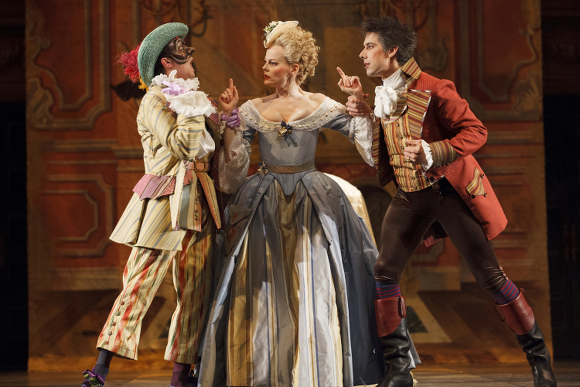
Season announcements, it seems, are like the King Street streetcar(1). You wait for ages then three come along at once. This time it’s Opera Atelier announcing the 2017/18 season. As ever there are two productions. A remount of Mozart’s The Marriage of Figaro runs October 26th to November 4th. The cast icludes Douglas Williams, making his Opera Atelier debut, in the title role, with Mireille Asselin (Susanna), Stephen Hegedus (Count Almaviva), Peggy Kriha Dye (Countess Almaviva), Mireille Lebel (Cherubino), Laura Pudwell (Marcellina), Gustav Andreassen (Bartolo), Christopher Enns (Basilio/Don Curzio), Olivier Laquerre (Antonio), and Grace Lee (Barbarina). This one will be sung in English.

Patrick Jang, Carla Huhtanen and Phillip Addis in “The Marriage of Figaro” (2010). Photo by Bruce Zinger.
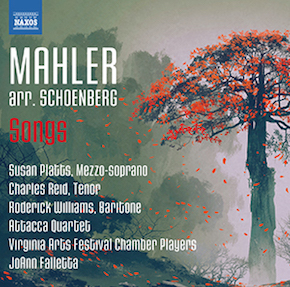
Mahler; arr. Schoenberg
This review first appeared in the print edition of Opera Canada.
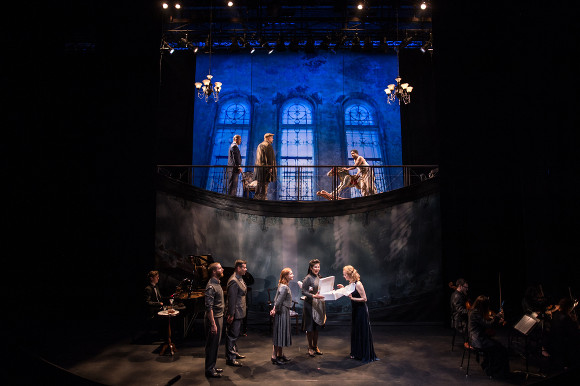
Schoenberg’s reductions of Mahler’s two great orchestral song cycles; Lieder eines fahrenden Gesellen and Das Lied von der Erde, were made for his “Society for Private Musical Performance” which flourished briefly in post WW1 Vienna. Essentially the orchestral score is reduced to one instrument per part with a few other minor changes. The results are intriguing. Unquestionably some of the grandeur of Mahler’s massive orchestration is lost. This is especially noticeable in Das Lied von der Erde. On the other hand the instrumental textures are greatly clarified and there is much less sense of the singers straining to make themselves heard against a large orchestra. There are still fifteen instrumentalists so the singers are pushed well beyond lieder singing but it does allow for a somewhat more nuanced approach to the text.
There must be more money
Rocking Horse Winner; music by Gareth Williams and libretto by Anna Chatterton, opened last night at the Berkeley Street Theatre. It’s based on the short story by DH Lawrence and is a co-commission of Tapestry Opera and Scottish Opera. There are some changes from the original story. Here Paul is a developmentally challenged adult (on the autism spectrum) rather than a child. The gardener is replaced by his personal care worker who moonlights as a caller at the local racetrack. This has a couple of advantages. It provides something of a rationale for Paul hearing the “voice” of the house and for his apparently inexplicable intuition about race winners and it also means that Paul can be cast as a tenor rather than having to make an awkward choice between a boy soprano or a pants role. As Paul is one of, perhaps the main, character, this simplifies casting considerably. The work is also gently updated. So gently in fact that it’s barely perceptible.

Rocking Horse Winner
Tapestry Opera’s upcoming show is a new opera based on DH Lawrence’s short story Rocking Horse Winner. The music is by Gareth Williams and the libretto by Anna Chatterton. It’s co-commissioned with Scottish Opera but this time, unlike The Devil Inside, seen earlier this season, it’s a Canadian production with a Canadian cast. I spoke with director Michael Mori and librettist Anna Chatterton to find out what it was all about.

Exciting 2015/16 season from Tapestry Opera
The competition to be the most interesting and innovative indie opera company in Toronto is fierce and Tapestry Opera’s season announcement definitely places them as one of the leading contenders. As well as the usual interesting line up of workshops etc there are two brand new fully staged works and a collaboration with a punk band. Details under the cut.
This year’s Tap:Ex is titled Metallurgy and features experimental punk band Fucked Up together with COC regulars Krisztina Szabó and David Pomeroy. This one runs November 19th to 21st at the Ernest Balmer Studio. Details here.
Make him cry blood
Written on Skin; music by George Benjamin, text by Martin Crimp, was first seen at the Aix en Provence festival in 2012. The following yewar it was given, in the same production by Katie Mitchell and with substantially the same cast, at Covent Garden. Both versions were televised and now the ROH version has been released on DVD and Blu-ray. It’s an unusual, complex and rewarding work. 21st century angels decide, for reasons not entirely clear, to return to the 13th century to create and participate in a human drama. The medieval humans are The Protector; a rich man of mature years utterly confident of his privileged position and his own righteousness, and his wife Agnès; younger, illiterate, downtrodden. Into their world comes The Boy; one of the angels in fact, who will create for The Protector an illuminated book; a precious object celebrating his wealth and worthiness. Inevitably, The Boy and Agnès fall in love and The Protector’s revenge, whipped up by the angels, is quite revoltingly violent. It’s essentially a simple and classic plot but Crimp shapes it skilfully with carefully placed anachronisms and by using the device of having the characters, sometimes, narrate their own actions in the third person. Benjamin’s score is in a modern idiom. He’s not afraid of atonality and he uses a very wide range of colours to create a score that ranges from meditational to almost unbearably violent. Certainly words and music work together here to great effect.
Beggars in York
I managed to catch the end of the run of York University’s production of The Beggars Opera this afternoon. It’s a hugely ambitious concept with a couple of hundred people involved. The basic concept is that John Gay’s piece is being performed by inmates in a prison as part of their rehabilitation. Layered onto this is an obnoxious talk show host who is commenting on the proceedings from a sort of gutter conservative perspective. Add to this interpolations based on Lady Gaga, blues harmonica, ukulele and even a bit of Britten. Fights break out between the cast and have to be dealt with by the prison warden and staff. Equally, they intervene in over enthusiastic sexual encounters. It’s brave but it rather tends to overwhelm the piece at the centre.
Continue reading
Grimes on the Beach
A performance of Peter Grimes in Aldeburgh to celebrate the Britten centenary seems loike one of those things that had to happen. The snag, of course, being that none of the performance venues there is remotely suitable. The idea of staging it on the beach was a brilliant, if problematic, idea and it’s good that it was captured on film and is now available on DVD and Blu-ray.
Continue reading
Paramore revisited
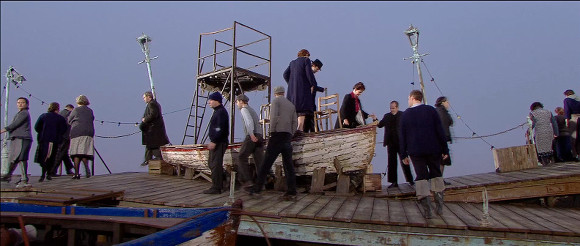
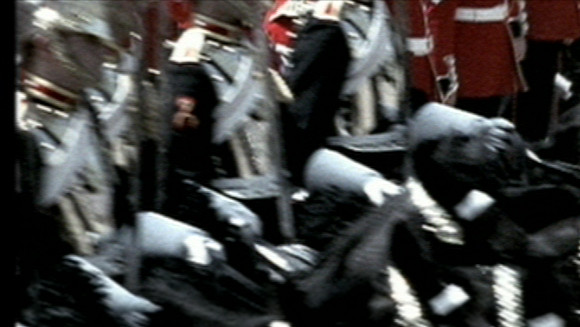
Great though my admiration for Benjamin Britten’s music is I wouldn’t consider him a creator of memorable female characters. There’s Ellen Orford, of course, but one struggles to find a Tosca, Lucia or Violetta in his oeuvre. I open with this because what struck me watching the 2001 Channel 4 film of Owen Wingrave for a second time was how generally unsympathetic the female characters are. This is an opera with a female librettist (Myfanwy Piper) and the film has a female director (Margaret Williams) yet, with the exception of the fairly ineffectual Mrs. Coyle, the female characters embody an unthinking militarism and behave with extreme malevolence towards Wingrave; none more so than his “girlfriend” Kate. The filming reinforces this with close up scenes of groups of the women spitting venom at young Wingrave.