
 Tapestry Opera’s original 2019/20 season was to have included a remount of Gareth Williams’ and Anna Chatterton’s Rocking Horse Winner which premiered to positive reviews in May 2016. This is quite unusual as all too often, new Canadian operas, even the successful ones pretty much disappear after an initial run. Needless to say the staged show didn’t happen but, happily, Tapestry decided to make an audio recording instead.
Three of the four principals from 2016; Asitha Tennekoon, Keith Klassen and Peter McGillivray reprise their original roles while Lucia Cesaroni replaces Carla Huhtanen as Ava. This time around the house is represented by Midori Marsh, Alex Hetherington, Stephen Bell and Korin Thomas-Smith.
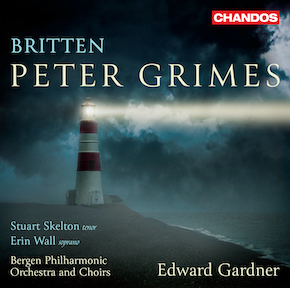 This new recording of Britten’s Peter Grimes was recorded from semi-staged performances in the Grieghallen in Bergen in November last year. It’s very good indeed. Of course, there are many good audio and video recordings of this piece going back to the composer’s own version with Peter Pears in the title role; recorded in 1959 and many fine singers have recorded the title role. To stand out from the field, a new recording needs an outstanding Grimes and in Stuart Skelton this version has one. He manages to encompass both the brutal, gritty side of Grimes as well as the more ethereal side. Pears did the latter brilliantly but could never quite manage the grit. Vickers, who practically owned the role in the 1970s, was brutal but didn’t have the voice or the stage skills to bring out the gentler side. Perhaps the first person to really portray the full complexity of the character was the late Philip Langridge and there’s much about Skelton’s portrayal that reminds one of him. It shades toward the delicate most of the time with some lovely singing in “Now the Great Bear” and in the mad scene. But when Skelton needs to be brutal he’s downright scary.
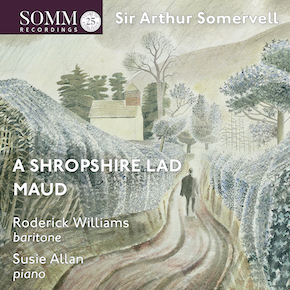 I was browsing the latest Naxos marketing material and was really intrigued by what claimed to be a disk of Tennyson and Housman settings by Sir Arthur Sullivan. It sounded too good to be true and it was. The music was by Sir Arthur Somervell; whose Housman settings I had previously encountered.

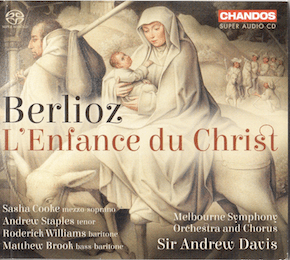 I got hold of the recent Chandos recording of Berlioz’ L’Enfance du Christ largely because I wanted to take a look at the Super Audio CD format. On that subject my thoughts are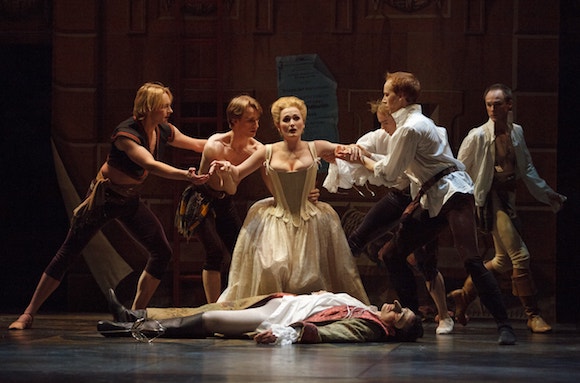
 I’m not sure how I’ve not come across the music of Howard Skempton before but it took a flyer for a disk with a setting of The Ancient Mariner to get my attention. I’m fascinated by what contemporary composers do with the broadly defined field of art song and Skempton’s piece is really interesting. He sets a mildly abridged version of the Coleridge but there’s enough to last past the half hour mark. The vocal writing is tonal, rhythmic and declamatory; hardly song at all in a way, but it supports the text rather well. It’s sung here by baritone Roderick Williams, for whom the piece was written. He has a clear, bright voice and the setting tends towards the upper end of the baritone range. He also has superb diction in the manner of the best of the “English school”. The result is complete comprehensibility for the text and full value for every word.

 operaramblings