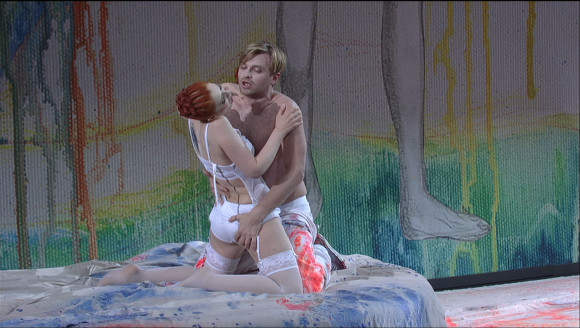
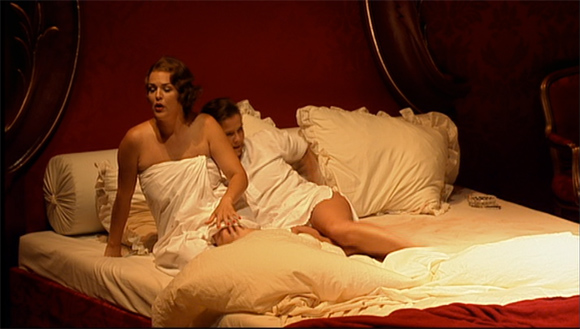
Vera Nemirova’s production of Berg’s Lulu was recorded in the Haus für Mozart at Salzburg in 2010. It’s presented in the now conventional three act version completed by Friedrich Cerha. The sets are painterly, including in Act 1 a giant painting of the title character. Lighting is used to create a very distinct palette for each scene and the detailed direction of the actors is careful and effective. I didn’t see any big ideas but then on this video recording, if there had been any, they would likely have been lost in the incessant close ups and strange camera angles. One “trick” perhaps is that much of the action in Act 3 Scene 1 takes place in the auditorium with a fair bit of confusion as the actors hand out fake cash to the punters. This is, of course, the scene where the glitterati go broke so perhaps some irony is intended.
Tag Archives: wiener philharmoniker
Die Soldaten
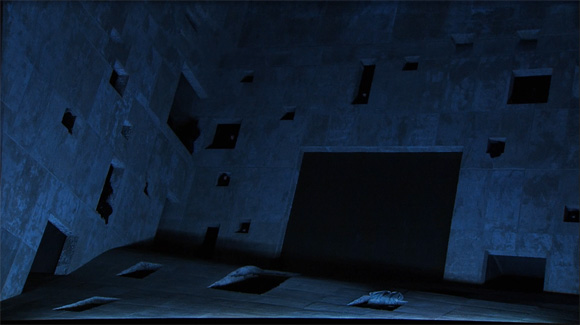
Berndt Alois Zimmermann’s Die Soldaten was something of a sleeper hit at the 2012 Salzburg festival and is now available on DVD and Blu-ray. It’s a peculiar work. It’s very episodic and requires massive forces. There are 16 singing and 10 non-singing roles, a 100 piece orchestra, a jazz band and more. At Salzburg the scale was magnified by staging it in the Felsenreitschule, using the full 40m width and enormous height of the stage. I’ve included some full stage shots in the screen caps to give an idea of how huge this all is. They can be expanded to full size Blu-ray caps (roughly three times the size of the image in the review).
Campy Clemenza
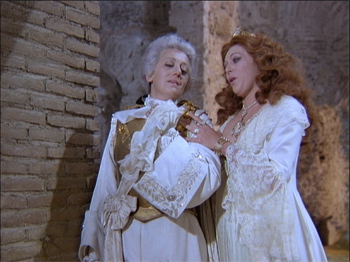
Besides the production of La Clemenza di Tito still in repertory at the Met, Jean-Pierre Ponelle also made a film of the piece. It was shot among the ruins of ancient Rome in 1980 and is one of those lip synched opera films popular in that era. The forces involved are eclectic. James Levine conducts the Wiener Philharmoniker and the Konzertvereinigung Wiener Staatsopernchor with mainly American soloists. Continue reading
Into the woods
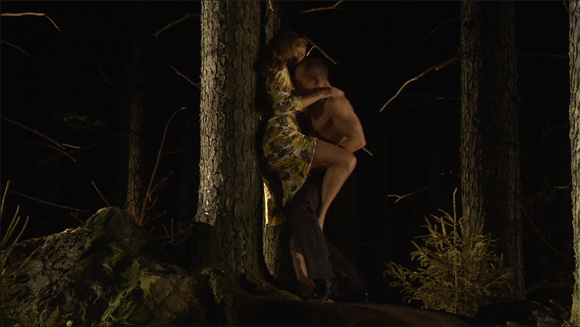
Claus Guth’s 2008 Salzburg production of Don Giovanni divided the critics along entirely predictable lines. It’s a very unusual treatment of Don Giovanni but the concept is stuck to with real consistency and it works to create a compelling piece of music theatre. The treatment on video too is not straightforward and, in a sense, the DVD/Blu-ray version is as much the work of Brian Large as it is of Claus Guth.
Full of sound and Furies
When I first encountered Richard Strauss’ Elektra as a teenager I found the music almost unbearably harsh. The more I listen to it the more erroneous that judgement seems. It has its “tough” moments to be sure. How could an opera about Elektra not? But it is also full of lush romanticism and there are some really quite lovely passages. In the 2010 Salzburg Festival recording Daniele Gatti explores both sides of the music in a rather thrilling reading of the score aided and abetted by the Wiener Philharmoniker and a pretty much ideal cast.
Rosenkavalier on the brink
Robert Carsen’s 2004 production of Der Rosenkavalier at the Salzburg Festival was apparently enormously controversial at the time. In many ways that says more about the iconic status of the piece in Salzburg tradition than about Carsen’s production. There are a few controversial elements. He has updated the period to 1914 and the third act is set in a brothel with a fair amount of nudity. Beyond that, the production is pretty faithful to the libretto and has, I think characteristic Carsen touches like long lines of tables and chairs and a certain geometric elegance. He seems to be using the sides of the stage to comment on the action which tends to be fixed centre stage. I say seems because the video direction (by Brian Large) is utterly perverse and makes it extraordinarily difficult to see what Carsen is doing, let alone decode it. We see the whole stage, maybe, for three seconds in the whole piece. Otherwise 99% of what we get is either close up and even closer up or apparently shot from the restricted view seats high up and close to the side of the stage. The other 1% is just plain nuts and includes a section of the Sophie/Octavian duet in Act 2 where, on stage, Octavian is maybe twenty feet to Sophie’s right but on camera he’s standing right up close on her left hand side. I could go on but I won’t. Suffice it to say the video direction comes close to wrecking an otherwise excellent DVD.
A rather straightforward Cenerentola
Rossini’s La Cenerentola takes almost three hours to tell a very straightforward version of the Cinderella story. Generally directors, despairing of the this, either camp it up (for example the Els Comediants production seen, inter alia, in Houston and Toronto in recent years) or they try to find a few more layers of meaning as in Ponnelle’s film version. Michael Hampe does neither in his 1988 Salzburg production, preferring to tell the story as a straightforward morality tale. I guess if one really loves the music and it’s really well sung this could work but, ultimately, I found it rather dull. Continue reading
Pulp Figaro
Today’s Ponelle production is the 1976 Le Nozze di Figaro. It has the starriest cast of any of the Ponelle films I’ve seen to date; Herrman Prey in the title role, Mirella Freni as Susanna, Kiri Te Kanawa as the countess and Dietrich Fischer-Dieskau as the count. It even, rather bizarrely, has Maria Ewing as Cherubino. To round things out Karl Böhm conducts with the Wiener Philharmoniker and Staatsopernchor. As we shall see, musically it lives up to the casting. Continue reading
Superbly sung Butterfly with Mirella Freni and Placido Domingo
Continuing the Jean-Pierre Ponnelle marathon we come to his 1974 film of Puccini’s Madama Butterfly with Mirella Freni in the title role and a young Placido Domingo as Pinkerton. Musically this is the most satisfying of the Ponelle productions I’ve yet come across. Freni is superb. Radiant is not too strong a term, Domingo sings pretty much as well (we’ll come to points of dramatic interpretation later) and the supporting cast is flawless. There’s some serious luxury casting here with Christa Ludwig as a superb Suzuki. Robert Kerns is an excellent Sharpless and Michel Sénéchal equally good as Goro. Herbert von Karajan conducts. He tends to go for sheer beauty of sound rather than maximum drama but what beauty of sound! The soloists are wonderfully backed up by the Wirner Philharmoniker and the Staatsopernchor. Continue reading
Artificial and cruel Così
In 1988 Jean-Pierre Ponnelle made the last of his lip synched opera films; Mozart’s Così fan tutte. It carries Ponnelle’s trademark “artificiality” even further than in other of his films that I have seen. The sets, the costumes, the acting and the camera work never let us forget that this is a work of the, in the director’s words, “greatest artificiality”. It also becomes increasingly clear as the piece progresses that Ponnelle has a very clear idea of what “the opera is about”. Continue reading