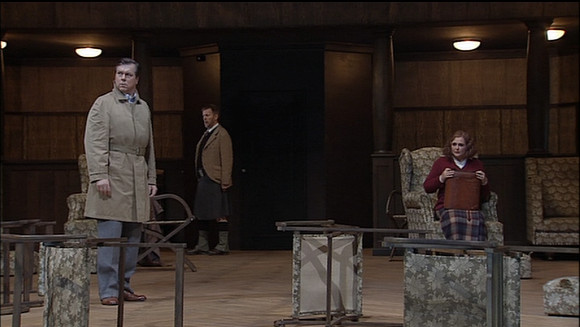
There’s a bit at the end of the first act of Parsifal where Gurnemanz looks at Parsifal and says “you haven’t understood anything have you?” or words to that effect. Watching Romeo Castellucci’s 2011 production for Brussels’ La Monnaie theatre my sympathy was very much with the Pure Fool. This is one of the most incomprehensible productions I have seen. Act 1 is very dark. Most of the time only a tiny fragment of the stage is lit. The first thing we see is a snake in its own tiny patch of light. Then we are in a forest and the Grail Knights appear to be part of the forest. Whether they are just wearing suits of leaves or are actually plants is unclear. Kundry, in a white hoodie, and Parsifal in street clothes are recognisably human. Titurel and his squires wear overalls and hard hats. One of them carries a chain saw. The “swan” appears to be a lit up tree branch though later it appears as a very decomposed skeleton. The Grail Scene is played out with a white curtain, with a small black comma on it, across the entire stage. The curtain is withdrawn and we see fluorescent lights above the greenery, which takes up much less space than one has so far imagined. Is Monsalvat a grow-op and the knights marijuana plants?
Tag Archives: wagner
The way by swan
No Madelaines were harmed in reviewing this DVD. It’s a 1992 recording from the Wiener Staatsoper of, of course, Lohengrin and its main claim to fame is that stars Placido Domingo (note no further jokes about water fowl despite the prominent role of Heinrich der Vogler). It’s one of those DVDs from the 80s and 90s that are a bit frustrating. The singing is very good indeed. Domingo is superb and the rest are at least very good plus Abbado conducts with real flair but the production is dull as ditch water and the video quality is awful.
Chéreau Ring – Götterdämmerung
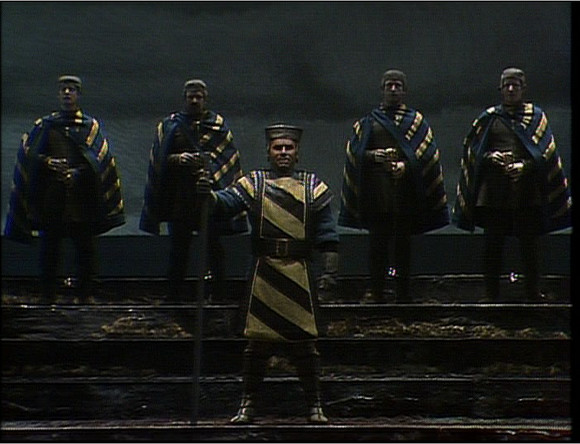
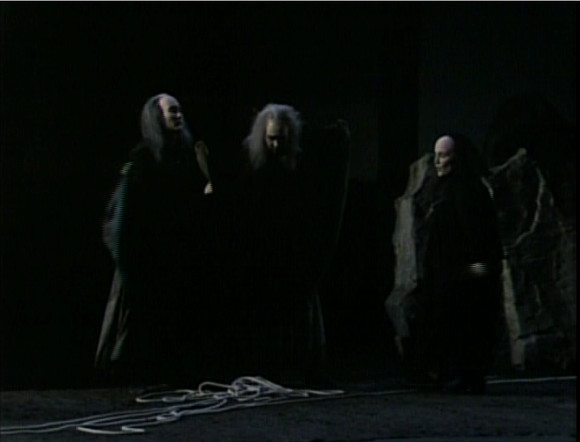
And so, at last to Götterdämmerung. The scene with the Norns is dark, very dark. There’s a rope and not much goes on (at least that is visible) but the singing is good. The “dawn” scene comes off more effectively here than the final scene of Siegfried but it’s still not great. I think the problem is a combination of Manfred Jung’s dry, rather nasal tone and Boulez rather fast tempu. It seems rushed rather than ecstatic and the Rhine Journey doesn’t thrill. I was concerned at this point that I was being unfair to a renowned production so I put on the same scene from Kupfer/Barenboim. It’s much better. Siegfried Jerusalem sounds truly heroic, Anne Evans richer tone blends better than Gwyneth Jones’ (though this could be an artefact of the recording) and, crucially, Barenboim gives the singers room to sing before markedly speeding up for the orchestral music. At least there is no naff attempt to depict a literal Grane in Chéreau’s version. At the conclusion of this scene Brian Large pulls off the first of his artsy effects. During the Rhine music he holds a close up of Brünnhilde for a rather long time before pulling out to a full stage shot which he then shrinks until there is just a tiny square of picture in the middle of a black screen which, when he slowly expands it, has transformed to the Gibichung hall. He does the same thing a couple more times. It seems odd to introduce that kind of thing at such a late stage in the cycle.
Chéreau Ring – Siegfried
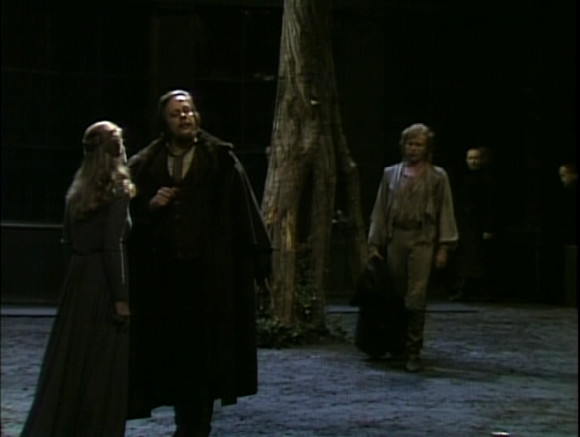
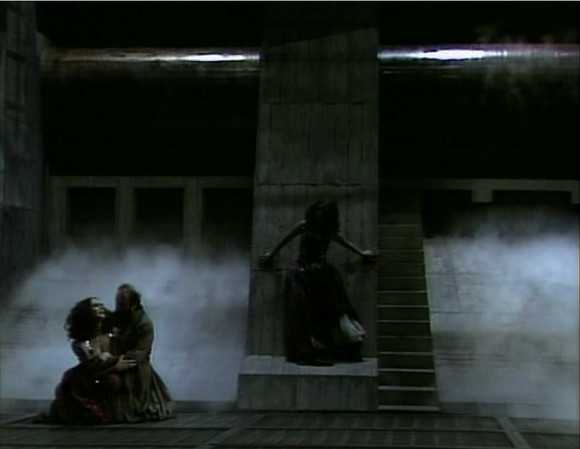
Chéreau’s Siegfried is even less obviously “industrial” than his Die Walküre. There’s a forge of course but there rather has to be. Other than that we get workshop, forest and lair pretty much as one might imagine until, of course, we end up back at the ruin where Brünnhilde waits. Brian Large injects lots of smoke at every opportunity.
Chéreau Ring – Die Walküre
The second instalment of Patrice Chéreau’s 1980 Bayreuth Ring cycle is set, like Das Rheingold, in a sort of industrial bourgeois late 19th century. One would almost say steampunk if that were not an anachronism. Actually the “industrial” side is much less evident than in the earlier work. There’s a sort of astrolabe/pendulum thing in Valhalla but that’s about it. Setting aside, the story telling is very straightforward; so much so that it takes a real effort of the imagination to get into a mindset where this production could ever have been considered controversial. It’s quite literal; Brünnhilde has a helmet and breast and back plates (worn over a rather severe grey dress), Wotan has a spear, Siegmund has a sword. There’s not an assault rifle or light sabre to be seen. It is though dramatically effective.
Chéreau Ring – Das Rheingold
So much has been written about Patrice Chéreau’s centenary production of the Ring cycle at Bayreuth that I approached reviewing it with some trepidation. I have decided to write about it “as is”; i.e. to write about what I see on the DVD and leave the undoubted historical significance, perhaps even revolutionary impact of the production, to others. Also, it’s apparent that what’s on the DVD, filmed in an empty house as was contemporary Bayreuth practice, must differ from what was seen on the Green Hill in certain key ways. This is a review of what;s seen and heard on the DVD.
Girard’s Parsifal on Blu-ray
François Girard’s production of Parsifal at the Metropolitan Opera was much written about at the time of the HD broadcast in March 2013. My review of that broadcast is here.I don’t think my opinion has changed very much. It’s a powerful and intensely beautiful production and there are some wonderful performances, especially that of René Pape. I’m not going to rehash the previous review but there were a few things I noticed second time around. In Act 1, for instance, the gendering of the scene is mirrored in other ways to emphasize the polarity. The knights are in white, the women in black. The men are in orderly circles, the women are just a crowd. Also the final scene is almost overwhelmingly intense. Kaufmann sings quite beautifully with fine diction, gravitas and simply gorgeous high notes. Pape caps off a performance of great pathpos and humanity with the gentle gesture with which he closes Kundry’s eyes in death. It’s compelling stuff.
Curiously aloof Tristan
Christoph Marthaler’s 2009 Bayreuth production of Tristan und Isolde is set in a sort of Stalinist brutalist aesthetic populated with stock figures from the 1950s. Passion is at a minimum and the characters all seem to be trying as hard as possible to be conventional representatives of their roles. The only one who shows any real human engagement is Kurwenal who comes across almost as a commentator on the action, or even a director. There’s also some fairly stylized gesturing in a sort of pseudo-Sellars manner. It’s epitomised by the costumes in Act 2 where Isolde and Brangäne look like dolls dressed as Hausfraus and Tristan wears a hideous blue blazer. This is all rather reinforced by Michael Beyer’s video direction which uses a lot of close ups but also has a curious stillness about it that seems to amplify the emotional void; if indeed one can amplify a void. Oddly though, in places this approach really works in that the distance, coupled with very precise blocking, gives space for the music’s essential intensity to come through. Act 2 Scene 2, perhaps the emotional crux of the piece, is very moving and the So stürben wir, um ungetrennt is quite impressive.
A Parsifal in three acts
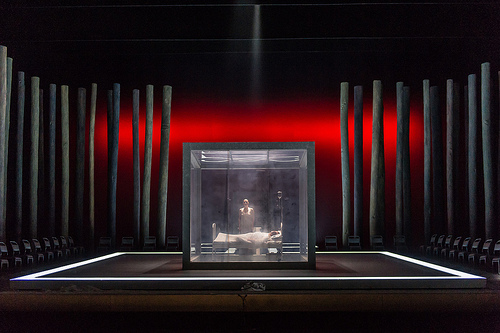
Yesterday, Easter Saturday, I got to see the Royal Opera House production of Wagner’s Parsifal. It was broadcast live to many locations of December 18th last year but hasn’t been seen in Toronto until now. It was very much a three act experience. At the end of the first and longest act I thought we were perhaps seeing greatness in the making. Stephen Langridge’s production concept supported by Alison Chitty’s fairly abstract modern designs were making all kinds of sense to me. At centre stage is a white, semi transparent cube serving as both grail shrine and Amfortas’ hospital room. Within it, various aspects of the back story are shown to us and it comes off as a place of knowledge; perhaps of a much deeper kind than has yet been revealed. This impression is reinforced with the unveiling of the Grail late in the act. It is a young, Christ like boy. The grail ceremony involves Amfortas cutting him to release the blood for the ceremony. There’s a lot of blood letting but it makes sense. We are seeing a very wounded and dysfunctional polity.