COC 2017/18

Last night the Canadian Opera Company announced the line up for the 2017/18 season.  It was all pretty much as predicted.  My predictions post got five out of six right and Dylan was right on the money down to timing.  So what do we get?

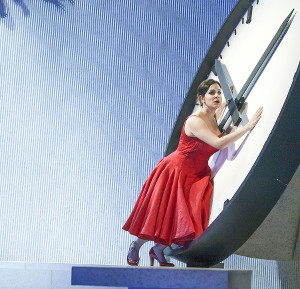
The fall season features, finally, Tim Albery’s production of Strauss’ Arabella first seen at Santa Fe.  Erin Wall, as expected, takes the title role while Jane Archibald, in one of three season appearances, sings Zdenka.  The Mandryka will be one of the few high profile imports, Tomasz Konieczny.  There are welcome appearances for David Pomery as Matteo and Claire de Sevigné as Flakermilli.  It’s a season full of Ensemble Studio graduates.  Patrick Lange conducts.  Partnering Arabella is Donizetti’s L’elisir d’amore in a production by James Robinson adapted to set the piece in pre WW1 Niagara on the Lake.  Simone Osborne and Andrew Haji play Adina and Nemorino with Gordon Bintner as Belcore.  This is, I think, the first time I’ve seen husband and wife as soloists at the COC though the Pomeroys have been seen on stage together quite a few times.  Brit Andrew Shore rounds things out as Dulcemara.  Yves Abel makes his COC debut in the pit.
arabella

Continue reading

Revive

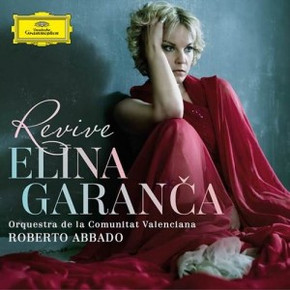
revive-300x300I’ve just been listening to Revive; a new recital disk from Elina Garanča.  It marks her move into more dramatic territory as she enters her fifth decade.  It also says quite a lot about how she wants to develop her career.  There’s a very personal introductory essay titled Strong Women in Moments of Weakness and it seems to me that she’s looking to find her place in the 19th century French/Italian romantic/verismo repertoire as opposed to, say, Strauss or Wagner.  Certainly the pieces on the disk represent roles like Eboli, Didon, Delila and Hérodiade, as well as some more obscure stuff like Musette from the Leoncavallo La Bohème and Anne from Saint-Saëns Henry VIII.
Continue reading

Where there’s a Will

So the Toronto Summer Music Festival continued last night with a Shakespeare themed show called A Shakespeare Serenade.  Curated and directed by Patrick Hansen of McGill it fell into two parts.  Before the interval we got Shakespeare scenes acted out and then the equivalent scene from an operatic adaptation of the play.  After the interval it was a mix of Sonnets and song settings in an overall staging that was perhaps riffing off The Decameron.  Patrick Hansen and Michael Shannon alternated at the piano.

Shakespeare-45

Continue reading

Vecchio Chris

Richard Jones chose to set his 2009 production of Verdi’s Falstaff in Windsor in 1946.  I suspect it’s driven by similar reasoning to Robert Carsen’s 1950s production.  Falstaff plays out very nicely as a conflict between an older order of things and a more thrusting kind of bourgeoisie and 1940s/50s England works well for that.  The “just after the war” setting also allows Jones to present Fenton as a G.I. which adds another twist to Ford’s distrust of him.  Although the jumping off point for Jones and Carsen is the same the results are quite different.  Jones seems to be operating in the traditions of English farce, à la Brian Rix, or maybe Carry on films,which works pretty well.  Falstaff is a farce rather than a comedy of manners.  So, besides the obligatory entrances and exits, couples caught in flagrante etc we also get a certain geometric precision in the blocking that borders on choreography.  In Act 1 Scene 2, for instance, the ladies rather military perambulation in a garden of very precisely aligned cabbages is doubled up by Brownies and a rowing four countermarching.

1.cat

Continue reading

Russell Thomas in the RBA

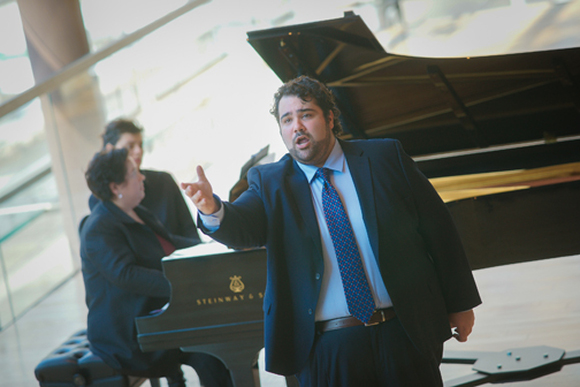
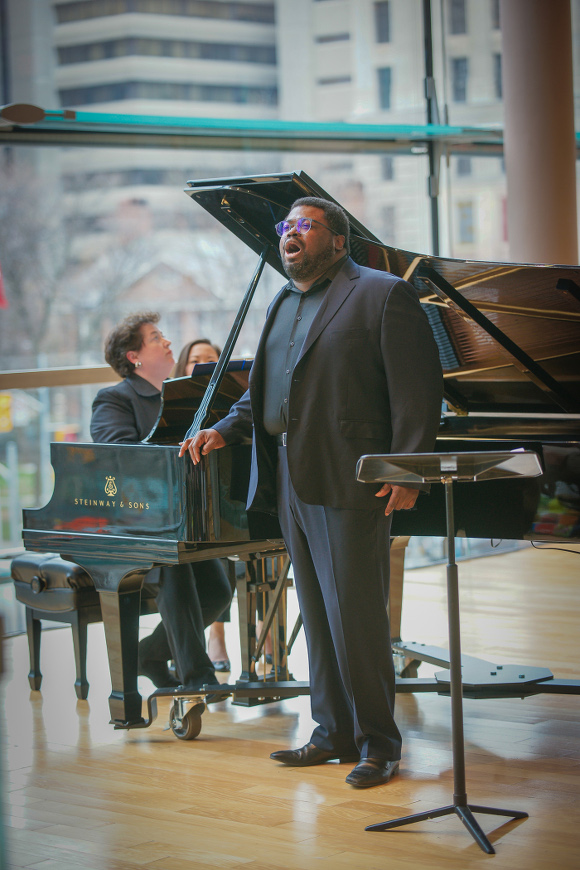
American tenor Russell Thomas, currently singing Don José in the COC’s Carmen, gave the lunchtime recital in the RBA yesterday.  The main item on the program was Schumann’s Dichterliebe; a setting of sixteen poems by Heinrich Heine and one of the great test pieces of the classic German lieder repertoire.  It was a red-blooded, operatic account.  Purists might think too much so but I enjoyed the sheer power and beauty of it, even at the expense of the (incredibly wonderful) text not getting the sort of attention it might get from someone like Ian Bostridge.  There was plenty of variation of tone and colour, some real virtuosity and even some humour in, for example, Ein Jüngling liebt ein Mädchen but the the most impressive and striking thing was the ability to effortlessly project a lot of rather beautiful sound.  Liz Upchurch’s accompaniment was very much in synch emotionally and musically.

SONY DSC

Continue reading

Traviata redux

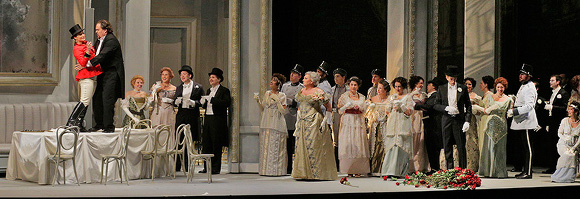
Nederland, Amsterdam, 02-05-2013. Muziektheater, DNO: La Traviata voorgenerale orkest.Last night we saw the last performance of the current COC run of La Traviata, this time with the alternate cast.  Joyce El-Khoury, Andrew Haji and James Westman came in for Ekaterina Siurina, Charles Castronovo and Quinn Kelsey.  We were also sitting in Ring 3 rather than lower down which gave a rather different perspective; perhaps not showing off the clever lighting for the intimate scenes quite as well but much more effective, by giving greater depth, for the party scenes.

Continue reading

Suirina, Castronovo and Kelsey rock Traviata

There’s a lot to like in the COC’s production of Verdi’s La Traviata that opened at The Four Seasons Centre last night.  Arin Arbus’ production; a co-production with Chicago Lyric Opera and Houston Grand Opera avoids the cloying sentimentality of many productions of this piece and, without being in any way gratuitous, deals very directly with the world Verdi wanted us to see; a world of hypocrisy, sex for sale and early, pointless death.

0097 – (in foreground) Roberto Gleadow as Dr. Grenvil and Ekaterina Siurina as Violetta in the COC’s production of La Traviata, 2015. Conductor Marco Guidarini, director Arin Arbus, set designer Riccardo Hernandez, costume designer Cait O’Connor, and lighting designer Marcus Doshi. Photo: Michael Cooper Michael Cooper Photographic Office- 416-466-4474 Mobile- 416-938-7558 66 Coleridge Ave. Toronto, ON M4C 4H5

Continue reading

Grumpy Otello

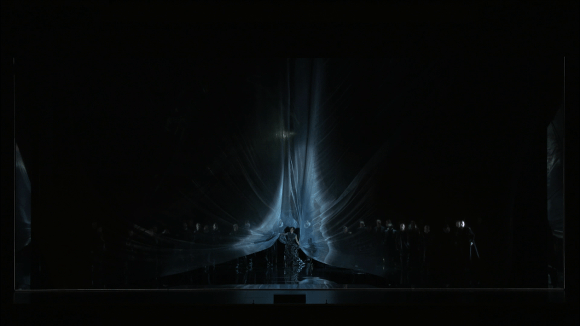
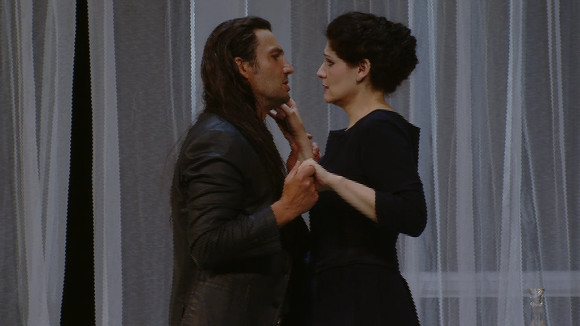
Verdi loved Shakespeare and tried to reflect the psychological depth of his characters in the operas he based on the bard.  You really wouldn’t know that watching the 2008 Salzburg Festival production of Otello.  There’s a lot to like in both production and performance but the emotionally monochromatic performance of the title role by Aleksandrs Antonenko, who can do every mood from fairly grumpy to furious, and the moustache twirling Jago of Carlos Álvarez rather reduce the piece to pathologically jealous nutter with anger management problem kills wife.

1.orgy Continue reading

Majesty, Murder and Madness

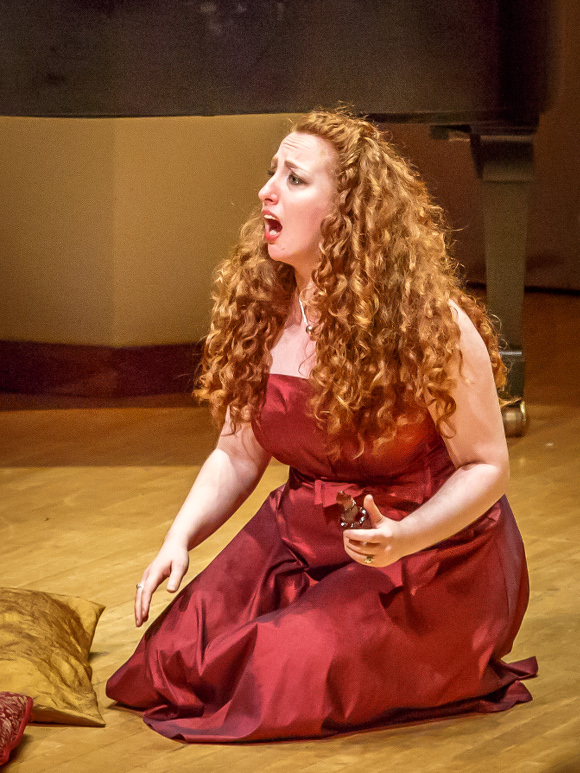
Friday night I went to see Teiya Kasahara and Stephanie Yelovich’s recital at First Unitarian.  Unusually for a voice and piano (Mark-Anthony Del Brocco) recital it was essentially all bel canto; a mix of Bellini and Verdi songs with some Donizetti opera excerpts (plus a duet from Norma as an encore).  It would be unusual programming for almost anyone and I was frankly a bit surprised because I don’t think of either singer as a bel canto specialist and, Teiya’s Lucia aside, a bel canto singer at all really.

I know that the event was a fundraiser to help pay for their summer in Italy studying mainly this rep and I guess, wherever one is headed as a singer, being able to sing bel canto well is an asset.  So maybe, to use a rugby analogy, it wasn’t so surprising that this felt a bit more like the training field than a competitive game; especially when the duets were both mezzo/soprano pieces being sung by two sopranos.

Both these young ladies have big voices.  Teiya in particular has real power, as well as coloratura chops, so perhaps she’s on the way to being that rare voice that can sing Norma and the Tudor queens.  Who knows?  Stephanie’s future probably lies north of the Alps though and it’s potentially a bright one.  I’ve seen these two ladies separately and together in contemporary works and they were really, really good.  Bel canto‘s not my sweet spot so maybe that’s part of the problem but I’m really not convinced it’s theirs either.

Andrew Davis and the Verdi Requiem

It’s forty years since Sir Andrew Davis first conducted the TSO and to celebrate the fact the TSO programmed a run of Verdi Requiems with Sir Andrew conducting.  I caught the last performance last night.  It’s in some ways a curious piece; very operatic and not especially liturgical but it does have its subtleties; the very quiet opening and the tenor solo Ingemisco for example but there’s also some moments of drama that are far from subtle.  The Dies irae is appropriately loud, even terrifying and it’s used as an accent before the Lacrymosa and during the Libera me.  It’s quite a compelling 90 minutes or so.

vreq1 Continue reading