Soundstreams’ opening concert of the season at Trinity St. Paul’s on Saturday evening featured Sarah Kirkland Snider’s Mass for the Endangered and an intriguing selection of 20th and 21st century music on related ecological themes.
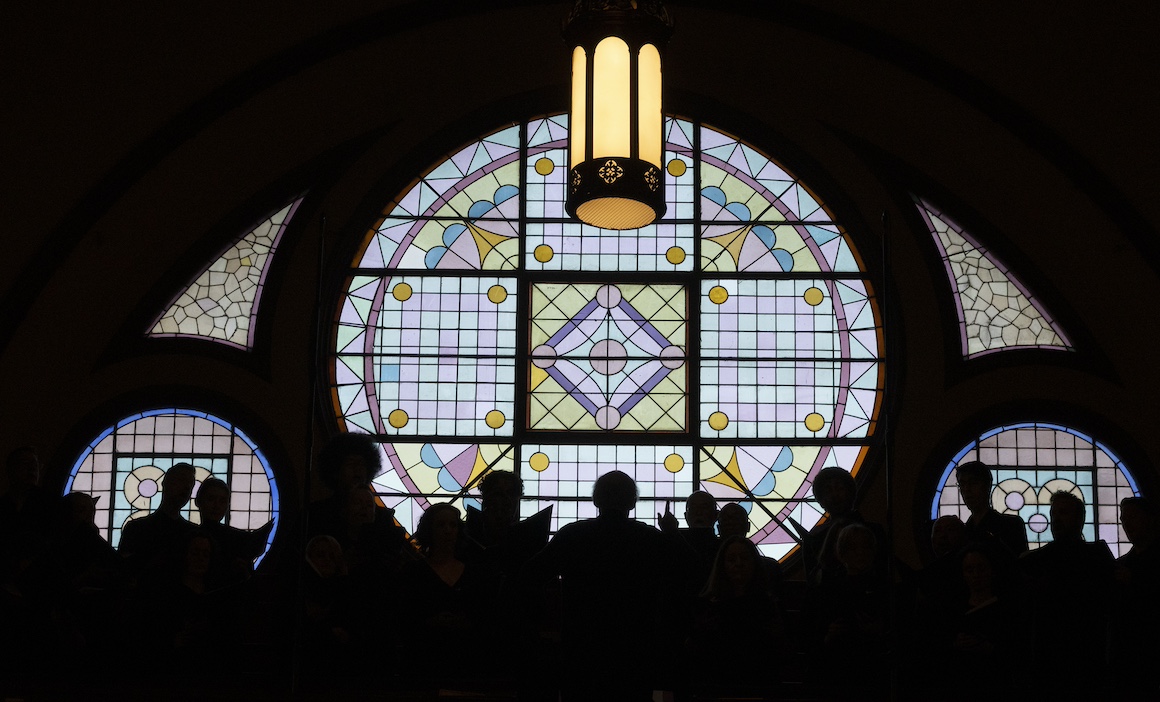

Soundstreams’ opening concert of the season at Trinity St. Paul’s on Saturday evening featured Sarah Kirkland Snider’s Mass for the Endangered and an intriguing selection of 20th and 21st century music on related ecological themes.
Opera in Concert opened their season at Trinity St. Paul’s on Saturday with the Canadian premiere of André Grétry’s 1784 opéra comique Richard Coeur-de-Lion. This is very loosely based on the story of Richard’s imprisonment by Leopold of Austria while returning from the Third Crusade. Richard’s man Blondel; disguised as a blind minstrel, discovers Richard’s place of imprisonment by playing a tune that Richard wrote. He then enlists the help of the Countess of Flanders, in love with Richard, (which would have come as a surprise to Berengaria of Navarre) and a Welsh knight; improbably styled Sir Williams, who his now (also improbably) running an inn in Austria and his daughter, Laurette. The governor of the castle where Richard is imprisoned, Florestan, in turn in love with Laurette, is tricked and Richard is freed to great rejoicing. (As opposed to a whopping ransom being paid!)

 Sunday afternoon saw VOICEBOX:Opera in Concert’s first performance in their new home; Trinity St. Paul’s. The offering was Gluck’s Alceste in the French language 1776 Paris version. Lauren Margison sang the title role with Colin Ainsworth as Admète. Guillermo Silva-Marin directed.
Trinity St. Paul’s has advantages and (perhaps) disadvantages over the Jane Mallett. It’s significantly better acoustically but much harder to do much in the way of staging. It’s a church and it looks like one with lots of carved wood and stained glass! I’m not sure that this is a disadvantage though. Rudimentary blocking with entrances and exits for the principals and concert wear is fine with me given that in either venue full staging wasn’t/isn’t very practical. The value proposition is more around getting to hear operas live that no-one else in Toronto is likely to do. I’m fine with that. Continue reading
Diasporic Bridges, at Trinity St. Paul’s on Sunday afternoon, was the Amici Chamber Ensemble’s final concert of the season. It celebrated the way that music binds emigrant communities together and provides a link to “home”. Most, though not all, of the pieces performed were by composers of diverse styles and backgrounds living and working in Canada and the live music was preceded by an excerpt from Amici’s upcoming film on the same topic. I’ll save writing about that until I’ve seen the whole thing.

I’ve seen Schubert’s Winterreise done many ways. There’s the classic one with baritone and piano and more rarely soprano (including a memorable performance by Adrienne Pieczonka as a passing cold front battered the hall!). I’ve seen it done with projections and three singers and I’ve seen made into a film. So there’s nothing particularly outré about arranging it to add a choir to baritone and piano. The choir can function as Greek chorus or alter ego or whatever. Any way that’s what Gregor Meyer did and what the Toronto Mendelssohn Singers conducted by Jean-Sébastian Vallée performed when they joined forces with Brett Polegato and Philip Chiu at Trinity St. Paul’s on Saturday night.
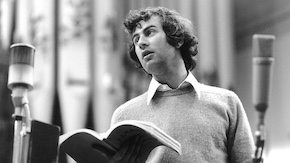 Iconic British countertenor James Bowman passed away last March. On Sunday night at Trinity-St. Pauls the Early Music folks at UoT presented a tribute to the man and his career. It was very well done. Music associated with Bowman; mostly Purcell and Britten, was interspersed with video and personal recollections/testimonials that fully reflected the considerable influence Bowman had on the English music scene and on the more widespread acceptance of the countertenor voice in the classical music world generally. Continue reading
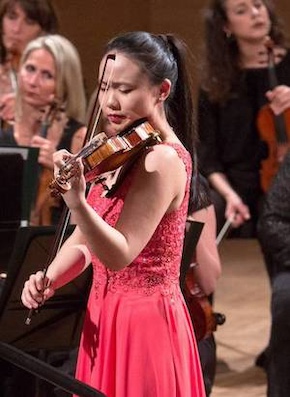
Stella Chen
Last night at Trinity St.Paul’s we got the first of two concerts in the fourth iteration of the OPUS Chamber Music series. Music director and pianist Kevin Ahfat had arranged an impressive group of young string players to join him in a varied and enjoyable programme.
From the United States we had violinist Stella Chen; a Queen Elisabeth Prize winner and Gramophone Young Artist of the Year, and up and coming violist Matthew Lipman. There was Berlin based cellist Brannon Cho. The local talent consisted of and violinist Isabella Perron, as well, of course as Kevin himself.
First up were Ahfat and Lipman with Rebecca Clarke’s Sonata for Viola and Piano of 1919. It’s quite a substantial piece with more than a hint of Debussy, especially in the piano part. The first movement is marked “Impetuoso” but it’s nothing like as frenetic as the second movement; “Vivace”, which is really densely scored. There’s a lovely, lyrical and expressive concluding “Adagio” which culminates in a very involved final section in high romantic style. Some gorgeous playing and great communication between the musicians here. Continue reading
Last night’s concert at Trinity Saint Paul’s by the Amici Ensemble and friends. was titled From Strauss to the Orient. Unsurprisingly, the first half of the concert was Strauss. The first piece was the Duett Concertino for clarinet, bassoon, strings and harp; arranged by Serouj Kradjian with piano replacing harp. Besides the Amicis (Serouj – piano, Joaquin Valdepeñas – clarinet and David Hetherington – cello) were guests Kathleen Kajioka and Timothy Ying – violins, Barry Shiffman – viola, David Lalonde – bass and Michael Sweeney – bassoon. It’s an interesting piece. The clarinet and bassoon basically carry on a conversation across three movements with the strings and piano as a sort of “backing band”. The overlapping ranges but very different colours of the two woodwind instruments are both pleasing and intriguing. It was nicely done. It’s always a delight to watch a chamber ensemble that is obviously communicating and having fun!

Saturday night saw the inaugural concert of the Toronto Mendelssohn Singers; the professional core of the much larger Toronto Mendelssohn Choir, at Trinity St. Paul’s with Jean-Sébastien Vallée conducting. There were four pieces on the programme; one very substantial and three shorter works. Things kicked off with a pleasant but essentially conventional arrangement by Dierdre Robinson of Steal Away. This was followed by an Arabic piece by composer-in-residence Shireen Abu-Khader called I Forgive where the choir was joined by soloist Raneem Barakat. This dealt with the short life and death of Egyptian LGBTQ activist Sarah Hegazi and was rather beautiful with intriguing Arab influences especially in the solo part. Then came Elgar’s Lux Aeterna arranged for choir by John Cameron.
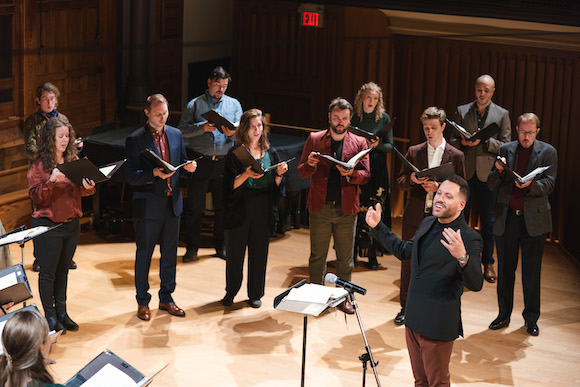
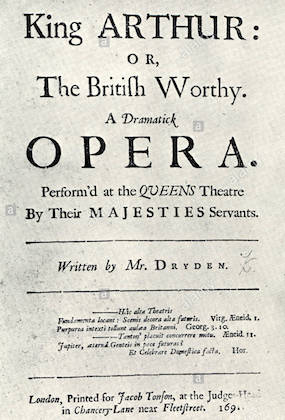 Last night various bits of the early music side of the UoT Faculty of Music, plus guests, put on a performance of Purcell’s King Arthur at Trinity St. Paul’s. I’m pretty familiar with the piece from both audio and video recordings (though this was my first time live) but it was clear last night that most people really don’t know the work and I suspect that the way the work was presented was not especially helpful for them.
The program contains detailed notes by director Erik Thor about his thoughts on presenting a “problem piece” without really explaining why King Arthur is a problem or why he made the choices he made. We are told it’s about conquest and erasure but not how and why it differs from what most people seem to expect when they see the title King Arthur. In short, it’s a highly fictionalised version of the very old Welsh stories about the resistance of the (Christian) Britons to the (Pagan) Saxons. Forget Geoffrey of Monmouth, Tennyson, TE White and Monty Python. Oddly, Merlin, perhaps the one character anyone would recognise, is cut here. The work itself is also a bit incoherent largely because Dryden (the librettist) tried to recast what was originally a court spectacular to the glory of Charles II as something that would work in the theatre and pass the censorship under William and Mary!
 operaramblings