Coming up

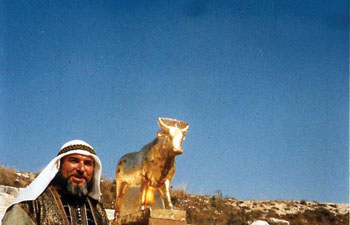
Here’s a round up of upcoming performances of interest over the next week or so.  Sunday at 3.15pm TIFF are showing Jean-Marie Straub and Danièle Huillet’s films Introduction to Arnold Schoenberg’s “Accompaniment to a Cinematographic Scene” and Moses and Aaron.  The films will be preceded by a live performance of a Schoenberg piece by Adanya Dunn and Topher Mokrzewski.  More details here.

Moses_et_Aaron_3_

Continue reading

Workshopping The Harvester again

stacie_3005bThis time last year I attended a workshop performance of a work in progress; Aaron Gervais’ The Harvester.  That time it was in piano score but semi staged.  Last night it was presented, at Gallery 345, in concert format but with chamber orchestra.  I’m not going to recap the plot etc because it’s all in last time’s review.  Let’s start by saying it’s coming along and I really look forward to seeing a fully staged version.

So, back to last night.  The concept is of a double bill of Schoenberg’s Erwartung in a chamber reduction followed by The Harvester so last night we started with half the Schoenberg (up to the discovery of her lover’s body).  The chamber reduction (by Aaron Gervais) for piano, three woodwinds, strings, horn and percussion works remarkably well.  The effect is similar (ironically) to Schoenberg’s chamber versions of Mahler’s songs.  Textures are clearer, if less lush, and the singer is less pushed for sheer volume which allows for a bit more subtlety.  It’s different but it works.  On this scale it’s a good fit for Stacie Dunlop; one of those singers who is an excellent musician and interpreter but is not a huge voice.

Continue reading

Mahler; arr. Schoenberg

mahlerschoenbergsongsThis review first appeared in the print edition of Opera Canada.
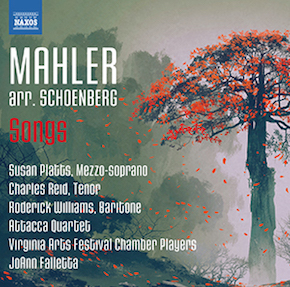
Schoenberg’s reductions of Mahler’s two great orchestral song cycles; Lieder eines fahrenden Gesellen and Das Lied von der Erde, were made for his “Society for Private Musical Performance” which flourished briefly in post WW1 Vienna. Essentially the orchestral score is reduced to one instrument per part with a few other minor changes. The results are intriguing. Unquestionably some of the grandeur of Mahler’s massive orchestration is lost. This is especially noticeable in Das Lied von der Erde. On the other hand the instrumental textures are greatly clarified and there is much less sense of the singers straining to make themselves heard against a large orchestra. There are still fifteen instrumentalists so the singers are pushed well beyond lieder singing but it does allow for a somewhat more nuanced approach to the text.

Continue reading

Lineage

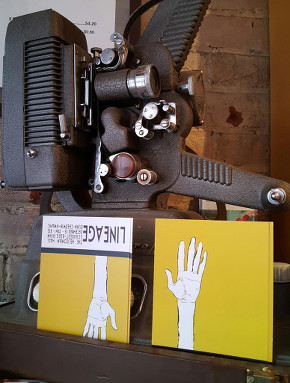
lineageLineage, performed last night at the Heliconian Club, is the latest show from Adanya Dunn, Brad Cherwin and Alice Hwang who brought us Evolving Symmetry in September.  Lineage featured German music from Schubert to Rihm so much more in my sweet spot than the French theme of the earlier show.  It was intriguingly constructed with three sets each of a pieces from Mendelssohn’s Lieder Ohne Worte and a Rihm song setting.  In between we got first Berg and then Webern, Schoenberg and Schubert.  It sounds bizarrely eclectic but the contrast between quite experimental pieces and more obviously accessible fare was very satisfying.  Also the sense that there is both a thematic unity and a tendency to experiment in a lot of German music regardless of period.

Continue reading

Schoenberg meets Mahler

Megan-Quick-Headshot-240x300At Walter Hall last night to see the Faculty Artists Ensemble with Megan Quick and Andrew Haji conducted by Uri Mayer perform the chamber versions of Das Lied der Waldtaube from Schoenberg’s Gurrelieder and Mahler’s Das Lied von der Erde in the Schoenberg arrangement.  The main reason for going was to get as chance to hear Megan in something more substantial than the things I’ve seen her in with UoT Opera.  Plus, a chance to hear Andrew is always very welcome.

The orchestration for both these pieces may be chamber scale but it’s heavy on the winds and it takes a fair bit of power to deal with that in a space like Walter Hall.  It was clear in Das Lied der Waldtaube that Megan has that.  Her instrument is a rich, darkish mezzo with significant beauty of tone and she has great control.  If I were to be picky, I’d say she has a tendency to focus on producing beautiful sounds at the expense of the text to some extent but I’d say that about a lot of successful singers.  It’s a matter of taste and maybe something she will feel differently about after a spell with the Ensemble Studio.  The basics are there for sure and the piece left me wanting to listen to Gurrelieder in full again.  It’s been a long time.   Continue reading

Eine Frau von Heute

I don’t usually associate Arnold Schoenberg with comedy but he did write a one act comic opera Von Heute auf Morgen which premiered in 1929.  It was an attempt to cash in on the vogue for satirical operas on modern themes characterised by Brecht and Weill and , if a bit slight and lacking Brechtian punch, it works well enough.  A bourgeios husband and wife have returned from an evening out where they have met an iold friend of the wife who has become something of a femme fatale.  There’s also a singer, inevitably a tenor, involved.  The husband is rabbiting on rather gormlessly about the charms of the “other woman” so his wife decides to teach him a lesson.  She apes the manners of a “modern woman”, neglects their child, plans assignations etc.  There’s a long phone conversation inwhich the “friend” and the singer invite them back to the bar.  By now the husband is beginning to realise what he stands to lose.  The wife realises she has won.  The other couple show up and there’s a “modern” vs. “traditional” quartet after which the “moderns” leave in disgust and the husband and wife revort to bourgeois domesticity.

1.couch Continue reading

Bluebeard’s Castle/Erwartung

Robert Lepage’s 1993 double bill production of Bartok’s Duke Bluebeard’s Castle and Schoenberg’s Erwartung was the iconic director’s first foray into opera and it has been argued tht it put the COC “on the map” as a serious international opera company.  It was revived last night with François Racine directing.

Blubeard-MC-0573 Continue reading

Barbara Hannigan in the RBA

OK so who noticed that Barbara contains RBA twice?  A perfect fit one might say and so it proved.  In a short late afternoon concert Ms. Hannigan, joined by the TSO Chamber Soloists (Jonathan Crow, Peter Seminovs, Teng Li and Joseph Johnson) and Liz Upchurch, showed her chops as one of the day’s best interpreters of modern vocal music.   First up was the String Quartet No.2 by Schoenberg.  This is a most unusual quartet in that the players are joined by a soprano soloist for the third and fourth movements.  It’s also unusual in that, although it predates Schoenberg’s full blown serialism, the first three movements are tonal (just) but the last is a full on experiment in atonality.  None of this makes it easy to play or sing!

2015-02-24-COC-Rapture-004 Continue reading

Transfigured: Transcribed

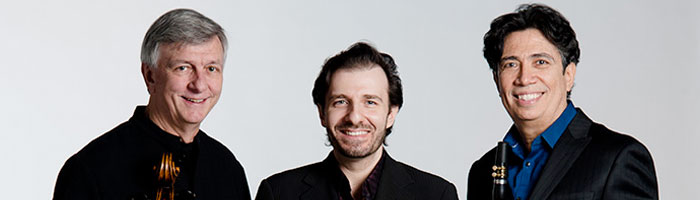
Yesterday’s Amici Ensemble concert featured four works transcribed for different combinations of instruments than the composer originally intended.  First up was Berg’s Adagio for violin, clarinet and piano.  This is from the Kammerkonzert originally scored for violin, piano and thirteen assorted wind instruments.  Unsurprisingly it doesn’t get played often in that arrangement.  It’s pretty typical second Vienna school; twelve tone but quite accessible and very pleasant to listen to.  It was expertly played by Serouj Kradjian (piano), David Hetherington (cello) and Joaquin Valdepeñas (clarinet).

amicirecordings Continue reading

Nihilist Night at the Opera

punchLater this month I’ll be attending a double bill of Barber’s A Hand of Bridge and Jean-Paul Sartre’s Huis Clos.  The latter, for those who don’t know the play, is the one with the famous line “L’Enfer; c’est les autres”.  I posted the details earlier.  Anyway, this led me on a train of thought that ended with the idea of Nihilist Night at the Opera; a sort of antidote to Rossini.  Ideally Nihilist Night would feature a double or triple bill of unrelievedly depressing operas and should leave the audience with no hope at all for humanity.

What might qualify?  Wozzeck coupled with Moses und Aron seems just about ideal.  Want something more contemporary?  How about Turnage’s Greek coupled with Birtwistle’s Punch and Judy?

The lines are open.