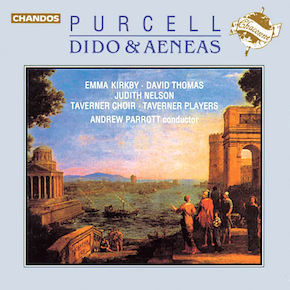
 And so we come to the third in our historical sequence of recordings of Purcell’s Dido and Aeneas. We are talking about Andrew Parrott’s recording with the Taverner Players and Choir recorded at Rosslyn Hill Chapel in 1981. It’s a record that I bought when it first came out and has been a point of reference for me ever since.
It’s a consciously academic affair in some ways. It was produced in conjunction with an Open University course ; “Seventeenth Century England: A Changing Culture”. It’s also musicologically rooted in scholarship. The album booklet even lists the provenance of the instruments used; mostly modern copies of 17th century models and we are told that the work is performed at pitch A=403. The band and chorus are realistically sized; six violins, two violas, bass violin with bass viol, archlute and harpsichord continuo. A guitar is used in some of the dance numbers. The chorus is six sopranos; some of whom do double duty as witches, the Sailor and the Spirit, four tenors and two basses.
Continue reading →


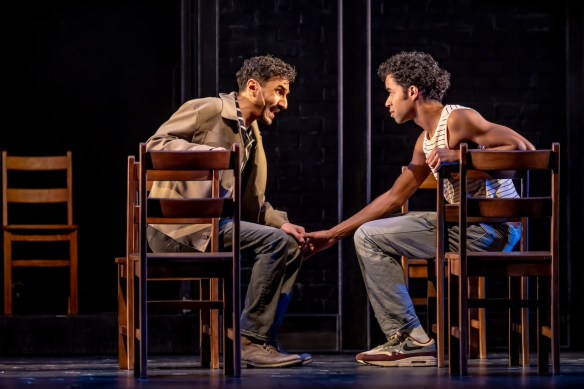
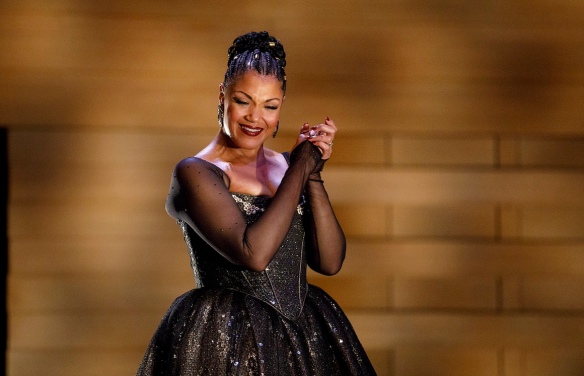
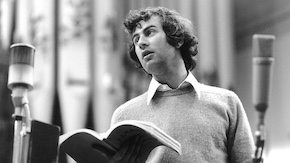 Iconic British countertenor James Bowman passed away last March. On Sunday night at Trinity-St. Pauls the Early Music folks at UoT presented a tribute to the man and his career. It was very well done. Music associated with Bowman; mostly Purcell and Britten, was interspersed with video and personal recollections/testimonials that fully reflected the considerable influence Bowman had on the English music scene and on the more widespread acceptance of the countertenor voice in the classical music world generally.
 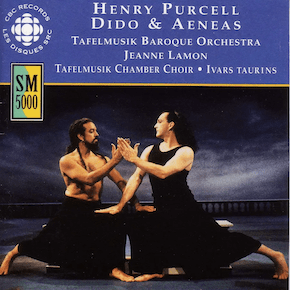 To round out this mini survey of the early discography of Purcell’s Dido and Aeneas I’m going to fast forward a bit to the 1995 recording by Tafelmusik. The most striking thing about this version is the very small instrumental ensemble; two violins, viola, violincello and harpsichord led by Jeanne Lamon. One quickly gets the feel for how they are going to perform with a very fast and rhythmically sprung overture.
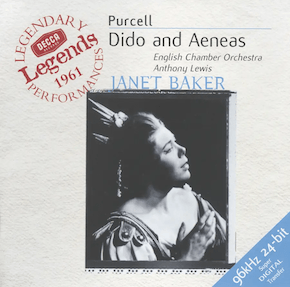 So, to continue our look at the recording history of Purcell’s Dido and Aeneas we turn to the 1961 Decca recording with Janet Baker in the title role. This has won so many awards and featured on so many “best of” lists that it might reasonably be considered to serve as some sort of “gold standard”. It’s certainly very good but I’m more interested in looking at what it says about the evolution of performance practice of Dido and Aeneas than in adding to the praise for Dame Janet’s performance.
 Purcell’s Dido and Aeneas has a long and dense history in the recording studio. The first recording dates back to 1935 and the vast stream of recordings since serve as a kind of barometer of the changes in style in performing 17th century music. I haven’t listened to every recording but I can look at four key moments in the discography and compare them. I’ve also listened or watched a fair number of fairly recent productions. The video review page has six entries for this work; all 1995 or later. There are also five reviews of live productions and reviews of several related shows. But for the purposes of this mini-project I’m going to look at four recordings that take us from the early 1950s to the mid 1990s. The four recordings are: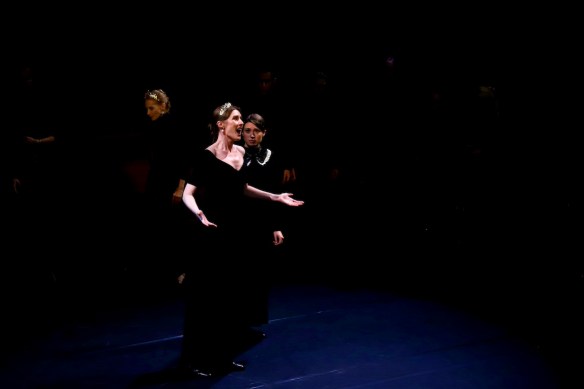

 operaramblings