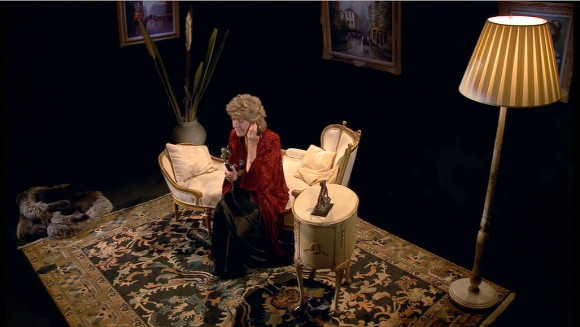
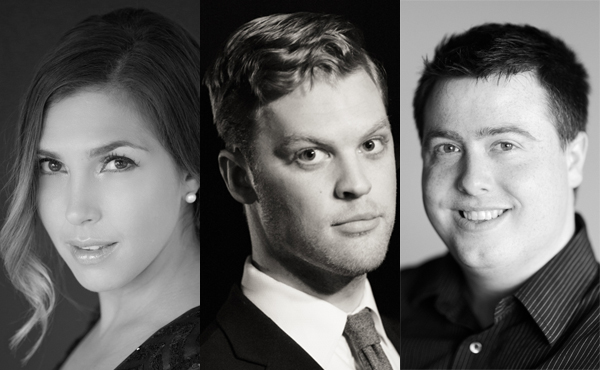
The 2013 recording of Poulenc’s Dialogues des Carmélites from the Théâtre des Champs Elysées has a cast that reads like a roll call of famous French singers; Petitbon, Piau, Gens and Koch are all there. Throw in Rosalind Plowright and Topi Lehtipuu and one gets some idea of the star power on display.
Tag Archives: poulenc
History’s worst fifty years in song
I guess it’s a good thing when one’s emotional and intellectual reactions to a program threaten to overwhelm one’s ability to listen analytically and evaluate. That’s what art is for isn’t it? Anyway that’s pretty much what happened to me today listening to a program called Songs of Love and War in the Richard Bradshaw Amphitheatre. The songs were all pieces more or less inspired by the catastrophes of the first half of the twentieth century; the wars, the rise of Nazi power, the occupation of France. These are all events that have many layers of meaning for me. I have studied them and the music and literature they generated for decades. I have known, often well, people who played roles in these events. I have deeply held views. You have been warned!
From Severn to Somme
Last night at Walter Hall, as part of the Toronto Summer Music Festival, Chris Maltman and Graham Johnson gave a recital that explored the experience of war through song. It was a long and varied programme with twenty two songs in four languages commemorating most of the great empires that went to war in 1914 though many of the songs were from earlier periods. At the core of the programme were early 20th century settings of English pastoral poems. Butterworth’s settings of Houseman were there but, sneakily, we got Somervell’s much less well known setting of Think no more lad. In a similar vein there were Gurney and Finzi. The Americas were represented in a characteristically rambunctious Ives setting of a horribly jingoistic McCrae poem; He is there. McCrae may be the only well known war poet who managed to survive until 1918 without developing any sense of irony. Beyond the English speaking world there were songs by Mussorgsky, Mahler, Fauré, Schumann, Wolf and Poulenc.
La voix humaine
Poulenc’s La voix humaine is as a rather peculiar little piece. It’s only 40 minutes long and it features a single singer, a soprano. It’s not exactly a monologue as what we hear is one end of a telephone conversation with implied contributions from the woman’s lover, the telephone operator, the lover’s manservant etc. A lot of what happens is an artefact of the French telephone system at the time (1928) that Cocteau wrote the play that supplies the libretto with operators, party lines, dropped calls etc.
Continue reading
A partridge without orange
It’s that time of year which marks the passing of the baton at the COC Ensemble Studio which is traditionally marked by a lunchtime farewell concert by some of the graduates. Today’s Les Adieux featured soprano Sasha Djihanian, baritone Cameron McPhail and pianist Michael Shannon.
How sweet to be a sloth
Yesterday’s Talisker Players concert Creature to Creature was a well balanced selection of music and readings inspired by the idea of a bestiary.
First up was a set of Poulenc settings of Apollinaire texts. These songs, for mezzo, string quartet, flute, clarinet and bassoon, are very short and deceptively simple being both textually and musically many layered. They were very beautifully sung by Norine Burgess. Her fairly bright mezzo seemed well suited and there was sensitive accompaniment from the band among whom clarinetist Peter Stoll was particularly impressive. Continue reading
Another intriguing program from the Talisker Players
The Talisker Players are presenting a show called present Creature to Creature on March 16 and 18 at Trinity St. Paul’s Centre. It’s inspired by mediaeval bestiaries and takes on human foibles through the lens of animal behaviour. It had better be good because I can scratch quite nastily. The Taliskers will be joined by mezzo soprano Norine Burgess, baritone Geoffrey Sirett (more impressive every time I see him), and theatre artist Ross Manson.
Another thought on offing nuns
I was riding my bike in the Don Valley this morning and, as I passed underneath the Bloor Street Viaduct, a thought struck me. Maybe Against the Grain Theatre’s next Toronto-centric opera adaptation coud be Dialogues des Carmélites. The last scene could be staged with the nuns jumping, one by one, from the viaduct. I don’t know whether enough people have read In the Skin of a Lion to get the reference but what could be more Toronto than Ondaatje?
Another look at Carmélites
It’s becoming a habit. For the fifth time this season I went back to take a second look at a COC production. This time it was Poulenc’s Dialogues des Carmélites. We were in our usual seats at the front of the Orchestra Ring rather than at the back of Ring 3 where I was on opening night. I still didn’t notice any real issues of orchestra/singer balance, which had been complained of by some reviewers. Maybe it was an issue towards the front of the Orchestra where the press tend to be?
Searing Carmélites from COC
Poulenc’s Dialogues des Carmélites is a strange and compelling piece. Dramatically it is very “slow burn” with a narrative arc that builds over almost two hours to a final scene of searing intensity. Without that final scene the piece would have no reason but it justifies all and only one “fit for treasons, stratagems, and spoils” could possibly leave the theatre unmoved. It’s not just moving, done well it’s emotionally devastating. And that’s the state I left the Four Seasons Centre in last night after a near perfect performance of Robert Carsen’s extraordinary production.