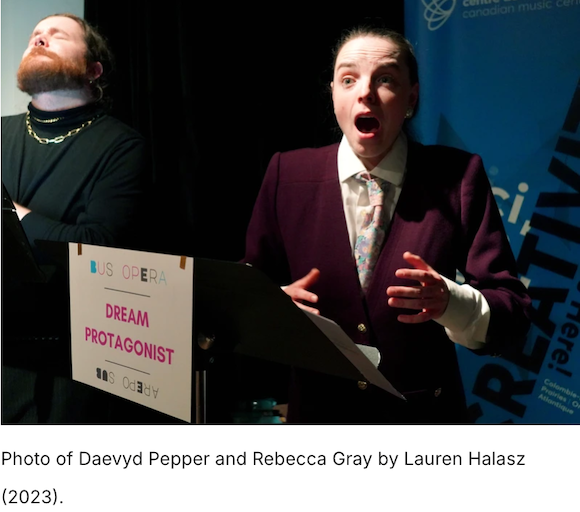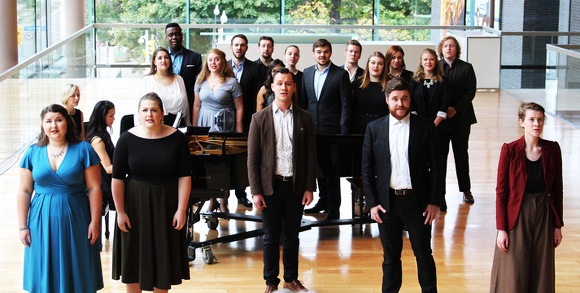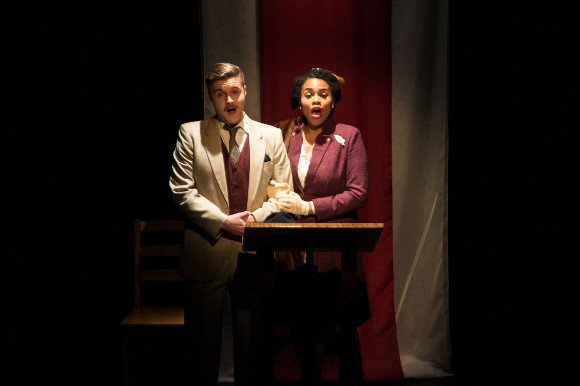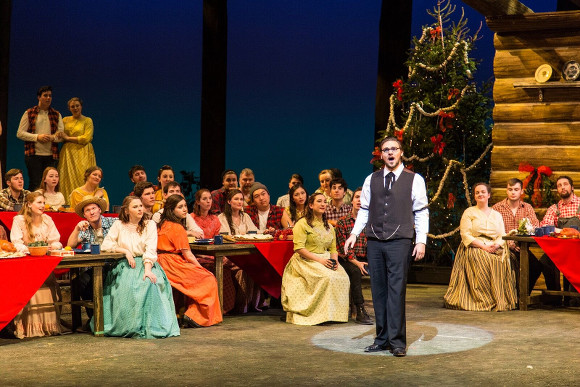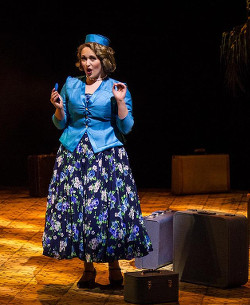
Rebecca Grey is a composer with a very individual view of the world and her art. Who else would write operas about nightmares on an overnight bus trip or about a savvy racoon taking on a rapacious Toronto landlord? Or, for that matter, cycle the Highway of Tears? Her most substantial project to date is Bus Opera. I first saw a workshop of an early version of it at the CMC a couple of years ago followed by a performance of extracts at one of New Music Concerts’ MAKEWAY concerts for early career creators at St. George by the Grange a few weeks later. So I was very happy when I was offered the chance to attend a workshop performance of the (pretty much) complete work at Hugh’s Room on Tuesday night.
Tag Archives: pepper
A cunning Turn of the Screw
It’s always been a bit of a mystery to me why Britten’s chamber operas are not done more often by smaller opera companies. They use a modest orchestra (13 players for The Turn of the Screw), have equally modest sized casts, no chorus and they are in English. They offer the chance to perform a work as written at much lower cost than grand opera and without the compromises inherent in downscaling works written on a larger scale.

Dido and Belinda
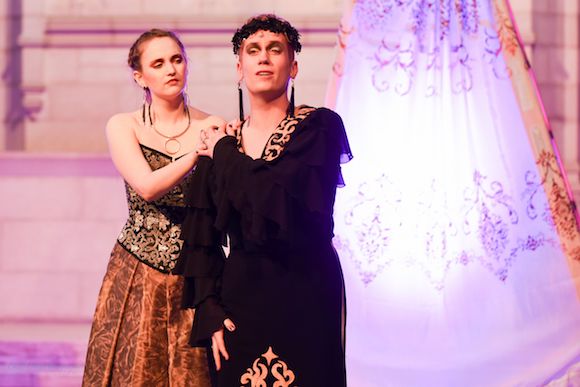
Dido and Belinda is the first show from Opera Q and Cor Unum Ensemble. It’s a reimagining of Purcell’s Dido and Aeneas from Belinda’s perspective and with a decidedly gender fluid twist. Nathum Tate’s libretto is extended by spoken passages which give Belinda’s take on the story and make it very much a story of the two sisters. The back story is Dido’s flight from Tyre rather than Aeneas’ flight from Troy. The future is about Belinda as Queen of Carthage not Aeneas’ “promised Empire”. It works pretty well though I have reservations about interpolating text in the final scene. I think Belinda’s accession as Dido’s successor could have been conveyed without interrupting some of the most sublime music ever composed. That’s a minor quibble though in a story concept that works.

Renaissance Splendours
I think I may have been missing out a bit with the Toronto Consort. I’ve been to the odd show that’s been identifiable as music theatre such as their excellent Play of Daniel but until I sat down with David Fallis and Laura Pudwell a few weeks ago I didn’t really have a clear sense of what they are about. Last night’s concert, Renaissance Splendours, at Trinity St. Paul’s, gave me a pretty good idea of what I’ve been missing and how it fits into my musical universe.

Porgi amor
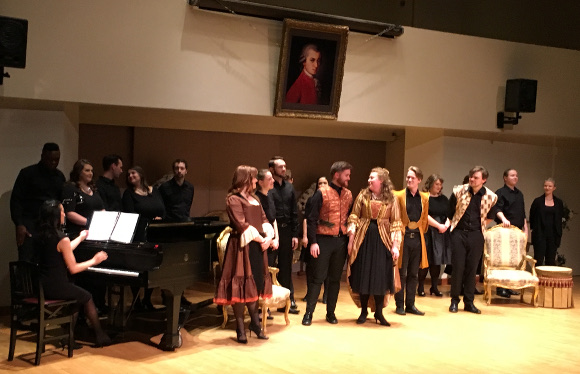
UoT’s show Porgi amor consisted of a series of staged and costumed scenes from Mozart operas with linking commentary, all designed by Michael Patrick Albano. The operas ranged from La finta giardiniera to La clemenza di Tito with all the major bases in between covered off. The emphasis was on ensemble numbers and providing opportunities for as many singers as possible so there was a cast of thousands. It was well structured, quite slick and there was some very decent singing. One expects a reasonably high standard from UoT Opera and we got it. As I usually do with this kind of show I’ll refrain from a play-by-play and just talk about a few highlights and do some “talent spotting”.

UoT Opera season opener
As has become the norm, UoT Opera opened their concert season with a free “preview” of their spring show in the RBA at noon today. It was a series of Mozart scenes which were given semi-staged today but will, in the fullness of time, form a staged and costumed performance. It’s always an interesting event because it’s so early in the academic year. It’s the first chance to try and talent spot and see how things develop over the rest of the cycle. As such, it’s often a bit rough but today really wasn’t. It was a surprisingly high quality across the board effort which augurs well. That said, it was all ensembles and nobody was asked to pull out vocal fireworks so maybe not the sternest test imaginable which makes star picking that bit trickier.
Is it all?
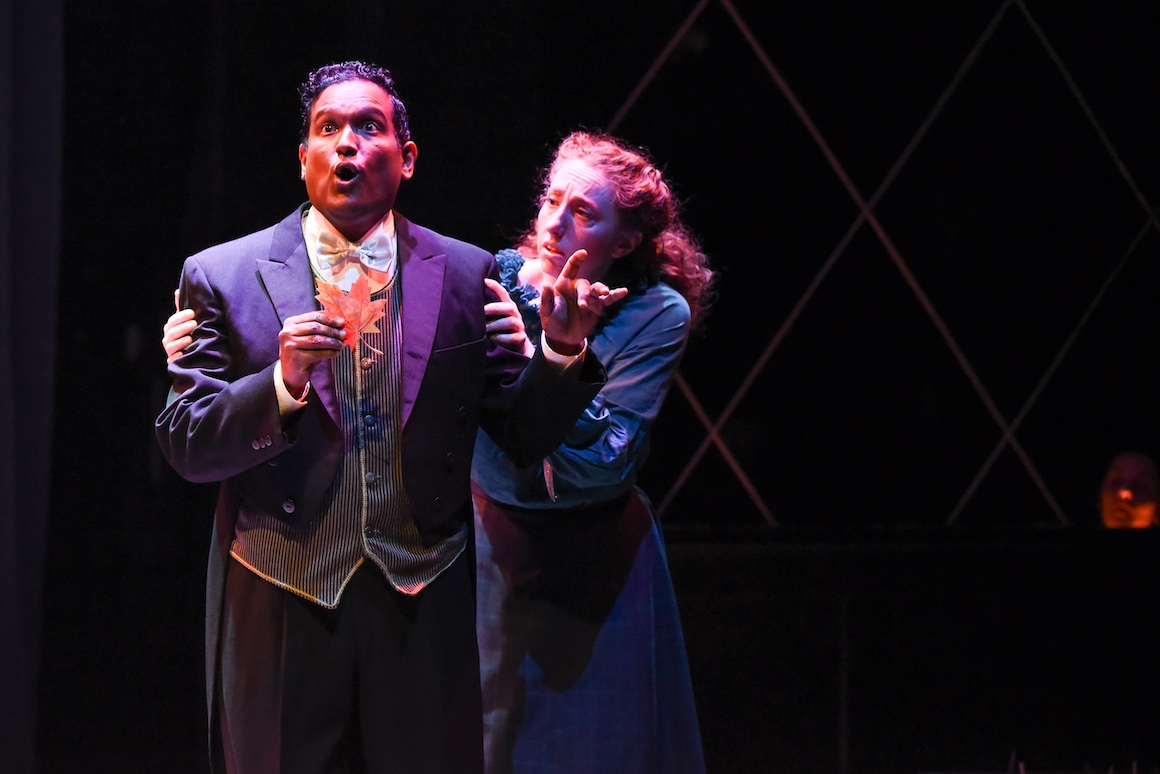
Anna Theodosakis’ production of Britten’s Rape of Lucretia for MYOpera updates the piece from proto-historical Rome to somewhere in the mid 20th century which is fine but doesn’t seem, of itself, to add any layers of meaning to the narrative. There are neat visual touches in a simple but effective set design and the nature of and relationships between the characters are deftly drawn. The rape scene manages to be disturbing without being gratuitously graphic. It’s skilful theatre. But is that enough?

I am Way, I am Act
This spring’s main opera production from UoT Opera is Britten’s Paul Bunyan. It is a really peculiar work. The libretto is by WH Auden and is, well, weird. It mixes up the (apparently) profound with the absurd and the downright silly. There’s a Swedish lumberjack fish slapping dance, talking cats and dogs, trees that aspire to be product and a philosophical accountant (*). There are also countless pronouncements from the off stage voice of Bunyan along the lines of the closing:
“Where the night becomes the day, Where the dream becomes the fact, I am the Eternal guest, I am Way, I am Act“
Walt Whitman meets Dr. Seuss meets a lot of drugs? One of those 1970s English public schoolboy prog rock bands?

Diva, diva, diva
Today’s lunchtime concert in the RBA featured the assembled students of UoT Opera in a staged programme called The Art of the Prima Donna. It was a sequence of mostly ensemble numbers drawn from the core 19th century rep. Verdi, Tchaikovsky, Puccini, Donizetti, Bellini, Bizet and Rossini all featured with works made famous by the great divas of the era’ Patti, Pasta, Malibran etc. Linking narrative, which skipped over who slept with Rossini, was provided by Michael Albano who directed the staging with Anna Theodosakis. Sandra Horst headed up the musical side and accompanied with help from Sue Black, Kate Carver and Ivan Jovanovic. Continue reading
The Fatal Gaze
The Fatal Gaze is, in a way, a follow up to last year’s UoT Opera show Last Days in that it consists of a staged performance of pieces of vocal music to a theme. This time the theme is the dangers of seeing or being seen and there’s quite a lot to unpack. The music all lies on an arc from Monteverdi to Gluck and the stories are all taken from classical mythology or thee Bible with some commentary from more modern figures.