Seamen from a distant Eastern shore

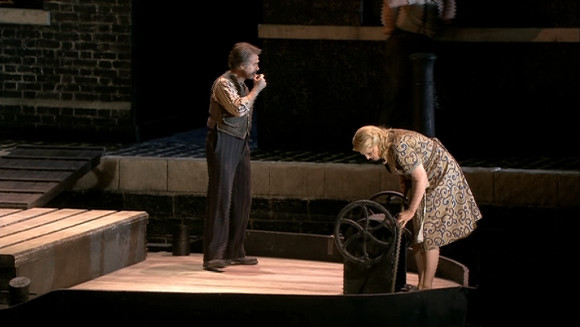
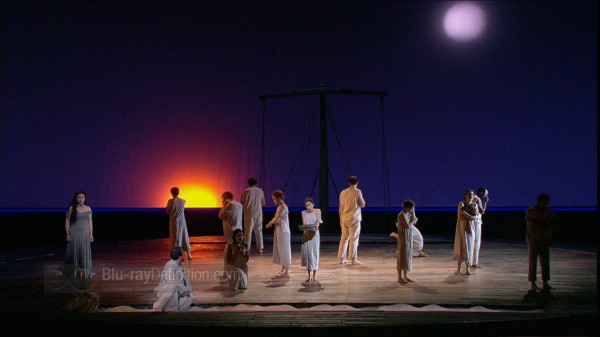
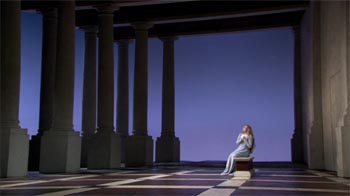
Berlioz’ Les Troyens is one of those pieces that really deserves the descriptor “sprawling epic” and, if anyone can make an epic sprawl it’s David McVicar.  This production, recorded at the Royal Opera House in 2012, is typical of McVicar’s more recent work.  It’s visually rather splendid and the action is well orchestrated but it’s short on ideas and long on McVicar visual cliches; acrobats, gore and urchins (but mercifully no animals).  I don’t want to be too hard on McVicar.  This piece is based on the sort of “Ancient History” one used to learn at prep school (British usage) and McVicar pretty much runs with that making no attempt to find deeper meaning, despite superficially translating at least the first two acts to the time of first performance; the era of European colonialism.

1.cassandre Continue reading

The Scottish opera

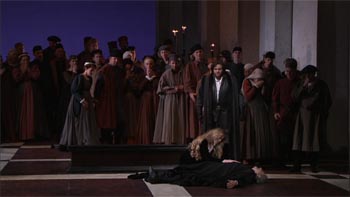
Verdi’s Macbeth is one of those early works where he seems to be trying to grow out of bel canto but not quite making it.  There is some splendidly dramatic music and some that just seems completely incongruous given the subject matter.  The witches’ chorus at the beginning of Act 3 is a case in point.  That said Phyllida Lloyd’s production for the Royal Opera House takes the piece seriously and does a pretty good job of presenting the drama in a straightforward but visually attractive way.

1.witches Continue reading

Il Trittico

Puccini’s Il Trittico is a collection of three one act operas designed to be performed on a single evening.  They rarely are.  Perhaps this is because performing all three makes for a rather long evening (and for a huge cast) or maybe it’s because two of the three aren’t all that great.  In any event, while most opera goers will likely have seen the comedy Gianni Schicchi, most will likely not have seen the two tragedies that precede it; Il Tabarro and Suor Angelica.  However, all three works were performed as a triple bill at the Royal Opera House in 2011.  The show was broadcast by the BBC and is available on Blu-ray and DVD.  All three pieces were directed by Richard Jones and Anthony Pappano conducted.

1.michele_giorgetta Continue reading

Starry Tosca

Puccini’s Tosca doesn’t seem to lend itself to Regie type treatments.  Even quite adventurous directors seem to mostly stick to the very specific time and place of the libretto (even though, as Paul Curran pointed out to me, the plot makes no sense in the Rome of 1800).  In the 2012 Royal Opera House recording Jonathan Kent certainly takes very few liberties with the piece; the church is a church, the palace a palace and the castle a castle. There are a few deft design touches.  Both Cavaradossi and Tosca wear very bright colours indicative of the new dyes that became available at the period (actually I think this is a slight anachronism – must check with the fashion lemur) whereas Scarpia is more conservatively attired.  Generally though it’s pretty straightforward.

1.painting Continue reading

Conspicuous Consumption

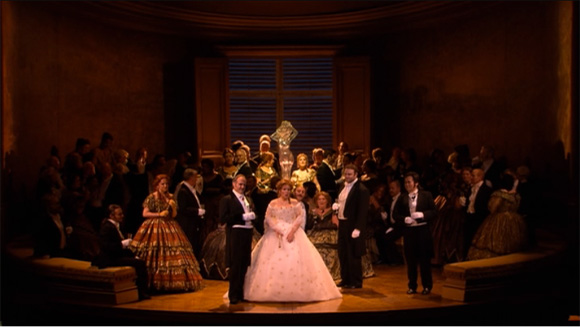
Richard Eyre’s production of La Traviata at the Royal Opera House, filmed in 2009, is a pretty good example of how to do a traditional production.  There’s nothing conceptual or thought provoking to it but the direction is careful and tells the story clearly and well.  The designs are mid 19th century with crinolines and tail coats but with the odd imaginative touch and a welcome refusal to succumb to the “more stuff” syndrome that plagues so many Verdi and Puccini productions.  Backed up by excellent music making it probably makes a near ideal introduction to the piece, even if it won’t entirely displace Willy Decker’s brilliant and disturbing Salzburg production in my affections.

Continue reading

Zambello’s Carmen

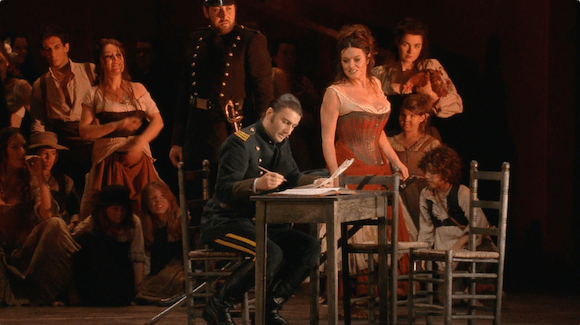
Francesca Zambello’s Carmen for the Royal Opera House has more going for it than is immediately apparent.  On the face of it it’s a very traditional, conservative production; period costumes, literal sets, hordes of kids in Acts 1 and 4, live animals, but a close look reveals rather more.  Zambello reveals her intentions during the overture where we see a manacled, distraught Don José dragged to execution by a masked executioner.  This is going to be Don José’s story rather than one that focuses almost exclusively on the title character.  What we see here is a stark contrast between what Don José really wants; respectability, an obedient wife, conformity with the Church, honour and what key choices, accidents and conflicts drive him to; criminality, liminality, execution and, we may suppose, damnation.  The staging subtly highlights each of the key moments in Don José’s descent; his arrest and demotion in Act1, the fight with Zuniga in Act 2 and the realisation, in Act 3, that Carmen will never be the women he really wants reinforced by Micaëla’s aria that ironically offers him the choice he can no longer make and does so unmistakeably in terms of Catholic eschatology.  There is so much more going on here than a sexy woman and some pretty tunes.

1.carmendonjose

Continue reading

The gods look down and laugh

Harrison Birtwistle’s The Minotaur premiered at the Royal Opera House in 2008 and got a DVD and Blu-ray release on Opus Arte not long after. It’s the sort of work I’m susceptible to. It’s a truly integrated music drama based on a classical, indeed universal, theme carried off without any kowtowing to current ideas of trendiness. I’ve watched it a few times now and like most modern works of substance it reveals more with a bit of time and effort.
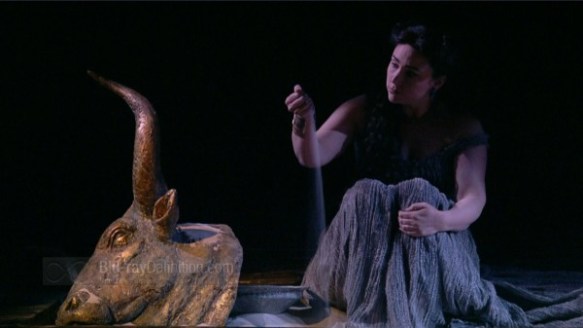
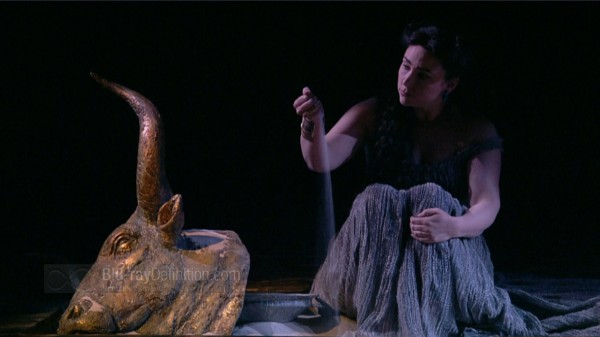
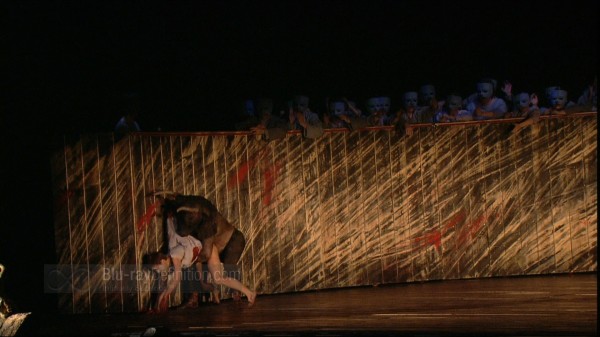
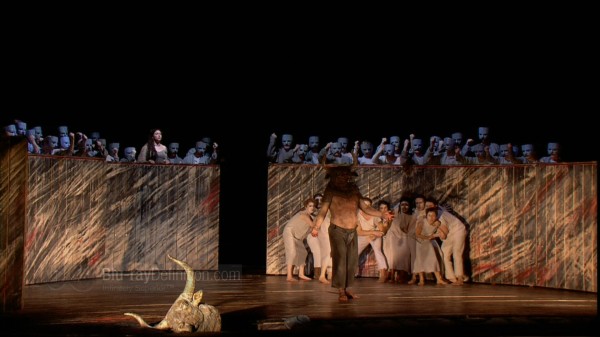
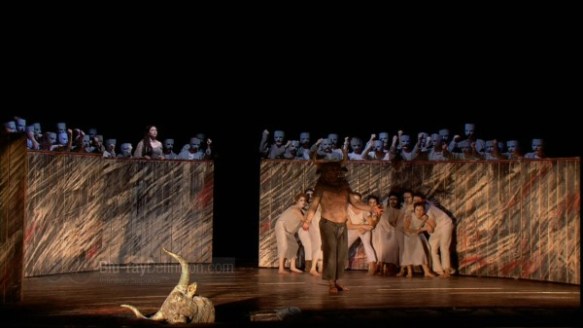
Librettist David Harsent’s take on the Minotaur myth is not at odds with versions many people will be familiar with (though whether in this day and age I’m not at all sure it’s safe to assume, as Harsent does, that “people are going in with a basic knowledge of the story”) but it does add some interesting ideas. His Minotaur, Asterios in this story, is articulate as a human only in his dreams and his dying moments. At these times he sings in English. As the awake monster in the Labyrinth he is restricted to inarticulate grunts. Also original is Harsent’s take on the relationship between Theseus and Ariadne. He sees this as a thoroughly corrupt relationship based on mutual need but riddles with disgust rather than love and so looking forward to the abandonment on Naxos. It works rather well. With those concepts in place we get a pretty straightforward account of the standard myth with some thoroughly brutal scenes of Asterios killing (and in one case raping) the Innocents in the Labyrinth to the blood curdling encouragement of a masked chorus of spectators. Another non-canonical addition at this point is the introduction of the truly horrific Keres who appear to feast on the bodies and the souls of the victims. It all leads up naturally to the death of Asterios at the hands of Theseus.
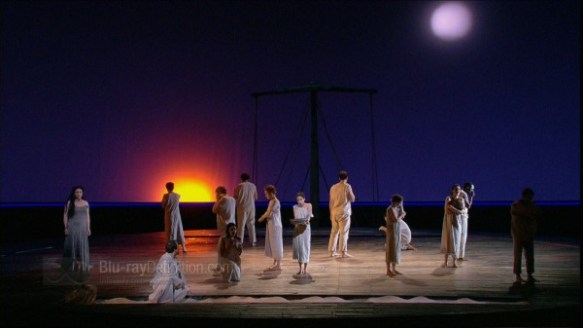
Birtwistle’s score is dense, multilayered and uncompromising. It’s clearly Birtwistle and makes no concessions to the current trend to try and make opera sound like a Broadway show. It’s not an easy listen but it repays a bit of effort and contains many interesting and deft ideas. For example Ariadne is paired throughout with the alto saxophone. Sometimes it takes up her singing line and carries it forward, sometimes it doubles her line and so on but nowhere does the saxophone interact with any other character. There’s a similar relationship between Theseus and the more conventional woodwind elements of the orchestra.
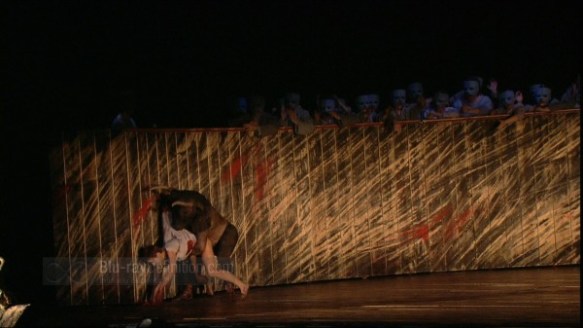
The design and direction; Alison Chitty and Stephen Langridge respectively, are very well integrated and are brilliantly supported by the lighting design of Paul Pyant. The result is some quite striking stage imagery that supports the changing moods of the piece really well. They also give us the mask that Asterios wears. It’s a framework affair so depending on the lighting Asterios can be fully beast or his human face under the mask can be made more present. It’s subtle and effective.
The performances are pretty much flawless. John Tomlinson, as Asterios, excels in a piece created for him. Christine Rice as Ariadne manages some really difficult music and a really long sing (she’s on stage nearly all the time) equally well. Johan Reuter (Theseus) has slightly off English intonation but sings powerfully and acts well. There are some excellent performances in the minor roles. For my money the best of these is the First Innocent of Rebecca Bottone who manages to look incredibly fragile but totally convincing during what is perhaps the most visceral scene of all where she is raped and killed by Asterios. There are very good cameos too from Amanda Echalaz as Ker and Philip Langridge as Hiereus. Antonio Pappano conducts and gets the necessary out of both orchestra and chorus.

The video direction is very good indeed. It appears to be a joint effort by Leo Warner and Mark Grimmer. The balance of setting shots and close ups is judicious and the close ups aren’t too close. They eschew silly camera angles. The picture on Blu-ray is 16:9 1080i and very good indeed. Sound is DTS 5.0 HD Master Audio and presents a vivid sound picture with good depth and breadth (PCM stereo also available). There are English, French, German, Spanish and Italian subtitles. The documentation includes a useful essay on the music and the disk has a 32 minute “Making of” documentary that is more informative than most of its kind.

All in all, this is a very impressive work, beautifully realised on stage and well presented on disk.

For the record the Opus Arte trailer and the whole piece are available on YouTube but the AV quality is appalling.

Domingo’s Boccanegra

Simon Boccanegra was the work that persuaded me that maybe I did like Verdi after all. It’s a terrific score and if the plot isn’t without it’s artificialities it’s full of strong characters and strong emotions which Verdi brings to life with fabulous orchestral and vocal writing.

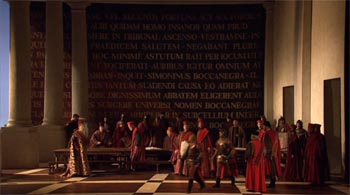
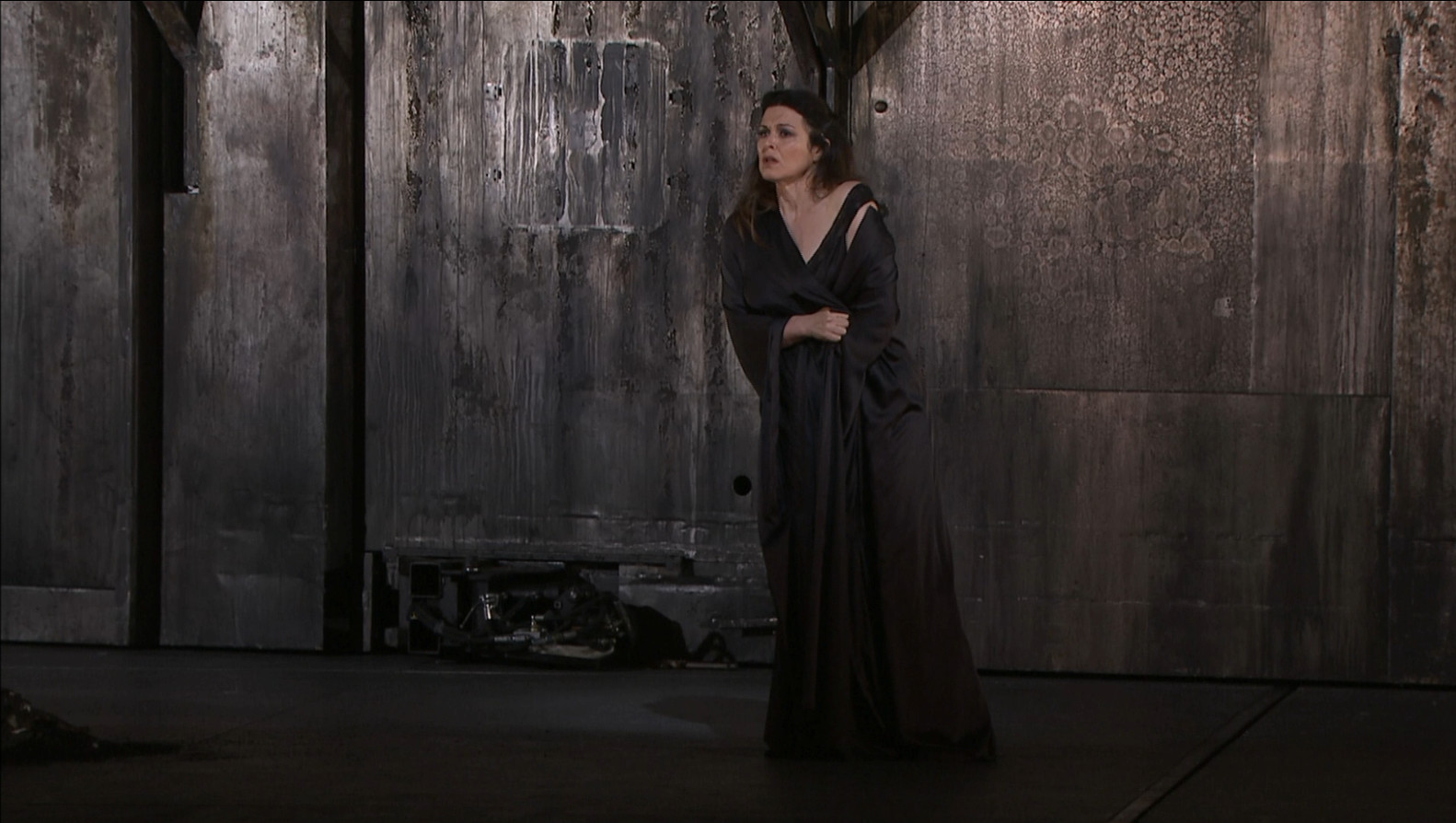
The most recent DVD version to appear is of the 2010 Royal Opera House production that was broadcast live on the BBC. It features Placido Domingo in his baritone incarnation in the title role. There’s a strong supporting cast with Ferrucio Furlanetto as his arch enemy, Fiesco; Jonathan Summers as the villain, Paolo; Joseph Calleja as the young rebel, Gabriele Adorno and Marina Polpavskaya as Boccanegra’s “lost” daughter, Amelia/Maria. The singing and acting are generally very strong. Placido is, of course, terrific. What more can one say? Furlanetto is a strong foil; excellent in both the prologue and the crucial final scenes. Summers is more than adequate though I might have hoped for more of a frisson when he curses himself. The real star for me is Calleja. He has a gorgeous voice and can float out a lovely pianissimo. His big aria early in the second act is particularly good but he is excellent all through the piece. The one weak link is Poplavskaya’s Amelia. It’s not bad. She acts well and looks the part but one really wishes for more beauty of tone. Pieczonka, in the Met HD broadcast, was much closer to the required vocal quality. Ensemble work throughout is excellent and there are some big set pieces! Antonio Pappano conducts brilliantly. He gets really good playing from the orchestra which is pretty crucial as there are some cruelly exposed woodwind and brass lines. He manages drama and urgency while still giving the singers room to do their thing when they need it. All in all, this is musically very satisfying.

The production, by Elijah Moshinsky, is pretty conventional. It’s a period setting with simple designs that suggest renaissance paintings. There are a few nice touches like the graffiti on the walls in the exterior scenes but mostly the look is just undistracting. There’s nothing beyond the text in the way the story is told either. Blocking is fairly basic and there’s a fair bit of “park and bark”. One senses that Moshinsky’s efforts have gone into character development rather than in trying to make any bold statement.

Sue Judd directed for TV and video and it’s a conventional TV view with too many close ups. She needs to watch some of François Roussillon’s recent work. We also get little chats from Pappano between scenes. These probably work OK first time through but I think would get pretty tedious on repeat viewing. There are short bonus features on  WorshippingWorking with Placido Domingo and Rehearsals with Elijah Moshinsky. The technical quality is very good. It was filmed in HD and the picture is clear and detailed. The DTS 5.1 sound is really excellent; detailed, very spacious and coping very well with the more congested passages. There is also LPCM stereo. This really deserves a Blu-ray release but it’s on EMI who so far seem not to have gone that route(1). There are English, French, Spanish, German and Italian subtitles. The documentation is missing from my library copy but apparently contains a track listing, synopsis and “notes”.

This is definitely worth a look and it will be very interesting to do a detailed “compare and contrast” if I can get my hands on the Sony DVD release of the 2010 Met HD broadcast with Domingo, Morris, Giodarno and Pieczonka.

fn1. EMI was recently sold to Universal; parent of Deutsche Grammophon, and Decca so I suppose anything is possible.

Don Carlos

There aren’t too many examples of the French version of Verdi’s Don Carlos on DVD. The one reviewed here is a 1996 Luc Bondy production from the Théâtre du Châtelet in Paris. It’s billed as the original 1867 five act version but I think some of the 1883 cuts are made. There’s no useful documenation so I can’t be sure. It features a very strong cast. Robert Alagna sings the title role, Thomas Hampson is Posa, Karita Mattila (looking very young!) is Elisabeth de Valois, José van Dam is Philip, Eric Halfvarson sings the Grand Inquisitor and, rather unexpectedly, Waltraud Meier is Eboli. Anthony Pappano conducts the Orchestre de Paris.

The set designs (Gilles Aillaud) are slightly stylized but essentially literal, simple and easy on the eye. Costumes (Moidele Bickel) are a sort of historical eclectic. There are nods to the 16th century but the women’s gowns could be any period or none, the Flemish deputies wear the sort of collar the vet puts on your pet after surgery and Alagna looks like he’s stepped out of Pirates of the Caribbean. That sounds negative but it’s actually just undistracting. There’s no high concept here so the whole thing turns on the Personenregie and, of course, the music. Bondy gets pretty impressive performances out of his players, creates some interesting stage pictures in the crowd scenes and doesn’t over egg the auto da fe. It’s not fancy but it works.

Musically this is a really good performance. All of the singers (except Halfvarson) tend to the light but beautiful end of the spectrum for their voice type and it all makes for an experience that seems especially apt for the french text. The revelation for me was Mattila. I’ve seen her only in heavier roles and I really had no idea she could sing so beautifully too. She is especially ravishing in the final scene where “Toi qui sus le néant” brought the house down. The chemistry between Hampson and Alagna is excellent and their voices blend well. Halfvarson is a stentorian and truly creepy Inquisitor. Meier seems a bit mannered at times but she pulls off the big moments fairly spectacularly. Pappano gets lovely playing from the orchestra but the voices are balanced quite a long way forward so we don’t get the full effect. All in all, it’s pretty compelling to watch.

Yves André Hubert is the video director. He does a good job. There isn’t a lot going on on stage other than the interaction between the principals most of the time so close ups there are fine and he does pull back when there’s something to pull back for. Picture quality (16:9) anamorphic is OK but not HD by any means. There are two sound options. I started with the Dolby 5.1 which I found lacks clarity and depth. The Dolby 2.0 alternative, while not of the highest quality, is much better. The whole 210 minutes with two soundtracks is crammed into 7.4 GB on a single DVD9 so top quality is hardly to be expected. There are English, French, Spanish and Japanese subtitles and documentation is minimal. Extras are limited to a cast list and synopsis.

All in all this is well worth seeing.