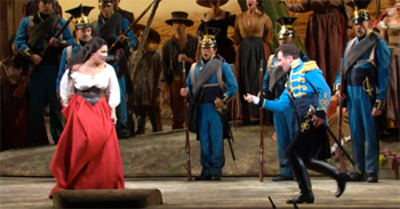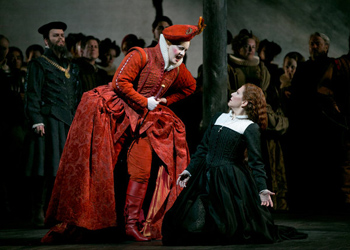
Today’s MetHD broadcast of Donizetti’s Maria Stuarda was a bit of a mixed bag. There were some really good performances. Joyce DiDonato in particular gave what may well have been a truly great performance and I would have loved to have seen it live. David McVicar’s production was much better than his Anna Bolena; visually interesting and with some strong dramatic ideas. However the good was pretty seriously undermined by another really awful piece of video directing by Gary Halvorson. I guessed it was him after about ten minutes. The incessant use of the nose cam and the incredibly irritating low level tracking shots were a dead give away. It was a big disappointment since the last two shows I saw, La Clemenza di Tito and Les Troyens, were filmed by Barbara Willis-Sweete and had given me some faint hope that the Met was capable of self analysis and improvement in this area. Hope that was, alas, sadly dashed today.
Tag Archives: methd
Now includes dwarf tossing
Berlioz’ Les Troyens is opera on a grand scale. Only a really big company like the Met could possibly afford to stage it. Yesterday’s performance used a chorus of 110, a larger orchestra, at least twelve soloists and a bunch of dancers. It also lasted 5 1/2 hours including the intervals. Was it worth it? For the most part I’d say yes.
Una opera in maschera
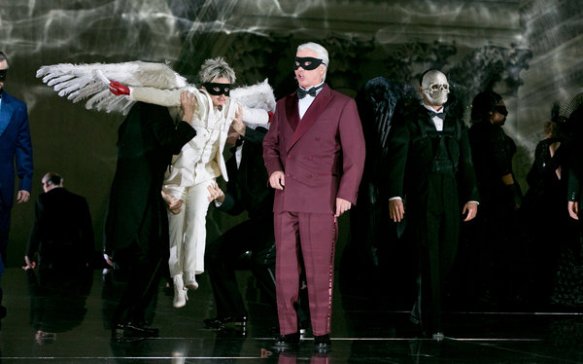
I despair. I really do. Yesterday’s MetHD broadcast of Verdi’s Un ballo in maschera had so much going for it. The singing was brilliant and David Alden’s production seemed to have plenty of interesting ideas. I say “seemed” because we only got the briefest of brief glimpses of it in between the succession of close ups served up by video director Matthew Diamond. On the odd occasions we got to see more than a head or a body it was usually from a weird angle. It’s particularly irritating because the two elements of the production that seemed to be most important were the ones most ruthlessly undermined. Alden’s movement of chorus, supers and dancers and the contrast between what they do and what the principals do seems to be important but who knows? Similarly his use of contrasting spaces, especially in Act 3, is obviously important but when the viewer gets only a couple of seconds to establish the context before the camera moves in and loses it the effect is fatally weakened.
Not a potato in sight
Today’s MetHD broadcast was Mozart’s last, and arguably best, opera La Clemenza di Tito. J-P Ponnelle’s production has been around for a while and offers nothing to offend traditionalists. There’s not a baked potato, muscle suit or child sacrifice in sight. The set, maybe more Italian Renaissance than Imperial Rome is elegant, undistracting and very singer friendly. The costumes are a rather eclectic mix of late 17th century and Republican Rome with a bit of Lady Capulet thrown in but only the black number with the big panniers that Vitellia gets in Act 2 would excite much comment. Direction then focuses rather on the characters and their relationships.
A more enchanted island
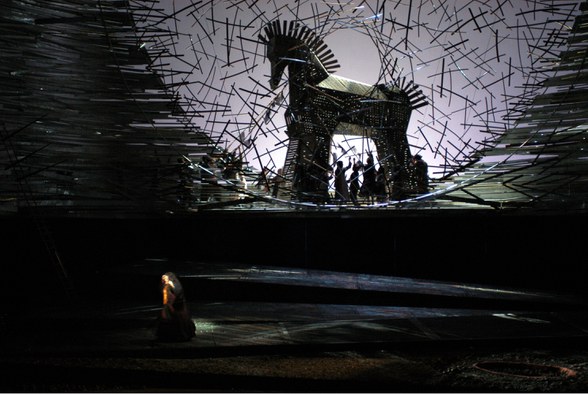
Thomas Adès’ The Tempest has had something like eight runs since its premiere at Covent Garden in 2004. It recently opened at the Metropolitan Opera in a new production by Robert Lepage which was broadcast as part of the Met in HD series this afternoon. It’s an interesting work musically. Some of the vocal writing is reminiscent of Britten. It all tends to a high tessitura for the voice type concerned and goes to extremes in that direction for the soprano part of Ariel where parts are so high that clear articulation of the words is impossible. Writing for voice and orchestra ranges from dissonant to extremely lyrical (the act 2 duet between Miranda and Ferdinand). Key and time signature changes are legion and many of the intervals for the singers are extreme. It must be extremely difficult to perform but it’s rather lovely to listen to.
Another Big COC Podcast
A couple of weeks ago we recorded another Big COC Podcast. It’s now available on the COC website and from iTunes. This time the panel was myself, Wayne Gooding from Opera Canada magazine and Gianmarco Segato and Gianna Wichelow from the COC.
Topics covered included Robert Everett-Green’s Globe and Mail article on Il Trovatore and the persecution of the Roma, upcoming opera productions across Canada (mostly Verdi!), an interview with Marilyn Gronsdal on her Montreal remounting of Christopher Alden’s production of Der Fliegende Holländer; seen at the COC in 2010, and that hardy perennial, HD cinema transmissions of opera with especial emphasis on the Met.
Heading into winter
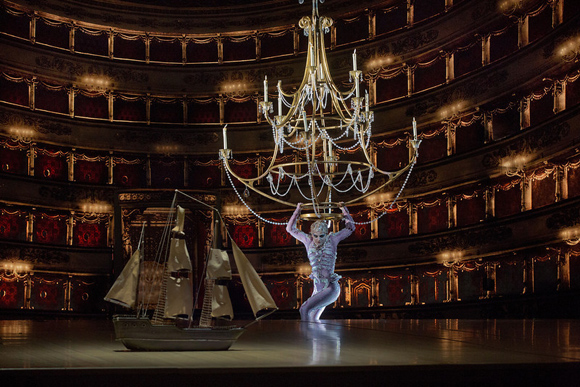
The leaves have turned and the Canadian Opera Company Season is underway so winter can’t be far away. I’ve now seen both the COC fall productions so I need to find alternative fare between now and February when things kick off again. So far I’ve found two live shows of interest in town. At the end of October Opera Atelier is putting on Weber’s Der Freischütz. This is a departure for OA who have previously (bar once) not put on anything later than Mozart and that in a rather idiosyncratic style. I think it’s an interesting move and I hope it stimulates the creative juices at OA and sparks some of the innovation that made OA such an exciting company ten or twenty years ago. If it turns into an exercise in persuading us that 19th century Romanticism is really just an extension of the Baroque I shall probably be feeling like the guy in the picture. The other live show is Essential Opera’s The Threepenny Opera being presented in concert at Heliconian Hall on November 7th. Essential Opera I suppose is a semi-pro outfit operating on very small budgets and The Threepenny Opera seems like a good fit. I felt that last year’s attempt at something grander was rather a case of biting off more than they could chew. Continue reading
L’Elisir di Steakhouse
Today was the first MetHD broadcast of the season and we got Bartlett Sher’s new production of Donizetti’s L’Elisir d’Amore. It’s what I would call a “steakhouse production”. It’s like a meal in a top end steakhouse. Your steak is a fine piece of meat, they don’t mess it up and ditto your baked potato. And it’s all served in luxurious surroundings with attentive service. It’s a terrific steak dinner but it costs the same as the tasting menu at a place with two Michelin stars and it’s still just a steak dinner.
So, a brilliant cast; Netrebko, Polenzani, Kwiecien and Maestri, singing and acting up a storm in a production that was pretty much devoid of ideas beyond a few odd costuming choices. Since when did Italian peasant girls get to dress like they are attending a ball in a Jane Austen novel? Still the girl singing Nanetta was cute and had the best dress. Gary Halvorson’s video direction was about par for the course in terms of virtually incessant close-ups. Not a bad way to spend a Saturday afternoon but ultimately forgettable.
Robert Carsen’s Eugene Onegin
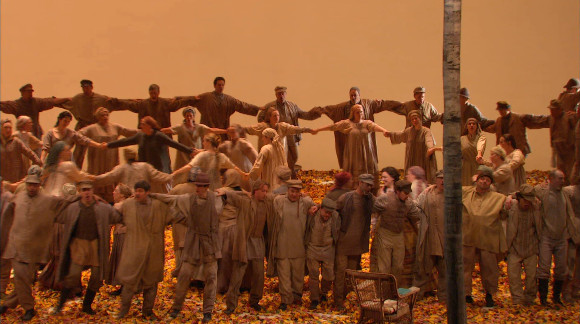
One of the early Metropolitan Opera Live in HD broadcasts was a 2007 showing of Robert Carsen’s 1997 production of Tchaikovsky’s Eugene Onegin with Dmitri Hvorostovsky and Renée Fleming. It was subsequently released on DVD and Blu-ray by Decca and remains one of the most successful disk releases spawned by the broadcasts.
They shoot horses don’t they?
Just back from the HD broadcast of the Met’s Götterdãmmerung.
Musically, I was really quite impressed. I thought Luisi’s take on the score was original, valid and enjoyable. His tempi were generally quite quick and there was a taut, sinewy quality to the strings that really brought out the shape of the music. No romantic wallowing here! I really liked the Gibichungs; Wendy Bryn Harmer as Gutrune, Iain Paterson’s Gunther and, especially, Hans-Peter König’s Hagen. All were well sung and characterful. Jay Hunter Morris as Siegfried and Deb Voigt as Brünnhilde were really exciting in the Act 1 love duet and Deb nailed the Immolation scene, almost managing to overcome the staging. So much for the music, what about the production?