Ein Reich, ein Volk, ein König

In many ways Meyerbeer’s Les Huguenots is a typical mid 19th century French grand opéra.  It takes a sweeping, epic story; in this case the St. Bartholomew’s Day Massacre, and grafts onto it the elements the paying public demanded; spectacle, ballet, showpiece arias etc.  The result is unwieldy and, when applied to such grim subject matter, almost grotesque.  The 1991 Deutsche Oper production by John Dew (performed in German as Die Hugenotten) takes these disparate elements and works with them; mixing laugh out loud and extremely grim to create a piece of music theatre that is truly disturbing.

1.badge Continue reading

Paramore shall welcome woe

Various thoughts about the Channel 4 film of Britten’s Owen Wingrave led to me seeking out the original BBC TV version from 1970, now available on DVD.  It’s extremely interesting and worthwhile.  Britten himself conducts and the cast includes many of the people involved in the first productions of many other Britten operas.  They include Peter Pears (General Wingrave/Narrator), John Shirley-Quirk (Coyle), Benjamin Luxon (Owen), Janet Baker (Kate), Heather Harper Mrs.Coyle) and Jennifer Vyvyan (Mrs. Julian).  The quality of the music making is superb and I found myself constantly surprised and delighted by details brought out by Britten supported by the excellent English Chamber Orchestra.  At the same time, the fluent and idiomatic singing pointed up the excellence of Myfanwy Piper’s libretto.  This really is Britten at his best.

1.portrait Continue reading

Look! No swan

1.kingSurprisingly perhaps I started out liking this 1986 recording of Lohengrin from the Metropolitan Opera quite a lot.  It’s a very traditional, literal and 70s/80s dark production but the orchestra and chorus are great, the P-regie seems pretty well thought out and the singing in the opening scenes is great.  Unfortunately it really rather goes downhill once Elsa, Lohengrin and Ortrud make their appearances.

Continue reading

Traditional Wozzeck from Vienna

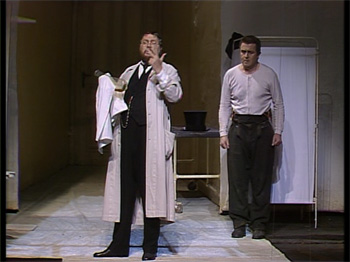
1.doctorThe 1987 recording of Berg’s Wozzeck from the Vienna State Opera is a bit of a mixed bag.  Claudio Abbado’s reading of the score is incredibly intense and powerful and he gets great support from the orchestra,  There’s also some very good singing.  Dramatically it’s a bit of a mixed bag and the DVD production isn’t particularly good.  Continue reading

Babes in bodices

After a less than satisfactory introduction to Donizetti’s Anna Bolena in a MetHD broadcast last year it was with some trepidation that I approached the DVD version recorded at the Wiener Staatsoper and also starring Anna Netrebko.  I need not have worried because it’s very good indeed.  It has a stronger cast, Eric Genovese’s relatively simple production trumps David McVicar’s overstuffed effort and Evelino Pido doesn’t try and make the orchestra sound like it’s playing Wagner.  The sound on the DVD is also way better than it was on that broadcast.

1.anna_giovanna Continue reading

Into the woods

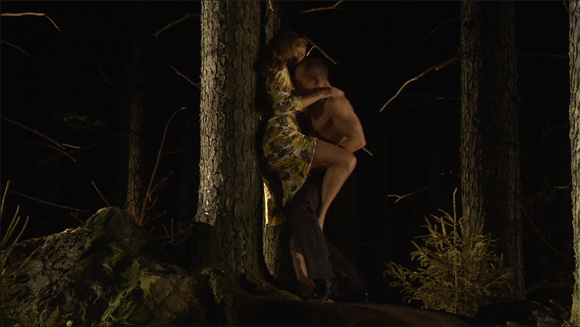
Claus Guth’s 2008 Salzburg production of Don Giovanni divided the critics along entirely predictable lines.  It’s a very unusual treatment of Don Giovanni but the concept is stuck to with real consistency and it works to create a compelling piece of music theatre.  The treatment on video too is not straightforward and, in a sense, the DVD/Blu-ray version is as much the work of Brian Large as it is of Claus Guth.

1.rape? Continue reading

At any price

Hans Werner Henze conceived of L’Upupa und der Triumph der Sohnesliebe as his farewell to the stage although, as it turned out, it wasn’t.  It’s a combination of Arabian Nights type themes crossed with elements from German folklore not unlike Die Zauberflöte, which is an obvious infuence.  So obvious, in fact, that in the scene where Kasim rescues his beloved she is given a line straight out of Schikaneder.  For the 2003 world premiere in the Kleinesfestspielhaus in Salzburg, director Dieter Dorn and designer Jürgen Rose chose a simple stage concept.  The action is encircled by an arch, at the apex of which is a tower room.  The old man, the ruler of the principality, inhabits the room.  The action mostly takes place in brightly coloured scenes under the arch.

1.arch Continue reading

Rosenkavalier on the brink

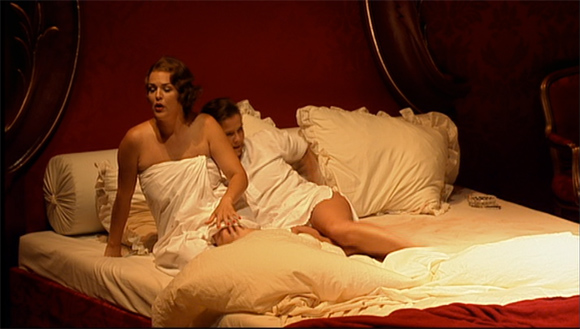
Robert Carsen’s 2004 production of Der Rosenkavalier at the Salzburg Festival was apparently enormously controversial at the time.  In many ways that says more about the iconic status of the piece in Salzburg tradition than about Carsen’s production.  There are a few controversial elements.  He has updated the period to 1914 and the third act is set in a brothel with a fair amount of nudity.  Beyond that, the production is pretty faithful to the libretto and has, I think characteristic Carsen touches like long lines of tables and chairs and a certain geometric elegance.  He seems to be using the sides of the stage to comment on the action which tends to be fixed centre stage.  I say seems because the video direction (by Brian Large) is utterly perverse and makes it extraordinarily difficult to see what Carsen is doing, let alone decode it.  We see the whole stage, maybe, for three seconds in the whole piece.  Otherwise 99% of what we get is either close up and even closer up or apparently shot from the restricted view seats high up and close to the side of the stage.  The other 1% is just plain nuts and includes a section of the Sophie/Octavian duet in Act 2 where, on stage, Octavian is maybe twenty feet to Sophie’s right but on camera he’s standing right up close on her left hand side.  I could go on but I won’t.  Suffice it to say the video direction comes close to wrecking an otherwise excellent DVD.

Continue reading

Pavarotti and Freni in La Bohème

The audience at this 1988 San Francisco Opera production of La Bohème clearly thought very highly of it.  There is even some applause for the scenery.  I’m less impressed.  Seen as a star vehicle for Pavarotti and Freni it’s quite adequate, though both are decidedly on the mature side for Rodolfo or Mimi.  Other than that it’s rather dull, the video direction doesn’t help it any and the technical quality is no more than adequate.  Continue reading

Frock Opera

Giordano’s Fedora is a sort of apotheosis of the 19th century Italian opera.  It’s a melodramatic love story in an aristocratic Russian setting.  There is murder and suicide and plots and a dead mother and brother.  The music is dramatic, even bombastic, when the mood suits but finds time to give showpiece arias for the principals.  There is not a single idea in libretto or score that could give anyone an uncomfortable thought.  The Metropolitan Opera’s 1996 production by Beppe di Tomasi builds on this by playing it dead straight and setting it in a series of suitably opulent settings complete with extravagant frocks.  The cherry on the already rather rich cake is casting Placido Domingo as Loris Ipanoff and Mirella Freni as Fedora Romazoff.  I imagine it’s many people’s idea of the perfect night at the opera   In it’s way it’s the polar opposite of, say, Bieito’s WozzeckContinue reading