Sweet prince

192996050Just been checking out the Glyndebourne 2017 season announcement.  Not that I’ll be going or anything but one production did catch my eye.  There’s a new Hamlet opera from Brett Dean and Matthew Jocelyn to be directed by Neil Armfield and conducted by Vladimir Jurowski which sounds promising enough but look at this cast: Allan Clayton (Hamlet), Sarah Connolly (Gertrude), Barbara Hannigan (Ophelia), Rod Gilfry (Claudius), Kim Begley (Polonius), John Tomlinson (Ghost of Old Hamlet).  There had better be a DVD.

Oh yes and they’ve unearthed yet another previously (more or less) unheard of Cavalli.
Ariadne goes to war

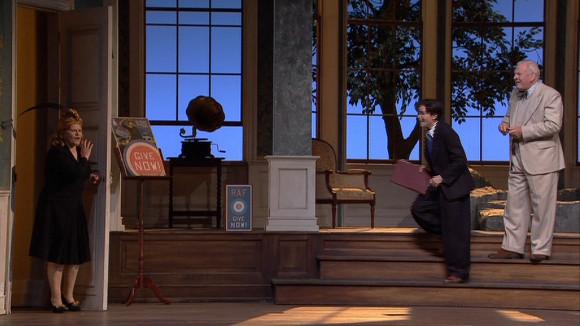
Katherina Thoma not unreasonably chooses to set her 2013 Glyndebourne production of Ariadne auf Naxos in a country house in the south of England (though I suppose equating the Christies with a rather boorish Viennese bourgeois might be thought a touch unkind).  She also chooses to set it in 1940 which sets us up for an almost Marxian dialectic not just between high art and low art but between art and life; especially where life and death are concerned.

1.setting

Continue reading

Intermezzo

It has been said that the best music in Richard Strauss’ Intermezzo is in the orchestral interludes that link the various scenes.  It’s probably true and certainly the singers don’t get much interesting to sing with the best music given to the orchestra even during the scenes.  That said, all of the music is vastly better than the truly cringe-worthy libretto, also by Strauss.  It’s in prose, much of it is spoken and there are odd interjections of more vernacular German for the servants, rather in the manner of the random cockney in ancient Ealing films.  The plot is based on an, aaparently real life, episode in the married life of the Strausses, here thinly disguised as the Storches, in which Frau Storch gets the wrong end of the stick about suspected infidelity by her husband and threatens divorce.  If Frau Strauss ever saw the piece, which is apparently unlikely, she might reasonably have seen the portrayal of herself by her husband as much sounder grounds for dumping him.  Christine Storch is the sort of woman one wants to tie up in a sack and drown!

1.bedroom

Continue reading

Ravel double bill

In 2012 Glyndebourne staged an interesting and contrasting double bill of Ravel one-acters in productions by Laurent Pelly.  The first was L’heure espagnole.  It’s a sort of Feydeau farce set to music.  The plot is classic bedroom farce with the twist that most of the doors the lovers come in or out of belong to clocks.  Concepción is the bored wife of a nerdy clockmaker.  She’s not overly impressed by her two lovers; a prolix poet and a smug banker, who show up while hubby is out doing the municipal clocks.  She’s much more taken by the slightly simple but very muscular muleteer who spends most of his time lugging lover infested clocks up and down stairs for her.  Pelly wisely takes the piece at face value and brings off a mad cap forty five minutes timed to the split second.

1.lovers Continue reading

Colourful Vixen from Glyndebourne

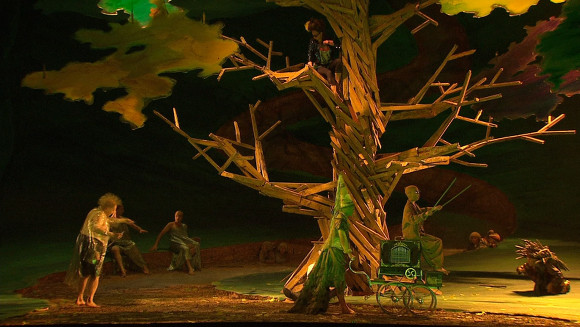
Melly Still’s 2012 Glyndebourne production of Janáček’s Cunning Little Vixen is straightforward and rather beautiful.  Certainly the staging matches the magic of this extraordinary score.  There are really two ideas underpinning the designs.  The animals are very human rather than the furries sometimes seen.  Their specific nature is hinted at rather than made terribly explicit.  They are differentiated from the humans by being very boldly coloured.  In contrast, the human world is a sort of monochrome 1920’s Moravia; all greys and browns.  Within this framework there are some neat touches.  The foxes carry their tales and use them to great demonstrative effect.  The chickens are portrayed as sex workers with the cockerel as, sort of, their pimp.  It’s not overdone and it’s very effective.  The sets are centred round a stylized tree with other structures as needed being erected on the fly with flats so the action never really stops.

1.forest Continue reading

Kitchen sink duly chucked

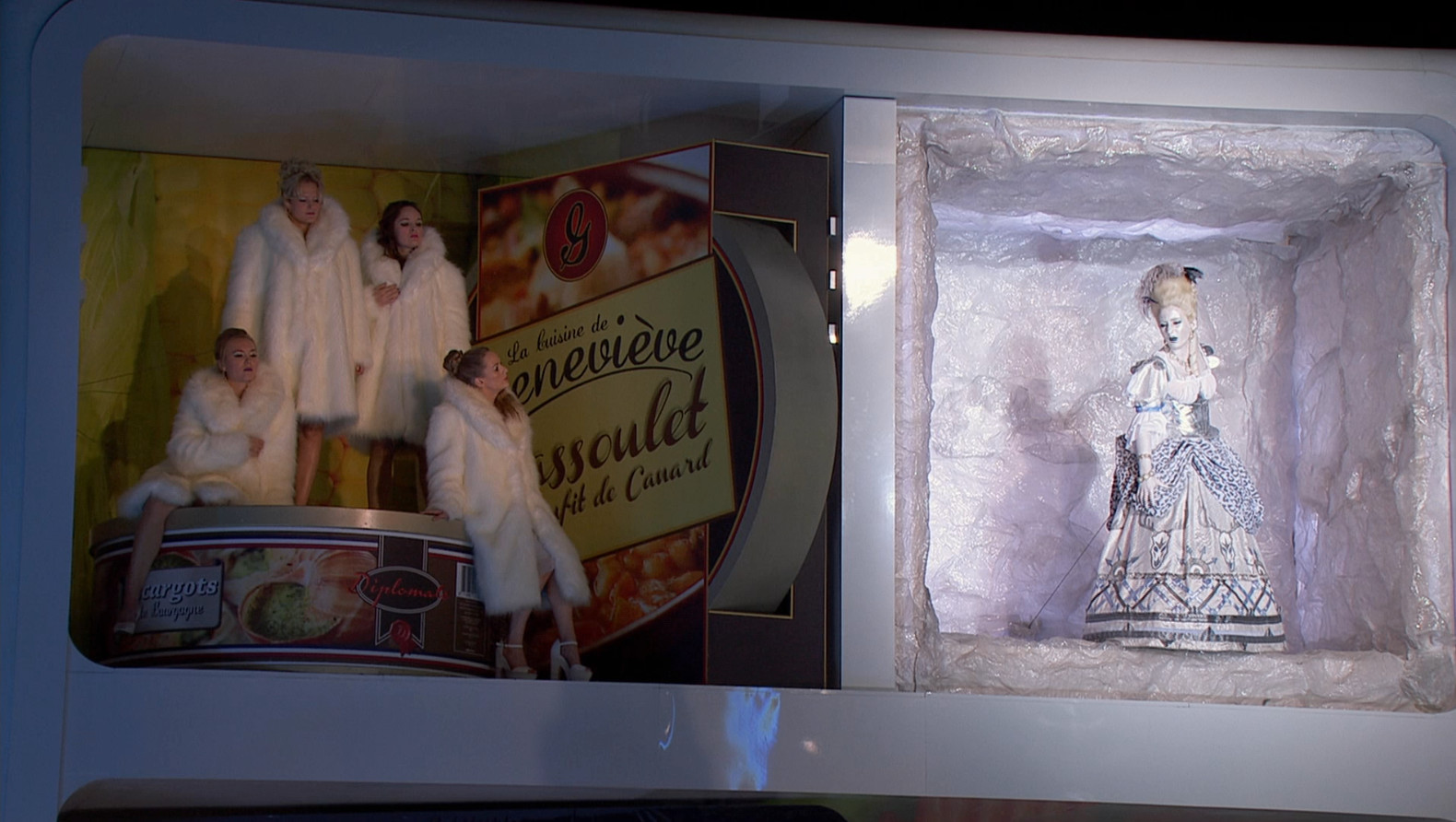
There’s a pretty good “making of” extra with the 2013 Glyndebourne recording of Rameau’s rarely performed Hippolyte et Aricie.  In it, director Jonathan Kent argues that there are essentially two ways of dealing with the French baroque; elegance or “throwing the kitchen sink at it”.  To this one might add a weird pastiche of bare chests, stylized gesture and high camp but that’s another story.  My best experiences with Rameau have definitely been of the kitchen sink variety.  I’m thinking of productions like José Montalvo’s Les Paladins.  Kent is a bit more restrained but still pretty inventive which I think is necessary as Hippolyte et Aricie is rather episodic and fragmented and could use some livening up.

1.fridge Continue reading

Another classic re-release

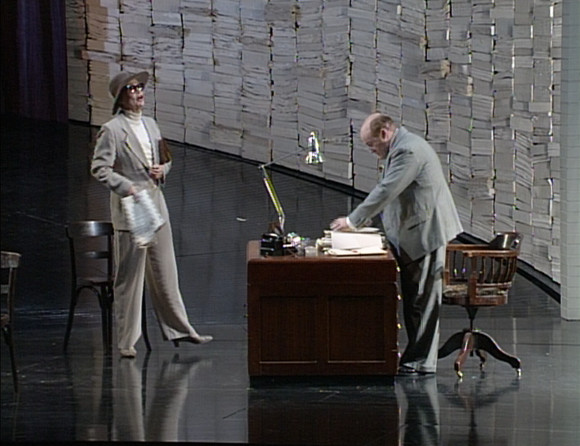
For the longest time the classic 1995 Glyndebourne recording of Janáček’s Věk Makropulos was the only video option.  It’s now been re-released on DVD and Blu-ray in a completely remastered version.  I watched the Blu-ray and it’s as well restored as the companion recording of Peter Sellars’ equally classic Theodora.  As it’s drawn from a Channel 4 broadcast the picture is 4:3 and it’s presented here formatted for wide screens in what is, apparently, called “pillarbox” mode in the UK.  At any event, the picture is excellent; certainly the equal of many more recent recordings, if not quite of the best HD quality.  The sound, stereo only, is decent but  a bit “boxed in” and the voices often seem to balanced a long way back.

1.office Continue reading

Cecilia and Bryn

Cecilia and Bryn at Glyndebourne is the DVD recording of a concert from 1999 featuring two of those singers who prove you don’t have to be dead skinny to be a great singer and have a commanding stage presence.  It’s great fun, focussing on the lighter end of the repertoire for the most part.  It’s mostly Mozart with some Rossini, Donizetti, Haydn and Handel thrown in.  There are a couple of overtures and a few arias but the greatest pleasure comes in the duets.  For the second time in a week I got to see Lá ci darem la mano sung by singers of extremely contrasting heights and where else is one going to see Mr. Terfel and Ms. Bartoli sing the Pa-pa-pa-pa duet from Die Zauberflöte.  As ever Ceci’s coloratura is a thing of wonder and Bryn is no slouch.  The accompaniment is ably provided by Myung-Whun Chung and the London Philharmonic.  It’s the perfect antidote to a week of watching Wozzeck.

1.hat Continue reading

The ceremony of Innocence is drowned

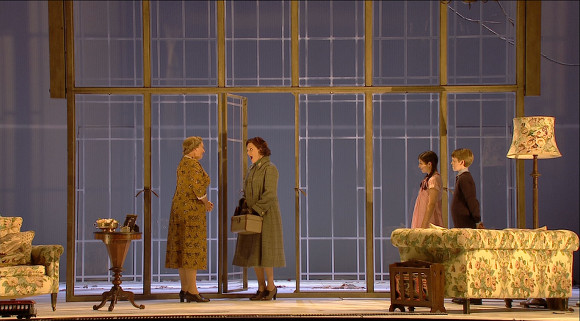
Jonathan Kent sets his 2011 Glyndebourne production of The Turn of the Screw in the 1950s.  It’s effective enough especially when combined with Paul Brown’s beautiful and ingenious set and Mark Henderson’s evocative lighting.  The set centres on a glass panel which appears in different places and different angles but always suggesting a semi-permeable membrane.  Between reality and imagination?  Knowledge and innocence?  Good and evil?  All are hinted at.  A rotating platform allows other set elements to be rapidly and effectively deployed.  There’s also a very clever treatment of the prologue involving 8mm home video.

1.arrival Continue reading

David McVicar’s Die Meistersinger

David McVicar chooses to set his production of Die Meistersinger, staged at Glyndebourne in 2011, in the 1820s or thereabouts.  It’s an interesting choice as it puts German nationalism in a specifically cultural rather than political context and also rather clearly makes the point that “foreign rule” = “French rule”.  That said, he really doesn’t develop any implications from that and what we get is a production typical of recent McVicar efforts.  There’s spectacle aplenty and very good character development but he doesn’t seem to have any Big Ideas; for which, no doubt, many people will be grateful.  The only place he seems to go a bit overboard is in laying on some fairly heavy German style humour.  People who think that slapping waitresses on the bottom is the height of comedic sophistication will probably appreciate it.

1.Eva and Walther Continue reading