
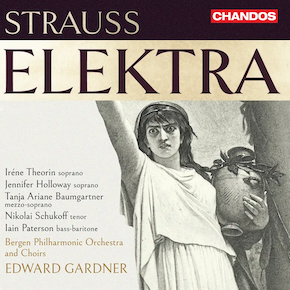
 Ed Gardner and the Bergen Philharmonic have produced some stunning recordings for the Chandos label. The new release of Richard Strauss’ Elektra is no exception. Indeed this is likely now the first choice audio recoding of this work.
It’s a very strong cast. Iréne Theorin has enough heft for the title role but she’s also surprisingly lyrical where appropriate, Jennifer Holloway is a sweet toned and sympathetic Chrysothemis and Tanja Ariane Baumgartner sounds suitably unhinged as Chrysothemis without sounding like her voice is past its sell by date. Iain Paterson is an interesting Orest. He’s kind of eerily creepy especially in his first scene with Elektra. I rather liked it. All the other roles are perfectly adequate too and so is the chorus.
But isn’t the real glory of Elektra the orchestral writing? Gardner gets the most out of it with a reading that’s both very dramatic and surprisingly lyrical. It’s taut too. The tension just goes on and on. The Bergen players respond splendidly.
The recording was made in the Grieghallen in December 2023 from live concert performances. It’s splendid and has been released as a hybrid SACD. The high resolution tracks are as good as any recording I’ve heard but this does mean that the dynamic range is realistically extreme! With the volume set to a realistic level for the voices, the orchestral climaxes are very loud indeed so unless you have no neighbours within miles you might prefer headphones. The climaxes though are super clean and detailed so not particularly fatiguing to listen to. There’s a booklet with useful info and full text and translation. The SACD physical release can, of course, be played like a standard CD on most CD players and the album is also available digitally as MP3 and lossless in 44.1kHz/16 bit and 96kHz/24 bit versions.
And what did my Elektra think? She thought it was perfect music for an extended nap!

Catalogue information: Chandos CHSA 5375(2)
 My main reason for getting my hands on a new CD of mainly orchestral music by Sibelius featuring the Bergen Philharmonic and Edward Gardner was to listen to the couple of tracks that feature soprano Lise Davidsen. I first saw her with the TSO in 2019 and I thought
 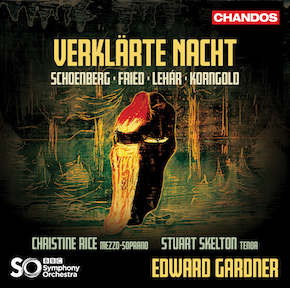 No, not Flanders and Swann but rather a well constructed new recording from Edward Gardner and the BBC Symphony Orchestra. It contains music by four composers exemplifying that lush territory that lies emotionally, if not always temporally, between Wagner and the Second Vienna School. The two central works were both inspired by Richard Dehmel’s Verklärte Nacht. The first is a 1901 setting of the text for mezzo, tenor and orchestra by Oskar Fried. It’s lushly scored and rather beautiful. The sound world is not dissimilar to Schoenberg’s Gurrelieder. Gardner gets a lovely sound from his players and some really gorgeous singing from Christine Rice and Stuart Skelton. The second Verklärte Nacht is the more familiar Schoenberg piece for string orchestra. It’s curious how without voices and with only strings it manages to sound almost as lush as the Fried.
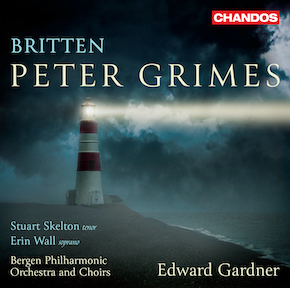 This new recording of Britten’s Peter Grimes was recorded from semi-staged performances in the Grieghallen in Bergen in November last year. It’s very good indeed. Of course, there are many good audio and video recordings of this piece going back to the composer’s own version with Peter Pears in the title role; recorded in 1959 and many fine singers have recorded the title role. To stand out from the field, a new recording needs an outstanding Grimes and in Stuart Skelton this version has one. He manages to encompass both the brutal, gritty side of Grimes as well as the more ethereal side. Pears did the latter brilliantly but could never quite manage the grit. Vickers, who practically owned the role in the 1970s, was brutal but didn’t have the voice or the stage skills to bring out the gentler side. Perhaps the first person to really portray the full complexity of the character was the late Philip Langridge and there’s much about Skelton’s portrayal that reminds one of him. It shades toward the delicate most of the time with some lovely singing in “Now the Great Bear” and in the mad scene. But when Skelton needs to be brutal he’s downright scary.
 operaramblings