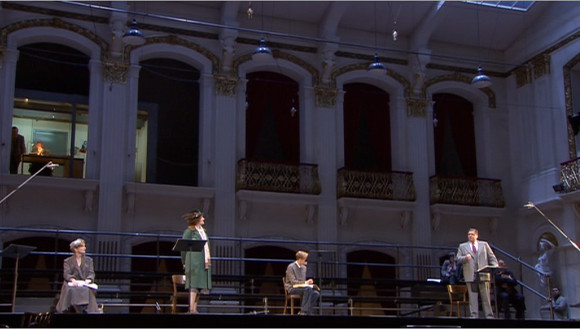
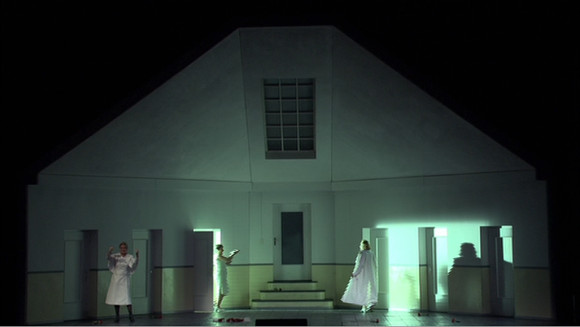
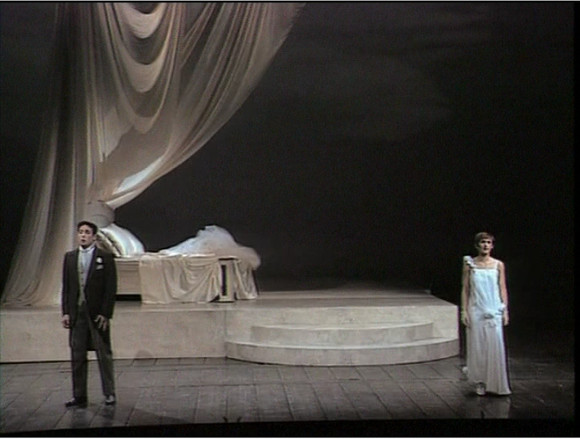
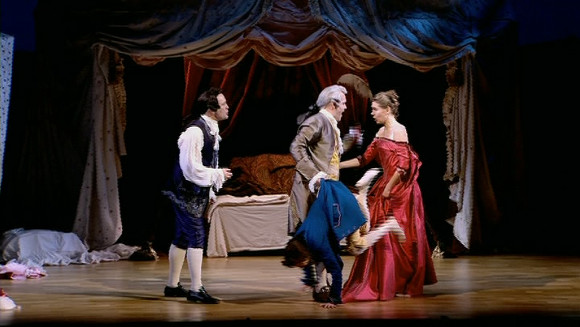
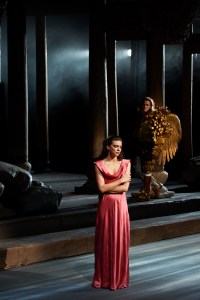
Christoph Loy, in his 2011 Salzburg production of Richard Strauss’ Die Frau ohne Schatten, avoids the problem of how to represent the Spirit World by essentially eliminating it. Instead we get a Konzept based on Böhm’s first recording of the work in Vienna’s Sofiensalle in 1955. Vienna is still recovering from the war and the hall is unheated and the singers unpaid. The Empress is rising star Leonie Rysanek and the Nurse is long time favourite Elisabeth Höngen. They represent the generations separated by the war. The Emperor is an American singing in Europe for the first time and, crucially, Barak and his wife are a real life married couple. Initially we see a lot of recording studio action as singers are moved about by actors in this experiment in early stereo. Then the action, particularly the Barak/Wife interaction slips more and more off stage. For the finale, we get a sort of celebratory concert in evening dress. It’s not a bad concept and this cast handles it very well but I fancy it’s a tough introduction to this far from straightforward opera and it does lose the magic of the Spirit World. (In other words I’m glad I saw the Met production before this one.)
Tag Archives: dvd
David McVicar’s Die Meistersinger
David McVicar chooses to set his production of Die Meistersinger, staged at Glyndebourne in 2011, in the 1820s or thereabouts. It’s an interesting choice as it puts German nationalism in a specifically cultural rather than political context and also rather clearly makes the point that “foreign rule” = “French rule”. That said, he really doesn’t develop any implications from that and what we get is a production typical of recent McVicar efforts. There’s spectacle aplenty and very good character development but he doesn’t seem to have any Big Ideas; for which, no doubt, many people will be grateful. The only place he seems to go a bit overboard is in laying on some fairly heavy German style humour. People who think that slapping waitresses on the bottom is the height of comedic sophistication will probably appreciate it.
Beyond pale
Paul Dukas’ Ariane et Barbe-bleue is a setting of a libretto by the symbolist poet and playwright Maeterlinck. It’s roughly contemporary with both Debussy’s Pelléas et Mélisande and Strauss’ Salome. It shows. It really is a product of a particular fin de siècle world view. Like Debussy’s piece, Ariane is loosely based on a folk tale. In this case it’s the gory story of Duke Bluebeard and his six wives but here it’s curiously etiolated. It’s as if Maeterlinck is reacting to the ultra-realism of, say, Zola, by retreating into a strange inner world. It’s not even the troubled inner world of Freud or Jung either. It’s colourless (and we’ll come back to that). All this is reinforced by Maeterlinck’s style of telling rather than showing. Much of what “action” there is takes place off stage and is narrated by the on stage characters. Both words and music are used to fill in the gaps.
In fair Verona, where we lay our scene
Where better to record a production of Gounod’s Roméo et Juliette than in the spectacular Arena at Verona? The productio, dircted by Francesco Micheli with sets by Eduardo Sanchi and costumes by Silvia Aymonino, is as spectacular as the setting and also quite weird in a space opera sort of way, The characters wear huge collars and are colour coded; Yellow for the Montagues, red for Paris and his entourage and blue for the Capulets. Only the non-feuding characters escape this schema notably, of course, the two lovers and Friar Lawrence. There are also lots of colourful cage like structures that character pop in and out of or sing from and a huge chorus and crowd of supers flow all over the vast space. It’s amazing to look at and actually suits a straightforward telling of the story quite well.
Sex and violets
Cilea’s Adriana Lecouvreur isn’t performed very often and, when it is, it’s usually because some great diva of the day wants to do it. That’s the case with the 2010 Covent Garden production which was created by David McVicar for Angela Gheorghiu. Actually I am a bit surprised it’s not done more often. It’s not a great masterpiece but it’s no worse than a great many commonly done pieces and, if the plot is a bit implausible, it’s not as offensive as half of Puccini’s output. I would have thought it would have great appeal to that opera middle ground to which I don’t belong.
Bosom stirring
Chabrier’s one act opera Une Éducation Manquée has possibly the most implausible plot in all of opera. It concerns a young aristocratic French couple on their wedding night. The whole plot turns on them having no idea what they are supposed to do. Not only are they French but they rejoice in the names of Gontran de Boismassif and Hélène de la Cerisaie. Titter ye not! Fortunately it only takes them 47 minutes to figure things out because a Wagner work on this theme would be quite intolerable. I’m not sure why anybody would bother with this piece of fluff but it made it onto DVD in a performance recorded in Compiègne in 1994. It’s probably the most amusing thing out of there since someone faked up a video of Hitler dancing in front of a train carriage. Which isn’t saying a lot.
You think this is funny, Beauty?
The DVD version of Michael Sturminger’s Giacomo Variations was recorded at the Ronacker Theater in Vienna in 2011. With the exception of Florian Boesch in the baritone role it’s the same line up as the performance in Toronto that I reviewed earlier this year. Watching the DVD didn’t change my views about the piece or the performances materially. It still feels a bit undercooked and schematic. I did like the quote on the DVD box about Malkovich’s singing from the Kürier “closer to Tom Waits than to Fritz Wunderlich”. I wish I’d said that.
Staging Handel’s oratorios
I’ve been watching a few staged versions of Handel oratorios recently and I’ve come to the conclusion that, in general, I prefer them to his Italian operas. It’s not just that they have really good plots they are also musically much more interesting than the operas. For the stage Handel stuck pretty firmly to the conventions of opera seria. Da capo aria succeeds da capo aria and only occasionally does a chorus or a duet break out and that bit is often the musical highlight of the piece, to my mind at least. Think of Io t’abbraccio in Rodelinda; surely the highlight of the whole work. In the oratorios Handel seems to feel much freer to use multiple forms and, of course, he writes magnificent choruses. Continue reading
Fear and loathing in Corinth
Cherubini’s 1797 opéra comique Médée was one of the first to use the form for serious drama. Krzysztof Warlikowski’s 2011 production filmed at La Monnaie in Brussels is certainly that. Jason, Medea and the rest are very contemporary characters though we often see them against a backdrop of 1960s style home movies and the chorus too, which tends to remain in the background also seems to be from the same period.The meaning of this juxtaposirtion isn’t clear and there is nothing on the disks or in the documentation to help. We are also told that the libretto was adapted by Warlikowski and dramaturge Christian Longchamp but nothing more than that. This is definitely a production where the director’s notes would be a major plus.
Jealousy, rage, love and fear
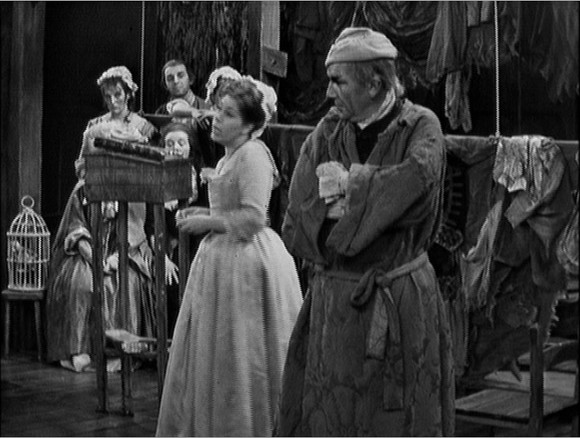
It’s a curious thing how some works get over recorded and others are almost entirely neglected. For example, there’s only one video recording of Weill’s Die Dreigroschenoper and that a 1931 film that omits huge chunks of the stage work. It’s inspiration fares little better. There’s only one video recording of The Beggar’s Opera by Johann Pepusch and John Gay. It’s a 1963 BBC TV production of Benjamin Britten’s reworking of the piece for the English Opera Group based on a stage production by Colin Graham. [ETA: There are actually two other versions; a 1953 movie version with Lawrence Olivier and a 1980s version with Roger Daltrey and John Eliot Gardiner].