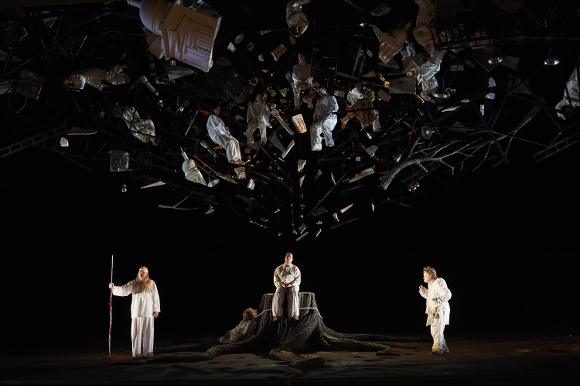
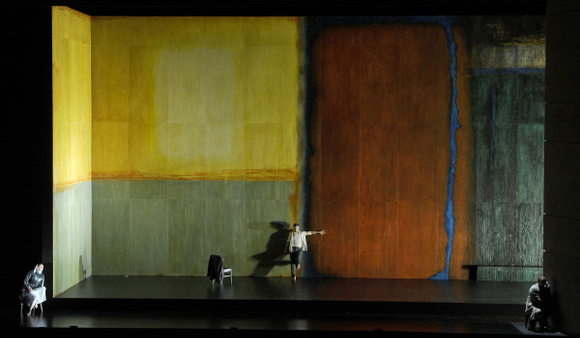
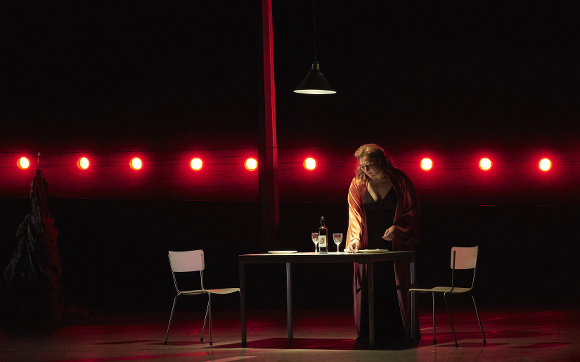
Last night the COC began its run of Götterdämmerung, the last and longest opera in Wagner’s epic tetralogy at The Four Seasons Centre. It’s very different from Die Walküre and Siegfried. The visual elements that tied them together; tottering Valhalla, disintegrating world ash, gantries, dancers, heaps of corpses are mostly gone. In Tim Albery’s production the visuals are spare almost to abstraction. The Gibichung Hall is a CEO suite with computer monitors and red couches, both Brünnhilde’s rock and the Rhinemaidens’ hang out look improvised, almost like squatters’ camps. Costuming, apart from an occasional flashback, as in Waltraute’s scene, is severely modern business; grey suits, black dresses. Only Siegfried himself in tee shirt and leather jacket stands out from the corporate crowd. Dancing flames are replaced by red lights. Everything that can be understated is and the world ends not with an overflowing Rhine and collapsing Valhalla but a stately pas de quatre between Brünnhilde and the Rhinemaidens.


 I took a quick look at the Metropolitan Opera’s recently announced 2016/17 and while for the most part it’s business as usual there’s maybe one surprise. There are 26 productions; 6 new, 20 revivals for a total of 225 performances. The first thing that struck me was how little Puccini there is. Only two Puccini works (La Bohème and Manon Lescaut) are being performed for a total of 23 shows (10.2%). There’s nothing pre Mozart and only one opera written post WW1; L’Amour de Loin which gets 8 performances (ETA: Apparently Cyrano dates from 1936 though you wouldn’t guess that to hear it. Still only 4 performances so it doesn’t affect the stats much). There are only two other works which could, at a stretch, be called “modern” stylistically; Salome and Jenůfa, but they were written in 1905 and 1903 respectively, and get only 6 performances each. Then there’ Rusalka (1901) and Rosenkavalier (1911) which are 20th century but not by any stretch “modern”. So, even on generous definitions of “modernity”, over 85% of the Met’s output is, essentially, 19th century.