Sighs Too Deep For Words

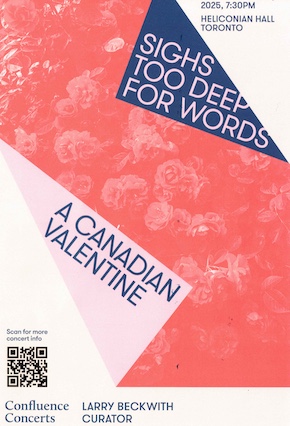
Friday evening at Heliconian Hall saw the second of two performances of Confluence Concerts’ Sighs Too Deep For Words: A Canadian Valentine.  It was an all Canadian concert featuring songs and spoken word including two world premieres and a performance of Omar Daniel’s 2005 piece Neruda Canzones.

The spoken word pieces, read beautifully by Alison Beckwith, ranged from Lucy Maud Montgomery to Margaret Atwood.  Some pieces straightforwardly celebrated romantic love and others came at it a bit sideways!  Songs by Canadian composers were well represented With Derek Holman, Jeffrey Ryan and John Beckwith all represented.  Anaïs Kelsey-Verdecchia performed (with Christopher Bagan) her own setting of “The Lark in the Clear Air” and Patricia O’Callaghan gave us her setting of “Some by Fire” with Chris again at the pianio, Andrew Downing on bass and a backing group.  So many styles!  No-one could say that Canadian music is samey or boring. Continue reading

Soundstreams 2023/24

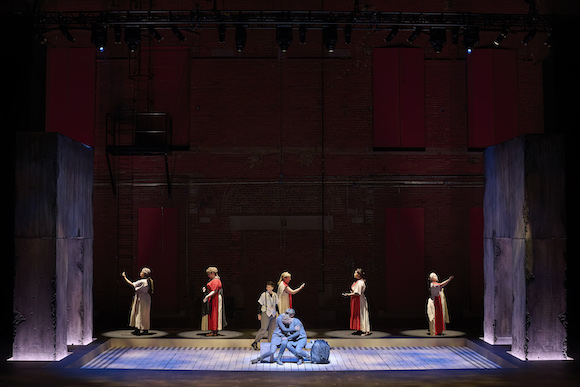
soundstreams2324Soundstreams has announced the line up for the 2023/24 season.  First up, and very exciting, is The Bright Divide, which will play Nov 10th and 11th at the TD Music Hall (the new performance space at Massey Hall).  It’s a staged show, directed by Tim Albery and featuring two works inspired by the work of Mark Rothko.  There’s Morton Feldman’s Rothko Chapel for viola, timpani and choir and a new work by Cecilia Livingston; mark for viola and voice.
Electric Messiah is back.  This time it’s at Theatre Passe Muraille from December 14th to 17th.  Adam Scime is in charge again for the Messiah where you don’t know what to expect.

Continue reading

Pomegranate at the COC

Almost exactly four years after Kye Marshall and Amanda Hale’s Pomegranate played at Buddies in Bad Times in a production by Michael Mori it reappeared at the COC in expanded form in a production by Jennifer Tarver.  The basic plot hasn’t changed much so I’m not going to repeat what I wrote about that in 2019.  The other changes are, though, quite extensive and I’m not convinced they are improvements.

22-23-07-MC-D-676-677 Continue reading

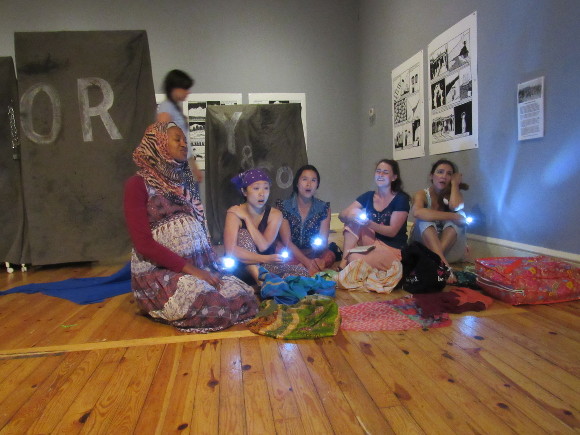
Eight singers drinking

michaelEight drinkers singing.  Or vice versa.  I forget.  Anyway, last night’s extravaganza from Tongue in Cheek Productions and Opera5 at Gallery 345 was a blast.  The schtick was that eight people got to choose a cocktail and a related song set while the audience could purchase their choice(s) of the said beverages.  There was a lot of clowning around and some very good singing all backed up by a very serious looking Trevor Chartrand at the piano. Continue reading
Latvian Radio Choir

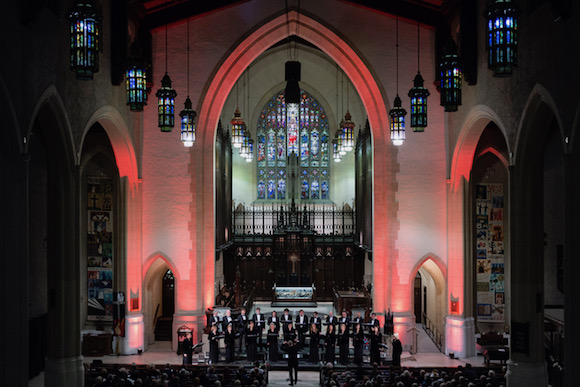
The Latvian Radio Choir tend to show up once a year as part of Soundstreams’ concert series.  Last night was the first time I have managed to go.  It was at Metropolitan United Church and I was up in the balcony.  It’s an awesome view and the sound is great but it’s hot!  I guess that’s where they put the sinners.

Soundstreams_LatvianRadioChoir_ClaireHarvie2018_1

Continue reading

Sweat

Yesterday I finally managed to do something bike related in conjunction with Bicycle Opera Project’s current tour of Sweat.  I got an early train out to Aldershot, biked to Hamilton and joined up with the bike tour of historic Hamilton organised by the Workers Arts and Heritage Centre to complement the opera, before seeing the afternoon performance of Sweat at WAHC.  I’ll add some bikey/historical observations at the end but since this is an opera blog let’s cut to the chase.

IMG_0046

Continue reading

Phantom of Lilith

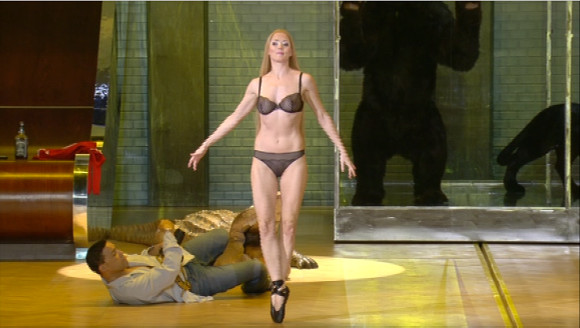
Krzysztof Warlikowski’s production of Berg’s Lulu (it’s the three act version with the Cerha completion) recorded at Brussel’s La Monnaie in 2012 is so stuffed full of symbolism it’s really hard to fully unpack.  There’s a sense that Lulu represents Everywoman, for some rather twisted definition of “woman”.  She’s Lilith.  She’s Pandora.  She’s the Black Swan and the White Swan.  She’s lost or corrupted childhood and she’s love gone wrong.  Maybe she’s even the phantom of Berg’s estranged daughter.  All these symbols recur again and again in various combinations.  In fact, on DVD, it’s pretty much impossible to keep track of them.

1.point Continue reading

Filming Gloriana

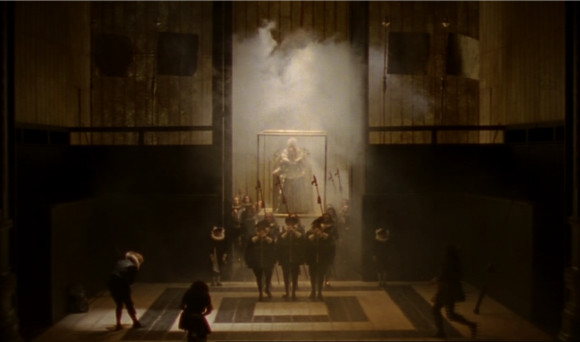
Phyllida Lloyd’s 2000 BBC film of Britten’s Gloriana, based on her production for Opera North, is quite fascinating.  The bonus interviews reveal the utter disdain for films/videos of stage opera productions held by pretty much everyone involved in the project.  It’s an interesting perspective to hear in a world where Cinema and streaming HD broadcasts are increasingly common and where Blu-ray/DVD has clearly overtaken CD as the preferred medium for opera recordings.  In some ways, of course, it’s because the technology has improved enormously.  DVD was still relatively new in 2000 and widescreen, flat screen TVs were yet to come.  In any event, this attitude led to the creation of a rather interesting film.

1.entrance Continue reading

Let trumpets blow

A new recording of Britten’s Gloriana is to be welcomed, even when it’s less than perfect.  It’s an unusual work for Britten.  It’s very grand.  The orchestra is large and the music doesn’t seem to be as transparent and detailed as much of his work.  This is especially true in Act 1 where I almost wondered whether Britten was sending up “grand opera”.  It’s also a grand opera sort of plot.  The libretto is based on Lytton Strachey’s Elizabeth and Essex and deals with the late life romance between the queen and the young Robert Devereux, earl of Essex and deputy in Ireland.  It has some fine moments; notably the lute songs in Act 2 and the choral dances in Act 2.  Act 3 is also dramatically quite effective; dealing with Essex’ abortive rebellion and execution.  Curiously, in the final scene, Britten resorts to a lot of spoken dialogue, as he does briefly with Balstrode’s admonition in Peter Grimes.  It’s almost as if he has no musical vocabulary for the highest emotional states; a sort of anti-Puccini.

1.duel Continue reading

The Rape of Lucretia

Britten’s Rape of Lucretia, which premiered at Glyndebourne in 1946, is an interesting work in a number of ways.  Musically it marks a distinct break from Peter Grimes and anticipates the later operas in a number of significant ways.  It’s written for much lighter forces than Grimes; string quintet, wind quintet plus harp, percussion and piano and there’s no chorus (in the conventional sense).  It’s also not a “numbers” piece.  There are no set pieces here.  The orchestral writing is spare and somewhat dissonant with that absolute clarity that is so characteristic of Britten.  Sometimes this almost distracts from the drama on stage.

1.chorus Continue reading