
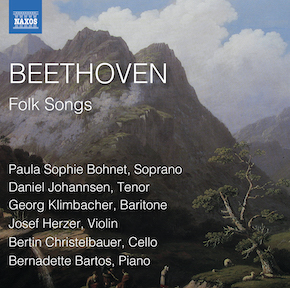
 To quote an opera by a rather different composer; “it is a curious story”. It’s the 1810s and in Edinburgh one George Thomson (not the one who became a European commissioner!) had a cunning plan to get various composers to do settings of Welsh, Scottish and Irish folksongs for the domestic amateur music making market. One of the composers he engaged was Beethoven (Haydn and Weber were also involved at various times) and a selection of the songs he produced are recorded on a recently issued Naxos disk.
Beethoven “folk songs”
2
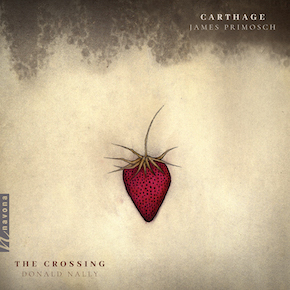 I’m never quite sure that unaccompanied choral music is quite my thing but The Crossing’s new recording of music by James Primosch caught my eye. It was the idea of the title track; Carthage, on prose by Marilynne Robinson from her novel Housekeeping, which employs the devastated city of Carthage as a metaphor for desire and imagination that drew me in. The image of once-fertile fields, salted and wasted, has haunted my imagination for decades and I wanted to see how it might play out in musical terms. I wasn’t disappointed.
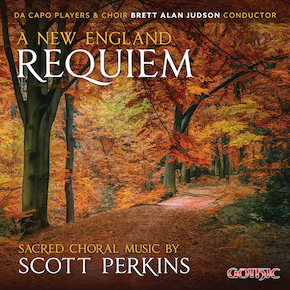 I’ve previously enjoyed both choral music and song from Scott Perkins so I was very interested to get hold of a disk of his sacred choral works which is anchored by his A New England Requiem. In the modern fashion this mixes text from the liturgy with poetry from various sources. It’s quite ethereal music and distinctly churchy; more Tavener than Elgar (though really nothing like either)! The theme is definitely “peace and rest”. There’s no Dies irae or anything like that! The scoring is imaginative and good use is made of the organ’s lower ranges. The singing is very beautiful as is the playing which comes from the sixteen players plus organ and twenty six voices of the Da Capo players & Choir with Tom Mueller on the organ and Brett Allan Judson conducting. A soprano soloist from the choir, Jasmine Gish is used in places. She has an almost vibratoless sound which suits nicely.
 Isabel Bayrakdarian’s latest CD is rather odd. The material is obscure. It’s all taken from 18th century operas about the Armenian king Tigranes and his daughter Cleopatra. The plots are basically the same. Tigranes wants Cleopatra to make a marriage of state but she is in love with Tigranes’ enemy Mithridates. The outcomes are predictable. Apparently, these operas are Bayrakdarian’s academic specialty and she has chosen excerpts from Cleopatra’s part in versions by Hasse, Vivaldi and Gluck.
 Carlisle Floyd’s Prince of Players was originally written for the Opera Studio in Houston as a chamber work. It was subsequently reworked as a full scale piece and taken up by Milwaukee’s Florentine Opera where it was performed and recorded in 2018. It’s a two act piece with a libretto by the composer that deals with the transition from men playing women on stage to the roles being taken by women for the first time in the reign of Charles II. It’s framed by the final scene of Shakespeare’s Othello. First time around Desdemona is played by noted actor Ned Kynaston to rapturous applause and praise from the king. The rest of the first act is the story of how Charles; influenced by his mistress and aspiring actor Nell Gwynn and the much more talented Meg Hughes who, to complicate matters, is Kynaston’s dresser and secretly in love with him, decides that times must change and women must play women on the stage. The act culminates in a confrontation between the king and Kynaston where the latter accuses the former of destroying his art and livelihood and the theatre with it. The king is unrelenting. This act is tight and well crafted with quite a lot of humour as well as some pathos.
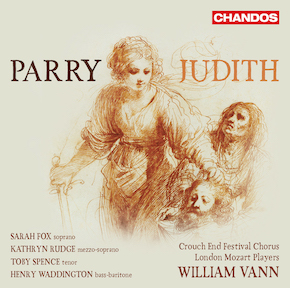 Hubert Parry’s Judith has been making something of a comeback. A new performing edition by Professor Stephanie Martin was performed
 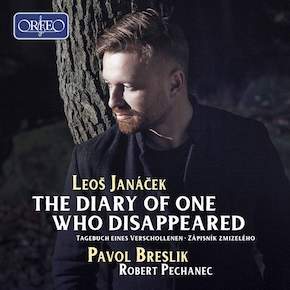 Pavol Breslik headlines on a new recording of Janáček’s Diary of One Who Disappeared; a song cycle about a young man who runs off with a gyosy girl. The piece is given in its original arrangement which, besides tenor and piano, features a mezzo in several of the songs and a brief appearance by a three member female chorus. No doubt this is one reason it’s performed less often than it might be. Breslik is pretty much ideal for this music. Obviosly he’s completely at home in Czech and he sings with clear articulation and has a rather beautiful instrument. He’s well supported by Robert Pechanec on piano plus mezzo Ester Pavlu; who has quite a bright sound for a mezzo but works well enough with Breslik. Dominika Hanko, Zuzanka Marczelová and Mária Kovács make up the chorus.
 I’m intensely interested in the different approaches that composers take to setting text so I was intrigued to read the blurb on a new CD release by American composer Jackson Greenberg. The text is Rilke’s Der Panther and the approach is to take an old (anonymous) recording of an actor reading the poem and provide an orchestral accompaniment for it. It’s quite short; just shy of eight minutes, and the music is an atmospheric variant on largely tonal minimalism. It’s not a big surprise to discover the composer works mainly in film and TV. It’s unusual and worth a listen.
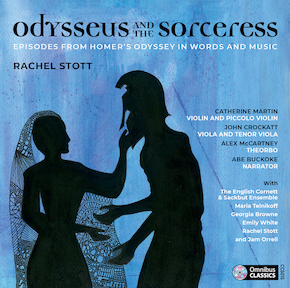 This is a really unusual CD. It combines readings; both in the original Greek and in English translation of some of the best known passages in Homer’s Odyssey with music for period instruments composed by Rachel Stott.
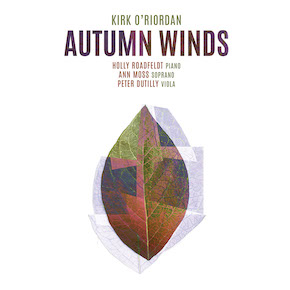 Autumn Winds is a new CD of vocal and chamber music by American composer Kirk O’Riordan. Much of the music is unashamedly beautiful but it doesn’t sound in the least retro. It’s a long way from the neo-Broadway style that drives me nuts.
 operaramblings