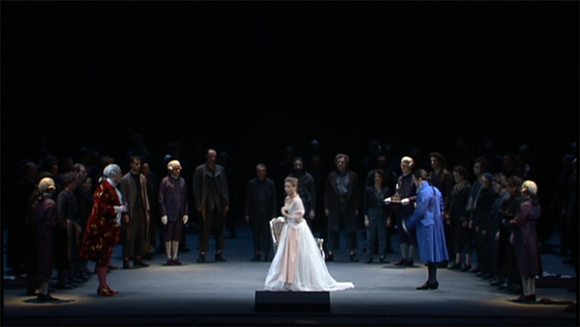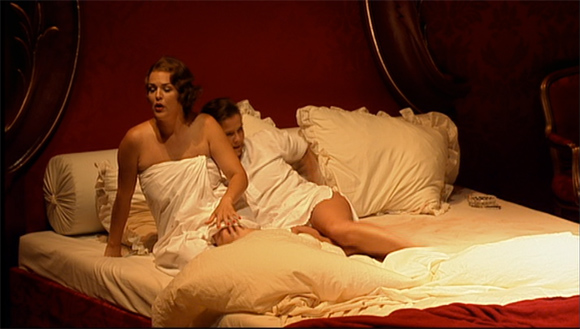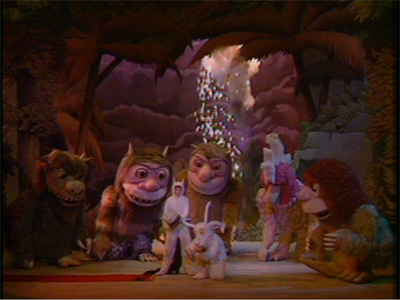
Robert Carsen doesn’t seem disposed to treat Handel too reverentially. Although there is some of the trademark Carsen cool minimalism in his 2011 Glyndebourne production of Rinaldo (not to mention symmetrically arranged furniture) there’s also a degree of humour, as there is in his Zürich Semele. I find it very effective and, judging by the audience reaction, so did the people who saw it at Glyndebourne.
Tag Archives: carsen
Watery Kat’a Kabanová
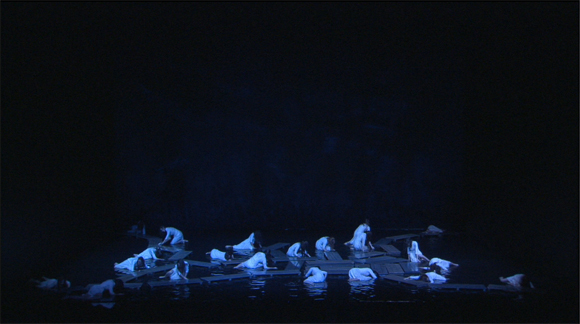
Robert Carsen’s producton of Janáček’s Kat’a Kabanová is typically simple and elegant. Recorded at the teatro Real in Madrid it features a flooded stage with a large number of wooden pieces, like palettes, that are rearranged to form the set. At the beginning of Act 1 the pieces form a pathway through the water simulating the banks of the Volga. Later they are rearranged int a square at centre stage to represent the claustrophobic Kabanov house. All this rearrangement is done by the ladies of the chorus who roll around in the water in white shifts. No breaks are needed between scenes, just the intermezzi the composer provided for the purpose. A mirror at the back of the stage reflecting the water and an elegant and effective lighting plot complete the staging.
What’s green and blue and Carsen all over?
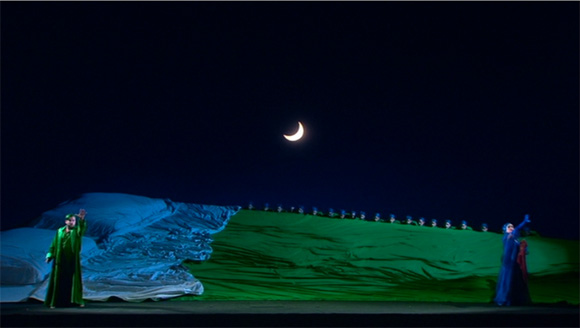
Robert Carsen’s production of Britten’s A Midsummer Night’s Dream is as visually striking as any of his productions. It’s also one that’s done the rounds, playing in Aix and Lyon before being recorded by a strong cast at the Liceu in Barcelona in 2005. The challenge with Dream is to create visual worlds for the Fairies and the Mortals that are different but work together. Carsen and his usual design team do this very well in this case. The Fairies are given striking green and blue costumes with red gloves. The mortals mostly run to white and cream and gold and they seem to spend a lot of time in their underwear. The lighting, as always with Carsen, forms an important part of the overall design. Carsen completists will also notice certain other characteristic touches like starkly arranged furniture.
Searing Carmélites from COC
Poulenc’s Dialogues des Carmélites is a strange and compelling piece. Dramatically it is very “slow burn” with a narrative arc that builds over almost two hours to a final scene of searing intensity. Without that final scene the piece would have no reason but it justifies all and only one “fit for treasons, stratagems, and spoils” could possibly leave the theatre unmoved. It’s not just moving, done well it’s emotionally devastating. And that’s the state I left the Four Seasons Centre in last night after a near perfect performance of Robert Carsen’s extraordinary production.
But is it art?
Wagner’s Tannhäuser is the earliest of the canonical works. In some ways it’s very Wagnerian. It has screwed up theology with a heavy dose of misogyny and some recognisably Wagnerian music. On the other hand it is structured more like a French grand opera and some of the music definitely has more than a hint of Meyerbeer to it.The basic plot is that of the hero seduced into sin by the pagan love goddess Venus and then redeemed by the love (and death) of the chaste virgin Elisabeth.
Carsen’s Hoffmann riffs off Don Giovanni
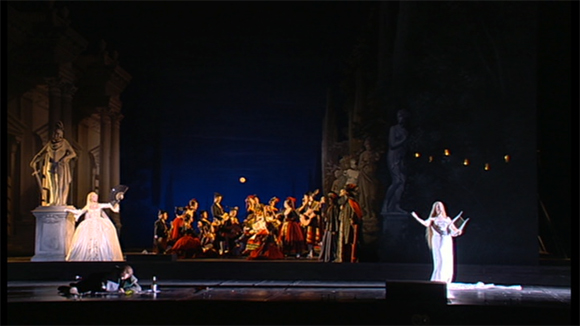
Robert Carsen’s production of Offenbach’s Les Contes d’Hoffmann does a very decent job of presenting this rather muddled and overly long piece. He sets it in and around a production of Don Giovanni in which Hoffmann’s current infatuation, Stella, is singing Donna Anna. There are several quite clever DG references scattered around. By and large it works and is one of the better “theatre in theatre” treatments that I’ve seen.
Wild Thing
So I thought the obvious antidote to Robert Carsen’s Dialogues des Carmélites would be the recording of Ollie Knussen’s Where The Wild Things Are and Higglety, Pigglety, Pop that was sitting in my ‘to watch’ pile. It’s a 1985 Glyndebourne recording and the Associate Director is one Robert Carsen, assisting Frank Corsaro. So it goes. Actually it was rather fun, if a bit irritating in the way that children’s literature written for kids with ADD seems to be. The music is terrific and not at all dumbed down. The sets and designs, as well as the libretto, are by Maurice Sendak himself and there’s some pretty neat lighting by Robert Bryan. The Wild Things are really cool and almost make up for the fact that Max (played here by Karen Beardsley) is an appalling little s$%t who needs a good kick in the backside. HHP is a bit more restrained and simultaneously manages to be less fun but also less annoying. It has a rather splendid lion and Cynthia Buchan does rather well as, to the best of my knowledge, the only Sealyham terrier in opera. Knussen conducts the London Sinfonietta and they sound really good. Continue reading
Revelatory Carmélites from La Scala
I was somewhat underwhelmed by my first encounter with Poulenc’s Dialogues des Carmélites. Watching this recording of a 2004 La Scala production by Robert Carsen really opened my eyes. It’s the conducting that makes it I think, Riccardo Muti seems to find much more in the score than Jan Latham-Koenig. There are passages of great meditative beauty interspersed with quite shocking violence, all within an essentially tonal framework. It’s very striking. He’s helped by the sound on the DVD which is exceptionally vivid and three dimensional, even using the LPCM stereo option, though the Dolby 5.1 track is even better.
Rosenkavalier on the brink
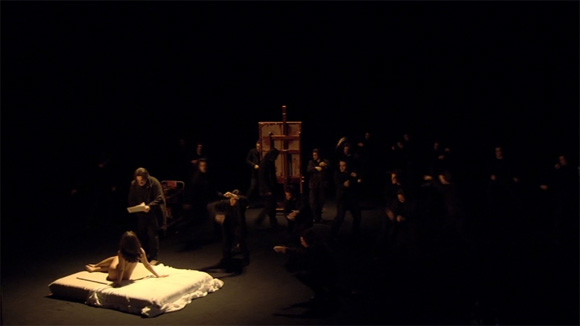
Robert Carsen’s 2004 production of Der Rosenkavalier at the Salzburg Festival was apparently enormously controversial at the time. In many ways that says more about the iconic status of the piece in Salzburg tradition than about Carsen’s production. There are a few controversial elements. He has updated the period to 1914 and the third act is set in a brothel with a fair amount of nudity. Beyond that, the production is pretty faithful to the libretto and has, I think characteristic Carsen touches like long lines of tables and chairs and a certain geometric elegance. He seems to be using the sides of the stage to comment on the action which tends to be fixed centre stage. I say seems because the video direction (by Brian Large) is utterly perverse and makes it extraordinarily difficult to see what Carsen is doing, let alone decode it. We see the whole stage, maybe, for three seconds in the whole piece. Otherwise 99% of what we get is either close up and even closer up or apparently shot from the restricted view seats high up and close to the side of the stage. The other 1% is just plain nuts and includes a section of the Sophie/Octavian duet in Act 2 where, on stage, Octavian is maybe twenty feet to Sophie’s right but on camera he’s standing right up close on her left hand side. I could go on but I won’t. Suffice it to say the video direction comes close to wrecking an otherwise excellent DVD.
Not a DVD review
There are an awful lot of opera DVDs about. It sometimes seems like there’s a new Tosca or Traviata out every week, often for no apparent reason. It’s perhaps surprising then that some works don’t make it to DVD. One particularly egregious case would seem to be John Adams’ Nixon in China. It’s a good piece and has had plenty of productions both in North America and elsewhere. A couple of years ago I saw it twice in 24 hours; on a Friday evening at COC followed by the HD broadcast from the Met the following afternoon and I’ve been listening to an audio recording of the COC version on my walk to and from work. But there’s no DVD! I guess that the Met probably planned to release the HD recording but James Maddalena, the Nixon in the recording, was so obviously ill I was actually surprised that he continued after the interval and I guess that scuppered that. Continue reading