Orlando in Craiglockhart

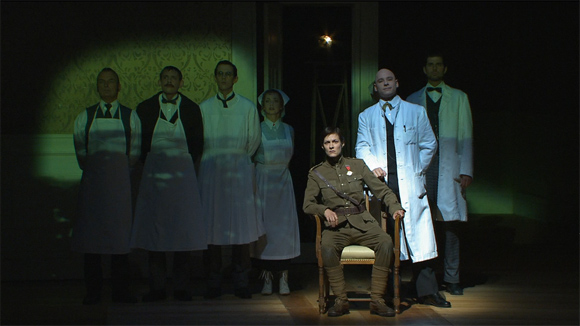
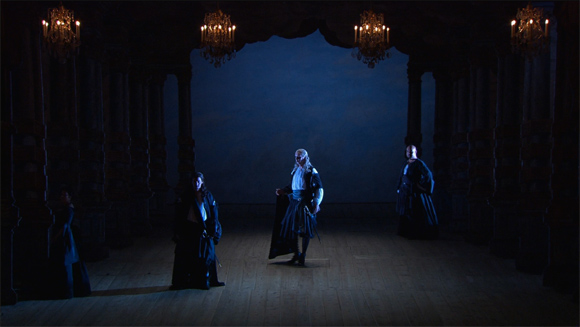
Handel’s Orlando is pretty classic opera seria stuff.  It’s based on an episode in Ariosto’s Orlando Furioso.  Orlando, a great soldier in Charlemagne’s army has lost his ardour for military glory because he has fallen desperately in love with the pagan princess Angelica, who is in turn in love with another man, Medoro. Orlando cannot accept this and he is driven to madness, prevented from causing absolute carnage only by the magician Zoroastro (who eventually restores his sanity).  There’s also a shepherdess, Dorinda, who is also in love with Medoro, but comes to accept her lot.  It’s all a bit daft and screams for a strong production concept.  In his 2008 Zürich production Jens-Daniel Herzog finds one.  He relocates the action to a military psychiatric hospital during, or just after, WW1.  Orlando is suffering from battle fatigue or PTSD and Zoroastro is a psychiatrist.  Angelica is still a princess but Dorinda has become a nurse.  It all works rather well.

Continue reading

Rigoletto in Zürich

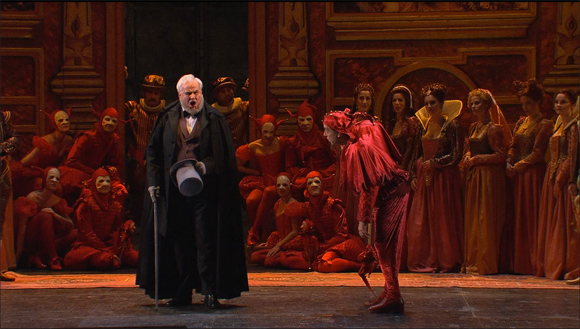
This is another of those Arthaus Blu-ray disks that’s sold at a silly cheap price as a carrier for two hours of trailers from the Arthaus catalogue.  That said, it’s very high quality indeed.  GIlbert Deflo’s production is, in the end, quite conventional though with careful and effective Personenregie.  He does trick us a bit at the start.  The scene opens with what is, apparently, a rather louche 16th century court entertainment/orgy.  There are bare breasted women and dancers of both sexes dressed as Satanic imps.  Everyone is in period costume including Rigoletto with jester hat, bells etc.  The scene is, perhaps, what we expect.  The “ladies” are very receptive to the duke’s advances.  The men are resentful but not actively so.  Then in comes Monterone in mid 19th century dress to denounce the proceedings and we, perhaps slowly, realise that this is a costume party.  From there on there’s nothing very tricksy.  The story gets told effectively and straightforwardly.  We have been pulled, effortlessly, from the time of the libretto to the time of first performance and the parallels are drawn.

Continue reading

The dream is over but the night not yet

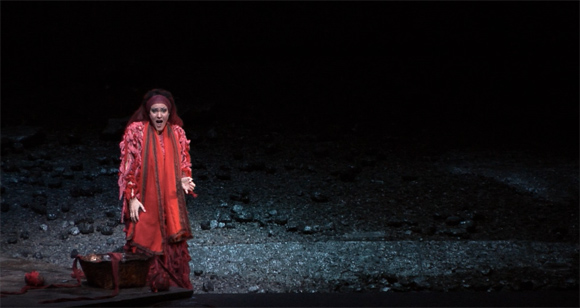
So closes Aribert Reimann’s 2010 opera Medea.  It’s a two hour piece in four “pictures” that premiered at the Wiener Staatsoper in 2010 and the Blu-ray/DVD recording is taken from that initial run.  Actually there’s a good deal more nightmare than dream in this version as, I suppose, there is in just about any version of the Medea story.  This one draws on Franz Grillparzer’s version for the libretto and is entirely concerned with events after Jason and Medea reach Corinth.  It’s unusually sympathetic to Medea herself with Jason and Kreon very much the villains.

Continue reading

A journey through space and time?

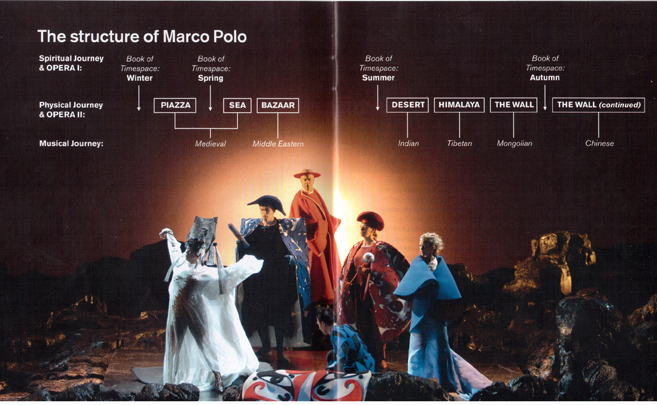
Tan Dun’s Marco Polo is hugely ambitious. He uses Marco Polo’s legendary journey as a metaphor for Space and Time.  He fuses a range of Western musical styles with Chinese, Tibetan and Indian instruments and vocal styles.  Although most of the work is sung in English there are sections in Italian and Chinese and other bits in a sort of random polyglot.  The cast includes a range of real, allegorical and psychological figures.  Marco and Polo are in fact two characters; one representing action and the external and the other the psychological and internal.  Kublai Khan, Dante, Shakespeare, Sheherazada and Mahler put in appearances and much of the narrative is carried by a Chinese opera singer playing the part of Rustichello; “the questioner”.  To be honest, despite having read the booklet, watched Reiner Moritz’s “Making of” documentary and studied the chart below, most of the time I had no idea what was actually happening.  It’s really all too abstract and involved to really work as music drama.

Continue reading

Traditional Traviata

The 2007 recording of Verdi’s La Traviata from Milan’s Teattro alla Scala is extremely traditional but very satisfying.  Liliana Cavani’s production is set in the mid 19th century with entirely conventional sets and costumes (with the obligatory cleavage) and nothing in the direction that adds up to an original concept or idea.  Act 1 is set in a glitzy ballroom.  Act 2 scene 1 takes us to a slightly odd sort of country house bedsit with billiard table  In Act 2 scene 2 we are back with the glitz with actual gypsies and bare chested matadors. Act 3 is set in a suitably dark invalid’s bedroom.  Angela Gheorghiu’s Violetta goes from ballgown to nightdress to ballgown to nightdress while maintaining Ange levels of, you guessed it, cleavage.  The guys are all in evening dress or operetta dress uniforms.  It’s all pretty and doesn’t distract from the music.
Continue reading

Beyond Good and Evil

Rameau’s Zoroastre is a tragédie lyrique in five acts.  It’s basically a story of love, power and revenge coupled with a metaphysical struggle between Good and Evil.  It has a seriously convoluted plot involving demons, incantations, good and evil spirits, a magical talisman book and human sacrifice.  Watching the illustrated synopsis on the disk is strongly recommended!  Being the baroque French beast that it is this work also has lots of ballets.  Pierre Audi’s production was staged and filmed at the court theatre at Drottningholm and is a sort of almost, but not quite, HIP concept, somewhat akin to Robert Carsen’s production of Les Boréades.

Continue reading

Picture quality – DVD vs. Blu-ray

As regular readers know posts on this blog frequently feature screen caps from the DVD or Blu-ray disk reviewed.  In the process of garnering the screen shots I have found out one or two interesting things about the picture quality of the originating disk.  Using vlc to play disks gives a window the size of the image in pixels.  (I use vlc because for some reason screen caps from DVDPlayer come out blank.)  Older opera DVDs have a picture that is nominally 720 pixels wide giving a 720×540 window for 4:3 pictures.  In practice there are often black bars at the side of screen reducing this a little and sometimes older TV derived material isn’t even really up to even that quality so this really represents an upper bound on the amount of information available.  More recent 16:9 DVDs tend to be a bit more information rich; 830×468 pixels seems quite common and some HD derived material checks in at around 850×480.  It does mean though that very few operas will fit on a single DVD9 disk.  Continue reading

Bartoli’s Semele

Robert Carsen’s clean, refined production of Handel’s Semele originated in Aix, was recorded in Zürich and eventually made it’s way to Vienna and Chicago.  In many ways it is classic Carsen.  It’s elegant and uncluttered, is strong on the detailed Personenregie, has a consistent design concept but isn’t really pushing a concept driven agenda.  It’s also quite funny without descending to priapic donkeys.  Also there are lots of chairs.

Continue reading

The Scrapheap of Capitalism

The 2010 La Fura dels Baus Madrid production of Weill’s The Rise and Fall of the City of Mahagonny is much the best version of the piece I’ve seen on DVD.  The production starts and ends on a rubbish dump and the dump and its people, curiously reminiscent of the vegetarian terrorists in Delicatessen, are present pretty much all the time.  It doesn’t pull any punches and tackles Brecht’s characteristically unsubtle parody of commodity capitalism straight on and without sentimentality or apology.  Perhaps the most effective scene is the sort of “orgy by Frederick Taylor” that accompanies Second comes the loving match in Act 2 but there are lots of telling moments from the widow Begbick first appearing from a derelict fridge to the pyre of mattresses on which Jim is executed.  Curiously perhaps the piece is given in Michael Feingold’s English translation but it’s a very good translation and little or nothing is lost.

Continue reading