Grimes on Blu-ray

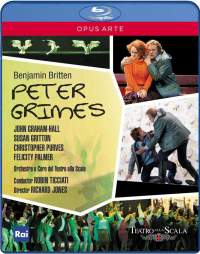
There is, finally, a recording of Britten’s Peter Grimes on Blu-ray.  It’s a Richard Jones production with a largely British cast, recorded at La Scala in 2012.  The sound and picture quality are first rate.  Unfortunately the production and performances aren’t so much.
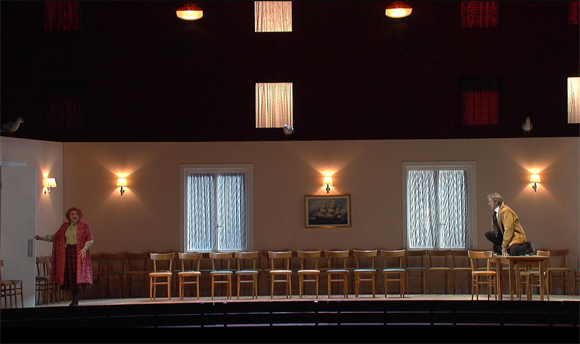
1.moothallRichard Jones has chosen to set the piece in the 1980s and to portray the inhabitants of the Borough as a sort of inbred hive mind fuelled by prejudice, alcohol and drugs.  Actually it’s not a bad concept but it comes off as exaggerated with cast and chorus repeatedly making more or less coordinated middle aged disco moves.  He also portrays the nieces as the sort of permanently stoned bubble heads one wants to avoid on the last train home. There are some neat touches.  The Moot Hall, The Boar and Grimes’ hut are all formed by box like spaces that are tilted and rotated to good effect.  The lighting is effective too.  Unusually for a modern production Jones doesn’t provide any staging for the interludes, leaving the theatre dark with the curtain down.  Overall, it’s a production I’d want to take a second look at but I suspect it’s just painted too broadly to be really effective.
Continue reading

All the Grimes that’s fit to print

opusarteoabd7119dIt will come as no secret to regular readers that I am something of a Peter Grimes completist.  Until recently this blog was probably the only place one could find detailed reviews of all the available video recordings of that great work.  Now the recent La Scala production has been released on Blu-ray and I am no longer complete.  Fear not though, the disk is in the mail as they say and the divine order will shortly be restored.

In other Grimes news, the Aldeburgh Festival is staging the work on the beach.  The estimable Chris Gillett, Horace Adams both there and at La Scala, is blogging about it in his usual inimitable style.  In some ways I really wish I could go but I know that coast.  Even on a good day the wind will freeze one’s soft bits off. Definitely a challenging place to perform or even watch opera.  It’s also just off the A12 and I still have the after effects of 24 stitches on my face from a rather unfortunate encounter on that highway in my youth.  I shall patiently await Ben Heppner, Alan Held, Ileana Montalbetti et al at the Four Seasons Centre in the fall.

In which Dido doesn’t die

Oddly enough, given the post previous to this, Reiner Moritz’s essay in the booklet accompanying this recording of Cavalli’s La Didone brings up the Harnoncourt/Ponelle Monteverdi recordings as a precursor to what he sees as Bill Christie’s similar championing of Cavalli.  I guess the big difference is that only three of Monteverdi’s operas survive while we have 27 of Cavalli’s.  I think he may have a point though.  It seems to me that 17th century Italian opera works on an aesthetic which is very in tune with today.  The relative spareness and clarity of the music seems closer to Britten than to Verdi and the cynicism and explicit sexuality of the libretti closer to Anna Nicole than La Bohème.

1.cassandra Continue reading

More Iphigénie

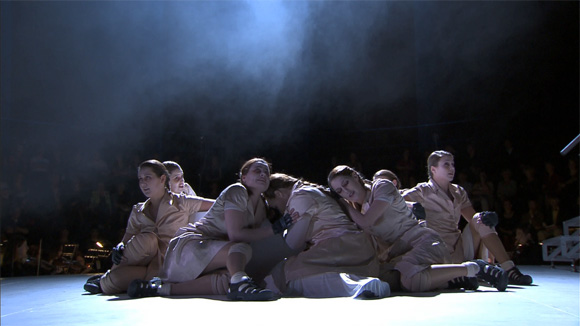
The second half of the Amsterdam double bill that opened with Iphigénie en Aulide is, of course, Iphigénie en Tauride.  In this piece the more usual version of the Aulis story, where Diana substitutes a stag for Iphigenia on the altar and whisks the girl off to be her priestess among the savage Scythians of Tauris, is assumed.  So the piece opens with Iphigenia and six other Mycenean priestesses (how they got to Tauris is a mystery) in Diana’s temple at Tauris where their job is to sacrifice any strangers who show up.  Almost at once the capture of two Greeks is announced.  They turn out to Iphigenia’s brother Orestes and his sidekick Pylades and the the next 90 minutes turns on Iphigenia failing to sacrifice either of them.

1.priestesses Continue reading

Iphigénie at last

Gluck’s Iphigénie en Aulide is finally available on Blu-ray and DVD.  It was staged and recorded as a double bill with Iphigénie en Tauride at De Nederlandse Opera in September 2011 in productions by Pierre Audi.  It’s excellent in just about every respect.  The cast is to die for, the production is interesting and so is the staging in the rather challenging space of The Amsterdam Music Theatre, which also poses problems for the video director.  Backed up, on Blu-ray, by a 1080i picture and DTS-HD-MA sound it’s a pretty compelling package.

1.camo Continue reading

Love is stronger than death

The 1996 Glyndebourne Theodora, featuring Dawn Upshaw as Theodora and David Daniels as DidymusPeter Sellar’s production of Handel’s Theodora has long been one of my favourite video recordings of opera.  It’s brilliant in so many ways and I don’t think I’ve ever made it through the whole thing without tearing up. It’s now been remastered from the original tape and reissued on Blu-ray.  The video and sound quality are distinctly better than previous DVD releases though not, inevitably, in the same class as the best modern recordings.  It’s also still a depressingly bare bones release with no extras and minimal documentation but don’t let that put you off.

My original review is here.  I thought about rewriting it but for the most part I stand by my original comments.  The only judgement I’d change is that, on greater experience, I do think this is one of Handel’s best works.

200 disks

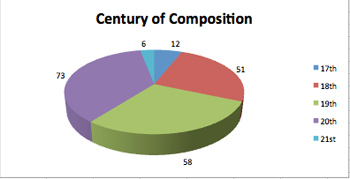
I’ve now reviewed 200 opera performances on DVD and Blu-Ray.  They range alphabetically from Adams to Zemlinsky and chronologically from Monteverdi to Reimann.  The oldest performance is a 1931 film of Die Dreigroschenoper and the latest a 2012 recording of Arabella.  Just for fun I did some quick stats on four parameters; century of composition, decade of performance, language of performance and place of performance.

centuryThe century of composition stats show, perhaps unsurprisingly, that my tastes don’t lie in opera’s temporal sweet spot, the 19th century.  My most popular century is the 20th with lots of Britten and Richard Strauss contributing a good chunk of the 73 disks.  The 19th does come in second at 58 but it’s only just ahead of the 18th at 51 with strong contributions from Mozart (of course), Handel and Rameau.  Continue reading

Sister swap

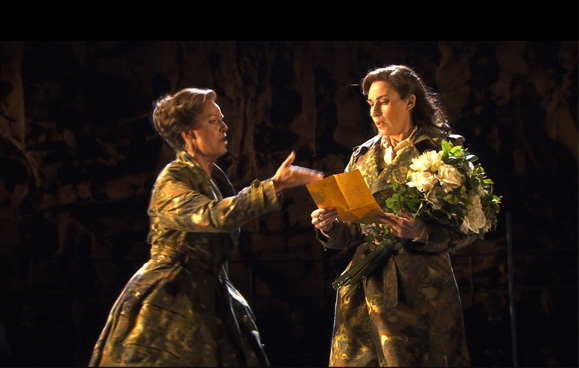
Richard Strauss’ Arabella is a bit of a peculiarity.  The music is top notch Strauss and the libretto is by von Hofmannsthal so it ought to be quite superb.  It doesn’t quite get there though.  It’s hard not to think that if von Hofmannsthal had lived a little longer he would have tightened up the libretto.  Act 1 works fine but Acts 2 and 3 seem rather contrived and could definitely use a few cuts.  I’m not sure that the whole Fiakermilli thing works either.  It’s almost as if Prince Orlofsky’s party mislaid Johann and found Richard by accident.  That said there is some very beautiful music.  Aber der Richtige, wenn’s einem gibt is going straight onto my list of top soprano duets.

1.zdenka_matteo Continue reading

Into the woods

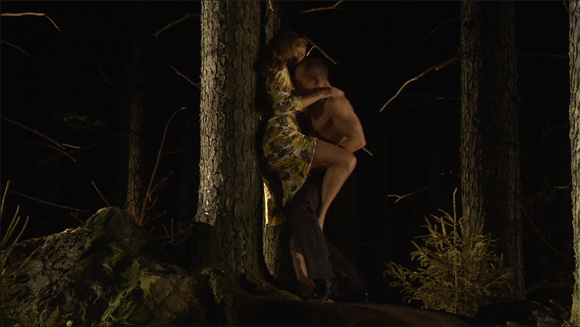
Claus Guth’s 2008 Salzburg production of Don Giovanni divided the critics along entirely predictable lines.  It’s a very unusual treatment of Don Giovanni but the concept is stuck to with real consistency and it works to create a compelling piece of music theatre.  The treatment on video too is not straightforward and, in a sense, the DVD/Blu-ray version is as much the work of Brian Large as it is of Claus Guth.

1.rape? Continue reading

There were rats

I guess Lohengrin is one of those operas that’s so loaded up with symbols it just begs directors to deconstruct it.  Well that’s what Hans Neuenfels’ Bayreuth production, recorded in 2011, does and then some.  There is so much going on in this production that I think it would take many viewings to really get inside it.  The bit most critics have fastened on is the costuming of the chorus as rats or, on occasion, half rat, half human.  It’s visually interesting and since there are also ‘handlers’ in Hazmat suits it’s clear that some sort of experiment is being alluded to.  Add in bonus rat videos at key points and there’s a lot to think about.  One thing this does do is solve the Teutonic war song problem.  A chorus of rather timid looking rats singing with martial ardour is a good deal less Nurembergesque than a similar chorus in armour or military uniforms.  Rats aside the story is really told in a quite straightforward and linear way while providing all sorts of moments that one might want to interrogate further,

1king Continue reading