Sex and violets

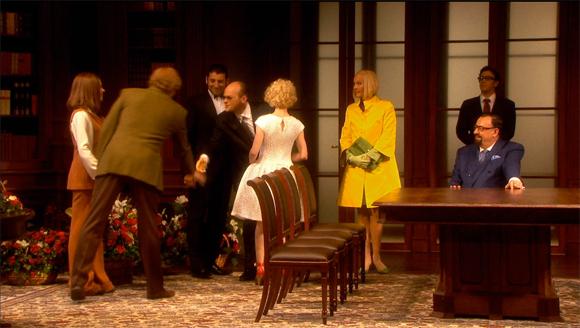
Cilea’s Adriana Lecouvreur isn’t performed very often and, when it is, it’s usually because some great diva of the day wants to do it.  That’s the case with the 2010 Covent Garden production which was created by David McVicar for Angela Gheorghiu.  Actually I am a bit surprised it’s not done more often.  It’s not a great masterpiece but it’s no worse than a great many commonly done pieces and, if the plot is a bit implausible, it’s not as offensive as half of Puccini’s output.  I would have thought it would have great appeal to that opera middle ground to which I don’t belong.

1.actresses Continue reading

A feast of a Belshazzar

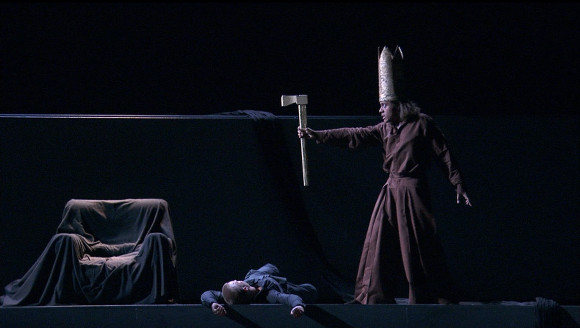
Handel’s Belshazzar, written as an oratorio, was staged at the Aix-en-Provence festival in 2008.  It works really well as a stage work.  The plot is straightforward but dramatic.  Impious Babylonian king Belshazzar is being besieged by the virtuous Cyrus of Persia.  Babylon is impregnable but a combination of Babylonian impiety and divine intervention on behalf of Cyrus(*) leads to Cyrus’ capture of the city, the death of Belshazzar and, almost incidentally, the liberation of the Jews.

1.belshazzar Continue reading

Can Bayreuth really tackle Meistersinger?

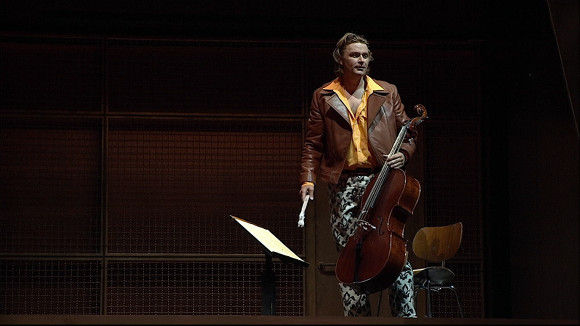
Die Meistersinger is a problematic opera, particularly for Bayreuth.  It has rather disturbing elements of German nationalism and a performance tradition at the festival of those being used for ends that most people would rather be able to forget.  No surprise then that Katharina Wagner’s production, recorded in 2008, tries to deal with both.  It’s a bold effort.  Like Robert Carsen’s Tannhäuser it tries to use visual art as a metaphor for music and art in general.

1.walther Continue reading

Starry Tosca

Puccini’s Tosca doesn’t seem to lend itself to Regie type treatments.  Even quite adventurous directors seem to mostly stick to the very specific time and place of the libretto (even though, as Paul Curran pointed out to me, the plot makes no sense in the Rome of 1800).  In the 2012 Royal Opera House recording Jonathan Kent certainly takes very few liberties with the piece; the church is a church, the palace a palace and the castle a castle. There are a few deft design touches.  Both Cavaradossi and Tosca wear very bright colours indicative of the new dyes that became available at the period (actually I think this is a slight anachronism – must check with the fashion lemur) whereas Scarpia is more conservatively attired.  Generally though it’s pretty straightforward.

1.painting Continue reading

Straightforward but effective Il Trovatore

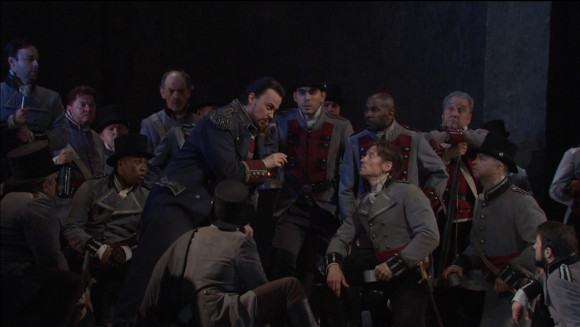
Verdi’s Il Trovatore really is a peculiar piece.  It’s a bit of a musical hybrid with huge, rousing choruses interspersed with bel canto arias which I suppose is fairly typical of middle period Verdi.  It has a truly silly plot (perhaps based on Blackadder’s lost novel) with gypsies, dead babies and  improbable coincidences galore.  It’s also notoriously hard to cast with five very demanding roles combining a need for flawless bel canto technique with lots of power.  David McVicar’s production at the Metropolitan Opera was broadcast in HD in April 2011 and subsequently released on Blu-ray and DVD.  I saw the HD broadcast and enjoyed it enough to buy the Blu-ray.

1.legend Continue reading

Watery Kat’a Kabanová

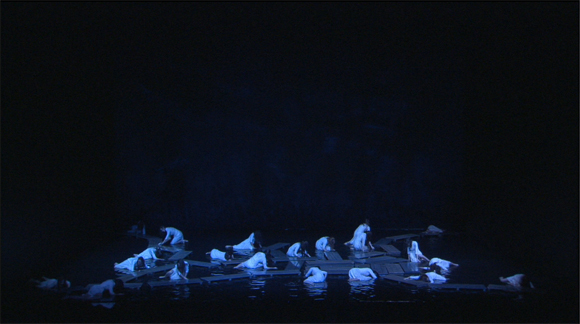
Robert Carsen’s producton of Janáček’s Kat’a Kabanová is typically simple and elegant.  Recorded at the teatro Real in Madrid it features a flooded stage with a large number of wooden pieces, like palettes, that are rearranged to form the set.  At the beginning of Act 1 the pieces form a pathway through the water simulating the banks of the Volga.  Later they are rearranged int a square at centre stage to represent the claustrophobic Kabanov house.  All this rearrangement is done by the ladies of the chorus who roll around in the water in white shifts.  No breaks are needed between scenes, just the intermezzi the composer provided for the purpose.  A mirror at the back of the stage reflecting the water and an elegant and effective lighting plot complete the staging.

1.water Continue reading

Happy families

Dmitri Tcherniakov’s Don Giovanni recorded at the 2010 Aix-en-Provence festival is full on Regie.  He takes the characters and story of Mozart/DaPonte and recasts them quite radically.  Zerlina is Donna Anna’s daughter.  Donna Elvira, Donna Anna’s cousin, is married to Don Giovanni.  Leporello is a family member too.  The sense is of one extended, conventional, bourgeois family in which Don Giovanni is a fatally disruptive intrusion.  Tcherniakov changes the time line too.  Instead of taking place over a 24 hour period the story plays out over many weeks.

1.family Continue reading

Putting the cars in Carmen

Calixto Bieito has a reputation as one of opera’s “bad boys” but there is nothing particularly shocking about his production of Carmen filmed at Barcelona’s Liceu in 2011.  The action is updated to maybe the 1970s (there’s a phone box and a camera that uses film) and there are lots of cars on stage.  For Bieito, this is a story of people living on the margins where sex is a commodity that women use as a trade currency and where violence, especially toward women, is endemic. It’s enough to disturb, as this piece did its original audience, without being gratuitous.

1.micaela Continue reading

Et in Bohemia ego

It’s a curious fact that two of the three most popular operas; Verdi’s La Traviata and Puccini’s La Bohème, are about women dying from tuberculosis.  It’s also curious that they are almost always presented as frothy escapist fantasies in which Death makes his appearance only in the tear jerking finale.  It’s very curious because Death stalks the libretto of both operas, albeit usually well hidden behind brocade, champagne and Christmas decorations.  In 2005, at Salzburg, Willy Decker broke with convention and made Death an explicit actor in La Traviata creating the famous red dress production that has even been seen at that bastion of conservatism the Metropolitan Opera.  In 2012 Stefan Herheim did something similar for La Bohème in Oslo.

1.bed Continue reading

Subtitles

Pretty much all opera video recordings have sub-titles.  Some, usually older, recordings just have hard coded English subs but most have selectable subs in half a dozen or so languages.  They almost always include English French and German but the others seem to be pretty much a crap shoot.  Does anyone, maybe who works in the business, know how they are chosen?  Italian and Spanish are quite common.  Usually the native language of the house in which the recording is made features and so I have recordings with Danish, Dutch, Catalan and Flemish subs though my Helsinki L’Amour de Loin lacks Finnish and there’s no Norwegian on my Oslo La Bohème.  Even more oddly there’s no Italian on the La Scala Peter Grimes even though the text within the DVD is all in Italian.  Asian languages are totally random though Chinese, Korean and Japanese all show up from time to time.  Enquiring minds want to know.

subs