Starry Tosca

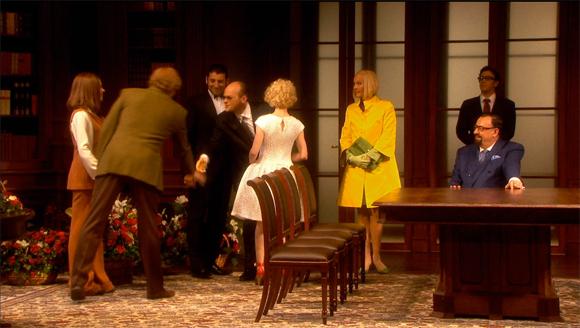
Puccini’s Tosca doesn’t seem to lend itself to Regie type treatments.  Even quite adventurous directors seem to mostly stick to the very specific time and place of the libretto (even though, as Paul Curran pointed out to me, the plot makes no sense in the Rome of 1800).  In the 2012 Royal Opera House recording Jonathan Kent certainly takes very few liberties with the piece; the church is a church, the palace a palace and the castle a castle. There are a few deft design touches.  Both Cavaradossi and Tosca wear very bright colours indicative of the new dyes that became available at the period (actually I think this is a slight anachronism – must check with the fashion lemur) whereas Scarpia is more conservatively attired.  Generally though it’s pretty straightforward.

1.painting Continue reading

Straightforward but effective Il Trovatore

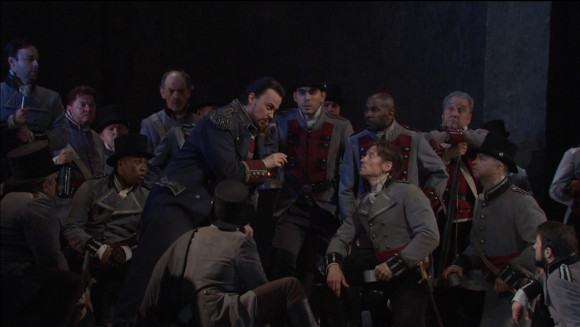
Verdi’s Il Trovatore really is a peculiar piece.  It’s a bit of a musical hybrid with huge, rousing choruses interspersed with bel canto arias which I suppose is fairly typical of middle period Verdi.  It has a truly silly plot (perhaps based on Blackadder’s lost novel) with gypsies, dead babies and  improbable coincidences galore.  It’s also notoriously hard to cast with five very demanding roles combining a need for flawless bel canto technique with lots of power.  David McVicar’s production at the Metropolitan Opera was broadcast in HD in April 2011 and subsequently released on Blu-ray and DVD.  I saw the HD broadcast and enjoyed it enough to buy the Blu-ray.

1.legend Continue reading

Watery Kat’a Kabanová

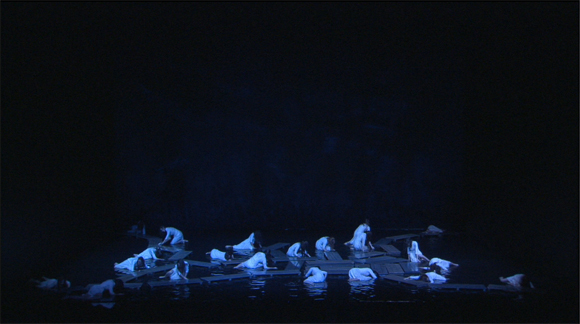
Robert Carsen’s producton of Janáček’s Kat’a Kabanová is typically simple and elegant.  Recorded at the teatro Real in Madrid it features a flooded stage with a large number of wooden pieces, like palettes, that are rearranged to form the set.  At the beginning of Act 1 the pieces form a pathway through the water simulating the banks of the Volga.  Later they are rearranged int a square at centre stage to represent the claustrophobic Kabanov house.  All this rearrangement is done by the ladies of the chorus who roll around in the water in white shifts.  No breaks are needed between scenes, just the intermezzi the composer provided for the purpose.  A mirror at the back of the stage reflecting the water and an elegant and effective lighting plot complete the staging.

1.water Continue reading

Happy families

Dmitri Tcherniakov’s Don Giovanni recorded at the 2010 Aix-en-Provence festival is full on Regie.  He takes the characters and story of Mozart/DaPonte and recasts them quite radically.  Zerlina is Donna Anna’s daughter.  Donna Elvira, Donna Anna’s cousin, is married to Don Giovanni.  Leporello is a family member too.  The sense is of one extended, conventional, bourgeois family in which Don Giovanni is a fatally disruptive intrusion.  Tcherniakov changes the time line too.  Instead of taking place over a 24 hour period the story plays out over many weeks.

1.family Continue reading

Putting the cars in Carmen

Calixto Bieito has a reputation as one of opera’s “bad boys” but there is nothing particularly shocking about his production of Carmen filmed at Barcelona’s Liceu in 2011.  The action is updated to maybe the 1970s (there’s a phone box and a camera that uses film) and there are lots of cars on stage.  For Bieito, this is a story of people living on the margins where sex is a commodity that women use as a trade currency and where violence, especially toward women, is endemic. It’s enough to disturb, as this piece did its original audience, without being gratuitous.

1.micaela Continue reading

Et in Bohemia ego

It’s a curious fact that two of the three most popular operas; Verdi’s La Traviata and Puccini’s La Bohème, are about women dying from tuberculosis.  It’s also curious that they are almost always presented as frothy escapist fantasies in which Death makes his appearance only in the tear jerking finale.  It’s very curious because Death stalks the libretto of both operas, albeit usually well hidden behind brocade, champagne and Christmas decorations.  In 2005, at Salzburg, Willy Decker broke with convention and made Death an explicit actor in La Traviata creating the famous red dress production that has even been seen at that bastion of conservatism the Metropolitan Opera.  In 2012 Stefan Herheim did something similar for La Bohème in Oslo.

1.bed Continue reading

Subtitles

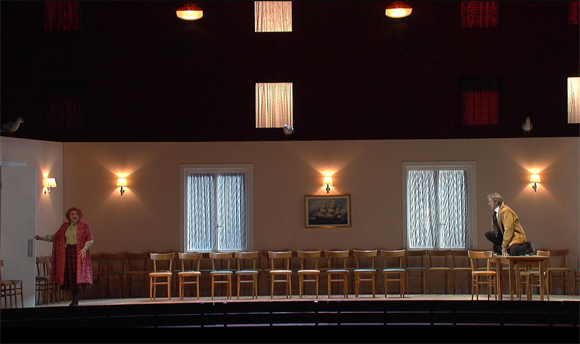
Pretty much all opera video recordings have sub-titles.  Some, usually older, recordings just have hard coded English subs but most have selectable subs in half a dozen or so languages.  They almost always include English French and German but the others seem to be pretty much a crap shoot.  Does anyone, maybe who works in the business, know how they are chosen?  Italian and Spanish are quite common.  Usually the native language of the house in which the recording is made features and so I have recordings with Danish, Dutch, Catalan and Flemish subs though my Helsinki L’Amour de Loin lacks Finnish and there’s no Norwegian on my Oslo La Bohème.  Even more oddly there’s no Italian on the La Scala Peter Grimes even though the text within the DVD is all in Italian.  Asian languages are totally random though Chinese, Korean and Japanese all show up from time to time.  Enquiring minds want to know.

subs

Grimes on Blu-ray

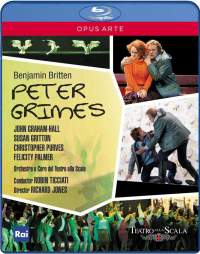
There is, finally, a recording of Britten’s Peter Grimes on Blu-ray.  It’s a Richard Jones production with a largely British cast, recorded at La Scala in 2012.  The sound and picture quality are first rate.  Unfortunately the production and performances aren’t so much.

1.moothallRichard Jones has chosen to set the piece in the 1980s and to portray the inhabitants of the Borough as a sort of inbred hive mind fuelled by prejudice, alcohol and drugs.  Actually it’s not a bad concept but it comes off as exaggerated with cast and chorus repeatedly making more or less coordinated middle aged disco moves.  He also portrays the nieces as the sort of permanently stoned bubble heads one wants to avoid on the last train home. There are some neat touches.  The Moot Hall, The Boar and Grimes’ hut are all formed by box like spaces that are tilted and rotated to good effect.  The lighting is effective too.  Unusually for a modern production Jones doesn’t provide any staging for the interludes, leaving the theatre dark with the curtain down.  Overall, it’s a production I’d want to take a second look at but I suspect it’s just painted too broadly to be really effective.

Continue reading

All the Grimes that’s fit to print

opusarteoabd7119dIt will come as no secret to regular readers that I am something of a Peter Grimes completist.  Until recently this blog was probably the only place one could find detailed reviews of all the available video recordings of that great work.  Now the recent La Scala production has been released on Blu-ray and I am no longer complete.  Fear not though, the disk is in the mail as they say and the divine order will shortly be restored.

In other Grimes news, the Aldeburgh Festival is staging the work on the beach.  The estimable Chris Gillett, Horace Adams both there and at La Scala, is blogging about it in his usual inimitable style.  In some ways I really wish I could go but I know that coast.  Even on a good day the wind will freeze one’s soft bits off. Definitely a challenging place to perform or even watch opera.  It’s also just off the A12 and I still have the after effects of 24 stitches on my face from a rather unfortunate encounter on that highway in my youth.  I shall patiently await Ben Heppner, Alan Held, Ileana Montalbetti et al at the Four Seasons Centre in the fall.

In which Dido doesn’t die

Oddly enough, given the post previous to this, Reiner Moritz’s essay in the booklet accompanying this recording of Cavalli’s La Didone brings up the Harnoncourt/Ponelle Monteverdi recordings as a precursor to what he sees as Bill Christie’s similar championing of Cavalli.  I guess the big difference is that only three of Monteverdi’s operas survive while we have 27 of Cavalli’s.  I think he may have a point though.  It seems to me that 17th century Italian opera works on an aesthetic which is very in tune with today.  The relative spareness and clarity of the music seems closer to Britten than to Verdi and the cynicism and explicit sexuality of the libretti closer to Anna Nicole than La Bohème.

1.cassandra Continue reading