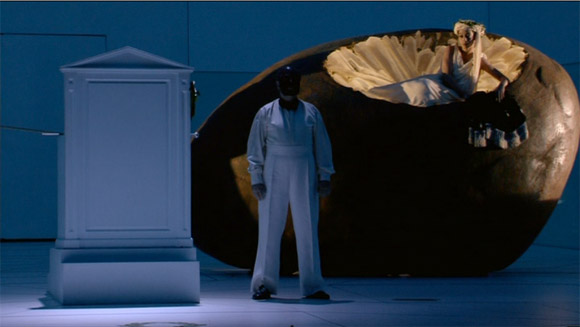
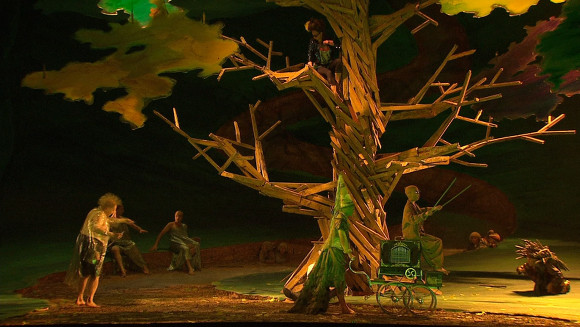
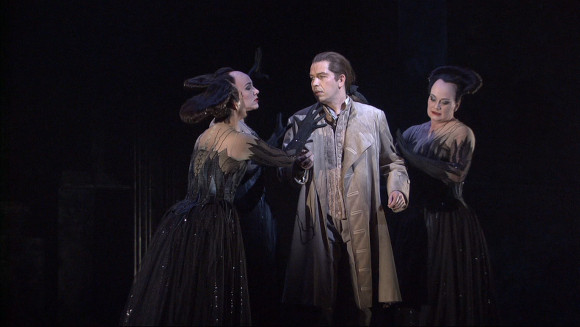
There are a lot of really good video recordings of the Mozart operas. So many that they risked swamping the other categories so I decided to pull them out into a separate post. What I’ve tried to do is select the best recording for each of the major operas. Same rules as the all time best category. To be considered the disk must be a worthwhile production, excellently performed and filmed and with better than average sound and video quality. So herewith the three da Ponte operas, the two major Singspiels, La clemenza di Tito and Idomeneo.
Tag Archives: blu-ray
Going for Baroque
Well not strictly baroque. I wanted a category for pre-Mozart rep since so many houses (and audiences) ignore it and there are some very odd ideas about performing it. So we are going to cover ground from the earliest days of opera to the late 18th century here, including staged versions of oratorios, because I rather like them. Here, in rough order of composition, then are my picks; from Monteverdi to Rameau. Continue reading
Subjective picks on DVD and Blu-ray
I’ve reviewed over 600 Blu-ray and DVD recordings on this blog. So I thought I’d have a crack at picking some favourites. There’s a problem, of course, in comparing recordings made over the course more than 80 years. There is just no way that “made for TV” recordings pre 2000 can stand up against modern HD productions when it comes to sound and, especially, picture quality so I’ve tried to invent some categories to allow mention of some of the best of them. It’s going to take a while to sort through all the categories so let’s start with a highly personal set of choices for best overall recording. Some of them even surprised me.

All star Carmélites
The 2013 recording of Poulenc’s Dialogues des Carmélites from the Théâtre des Champs Elysées has a cast that reads like a roll call of famous French singers; Petitbon, Piau, Gens and Koch are all there. Throw in Rosalind Plowright and Topi Lehtipuu and one gets some idea of the star power on display.
Ravel double bill
In 2012 Glyndebourne staged an interesting and contrasting double bill of Ravel one-acters in productions by Laurent Pelly. The first was L’heure espagnole. It’s a sort of Feydeau farce set to music. The plot is classic bedroom farce with the twist that most of the doors the lovers come in or out of belong to clocks. Concepción is the bored wife of a nerdy clockmaker. She’s not overly impressed by her two lovers; a prolix poet and a smug banker, who show up while hubby is out doing the municipal clocks. She’s much more taken by the slightly simple but very muscular muleteer who spends most of his time lugging lover infested clocks up and down stairs for her. Pelly wisely takes the piece at face value and brings off a mad cap forty five minutes timed to the split second.
Overstuffed Carmen
It’s nearly five years since I saw the MetHD broadcast of Carmen with Alagna and Garanča. I remember being quite impressed at the time. Watching it again on Blu-ray I came away with a less favourable impression. It’s not that it’s bad. It’s not. It just feels a bit lacklustre in a very crowded field. Let’s start with the positives. Elina Garanča is a very good Carmen. She sings superbly and grows into the role dramatically as the work progresses. She’s also a very good dancer and the production exploits that. In fact dance is used very well throughout with specialist dancers used to stage a sort of prologue to each act as well as the obvious places being reinforced with “real” dancers. As always, the Met doesn’t stint on this element and the dancers used are first rate.
The Met’s Prince Igor
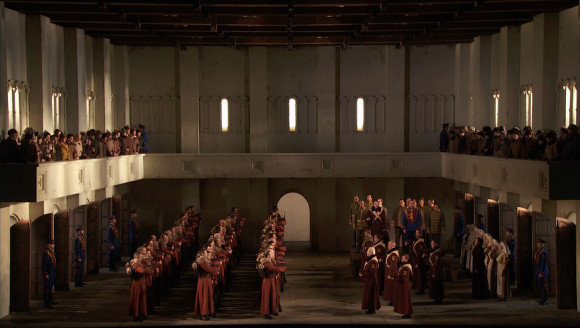
Earlier this year the Metropolitan opera staged Borodin’s Prince Igor for the first time in nearly a hundred years with an HD broadcast and a DVD/Blu-ray release to boot. It’s an odd work. It’s quite long; a prologue and three acts running over three hours and it’s very episodic. The prologue takes place in Ptivl; the principality of which I gor is prince. He’s about to lead his army against the invading Polovtsians. There are dark omens. The next thing we see, as Act 1 opens, is that Igor is defeated and a captive of Khan Konchak who’s daughter is now in love with Igor’s son. It’s all just happened. Cue lots of exotic Polovtsiania. In Act 2 we are back in Ptivl where Galitsky is making trouble for his sister, Igor’s wife, who has been left as Regent. Mostly the trouble seems to be drunken partying and when the Polovtsian army arrives at the gates the brother, Galitsky, drops dead. In Act 3 the city has been sacked and everybody is kind of mooning around in the rubble until a pretty depressed Igor shows up and implores the other Russian princes to get off their arses and do something (unspecified). All the important stuff happens off stage and there really isn’t any resolution. There is some great music though.
Colourful Vixen from Glyndebourne
Melly Still’s 2012 Glyndebourne production of Janáček’s Cunning Little Vixen is straightforward and rather beautiful. Certainly the staging matches the magic of this extraordinary score. There are really two ideas underpinning the designs. The animals are very human rather than the furries sometimes seen. Their specific nature is hinted at rather than made terribly explicit. They are differentiated from the humans by being very boldly coloured. In contrast, the human world is a sort of monochrome 1920’s Moravia; all greys and browns. Within this framework there are some neat touches. The foxes carry their tales and use them to great demonstrative effect. The chickens are portrayed as sex workers with the cockerel as, sort of, their pimp. It’s not overdone and it’s very effective. The sets are centred round a stylized tree with other structures as needed being erected on the fly with flats so the action never really stops.
Dark but straightforward Zauberflöte
The 2003 Royal Opera House recording of Die Zauberflöte has a terrific cast and it has Sir Colin Davis conducting. The production is by David McVicar and it’s one of those that make one wonder how he ever got a “bad boy” reputation. It’s perfectly straightforward though rather dark (emotionally and physically) and has a vaguely 18th century vibe. In places it seems a bit minimalist, as if the director couldn’t really be bothered with things like the Trials. The interview material rather suggests that McVicar was a bit overawed by doing Mozart with the great Sir Colin and tried very hard to match his rather old fashioned theatrical sensibilities.
Girard’s Parsifal on Blu-ray
François Girard’s production of Parsifal at the Metropolitan Opera was much written about at the time of the HD broadcast in March 2013. My review of that broadcast is here.I don’t think my opinion has changed very much. It’s a powerful and intensely beautiful production and there are some wonderful performances, especially that of René Pape. I’m not going to rehash the previous review but there were a few things I noticed second time around. In Act 1, for instance, the gendering of the scene is mirrored in other ways to emphasize the polarity. The knights are in white, the women in black. The men are in orderly circles, the women are just a crowd. Also the final scene is almost overwhelmingly intense. Kaufmann sings quite beautifully with fine diction, gravitas and simply gorgeous high notes. Pape caps off a performance of great pathpos and humanity with the gentle gesture with which he closes Kundry’s eyes in death. It’s compelling stuff.