The ur Nixon

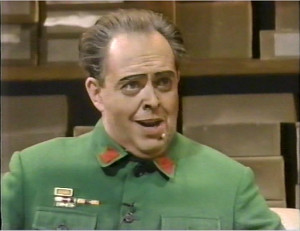
1.maoI found it a bit shocking that John Adam’s Nixon in China wasn’t released on DVD until after the MetHD broadcast in 2011.  I was even more shocked when I found out that the original 1987 Houston production had been recorded and broadcast on PBS.  Just recently, thanks to a kind reader of this blog, I’ve been able to watch that original broadcast.  It’s TV from 1988 recorded on VHS and then digitized so the picture quality isn’t state of the art but the sound is surprisingly good. Continue reading

El Niño

John Adams’ El Niño was conceived as an oratorio but thoughts turned to it being staged early in the creative process.  The final result, as staged at Paris’ Châtelet in 2000, defies easy characterization.  There are singers and dancers on stage but they don’t represent unique characters.  So, for example, at one moment Willard White is Herod and at another Joseph.  To further complicate matters video is constantly projected onto a screen above the stage space.  It was specially created for the piece being shot on location in Super 8.  There’s no clear narrative either.  To some extent it tells the Christmas story but it’s at least as much about the feminine experience of giving birth as anything from Isiah or the Gospels.  It also uses a very eclectic mix of texts; from the Bible, from the Apocrypha, from female Latin American poets, from Hildegard of Bingen and so on.  There are lots off Sellars’ trademarks in the staging too; semaphore and so on.  Does it work?  I don’t really know as it’s really hard to tell from the video recording (see para 3).

1.stage Continue reading

How can peace come from so much pain?

Making a film of an opera rather than filming an opera involves interesting choices and one of the strengths of the DVD of Penny Woolcock’s film of John Adams’ and Alice Goodman’s The Death of Klinghoffer is that includes 47 minutes of Woolcock, Adams and others discussing just how one takes a rather abstractly staged opera (the original staging was, inevitably, by Peter Sellars) and turn it into an essentially naturalistic film.  Of course, naturalism will only go so far with opera but this goes a long way in that direction.  The soloists are filmed mainly on location and they sing to the camera.  The choruses, mainly backed by documentary footage, and the orchestra were recorded in the studio but the actors sing ‘live’.  The one concession to “being operatic” is having a mezzo voice one of the Palestinians though he is played by a male actor.

1.palestine Continue reading

New (more or less) works for two pianos

adamsWorks for two pianos are comparatively rare and the chance to hear two contemporary works for them rarer still.  Today, in the Richard Bradshaw Amphitheatre we got to do just that.  The program consisted of John Adams’ 1996 Hallelujah Junction, which i have heard a few times before, and Hans Thomalla’s 2004 piece Noema.  Both composers were there to introduce there works. Continue reading

War in opera

As November 11th comes around for the 94th time since the guns were, very temporarily, silenced I thought it might be interesting to look at how war has been seen by librettists and composers over the years. Very early on we get a very gritty take on the subject in Monteverdi’s extremely compact Il combattimento di Tancredi e Clorinda but not so long after the path for the next three centuries is set with Purcell’s broadly comic King Arthur.  As far as I can see from Purcell to 1945, with very minor exceptions, the message is largely “war is fun”.  War is an excuse for a big parade (Aida; unless Tim Albery is directing!), an excuse for a drinking song (Faust), just plain comedic (La Fille du Regiment), a plot device (Cosí fan tutte) or a background event (Tosca, various versions of the Armida story).  The only opera, pre 1945, that I can think of that deals with the horror of war is Les Troyens, and that of course takes place in a distant, mythical, past.

Continue reading

Not a DVD review

Nixon in China at the COC

There are an awful lot of opera DVDs about.  It sometimes seems like there’s a new Tosca or Traviata out every week, often for no apparent reason.  It’s perhaps surprising then that some works don’t make it to DVD.  One particularly egregious case would seem to be John Adams’ Nixon in China.  It’s a good piece and has had plenty of productions both in North America and elsewhere.  A couple of years ago I saw it twice in 24 hours; on a Friday evening at COC followed by the HD broadcast from the Met the following afternoon and I’ve been listening to an audio recording of the COC version on my walk to and from work.  But there’s no DVD!  I guess that the Met probably planned to release the HD recording but James Maddalena, the Nixon in the recording, was so obviously ill I was actually surprised that he continued after the interval and I guess that scuppered that. Continue reading

Some help from my American friends?

I believe in new opera. I think it’s vital to the survival of the genre and I like quite a lot of it. Most of what I like has come from European or British composers or John Adams. I love Reimann’s Lear and Birtwistle’s The Minotaur and Sariaaho’s L’Amour de Loin.  I’m equally impressed by Nixon in China and, maybe to a lesser extent, Doctor Atomic.  All of these, it seems to me, lie within the range of idiom of contemporary symphonic or chamber music.  I’ve had much less luck finding contemporary American opera, Adams aside, that I enjoy or even find interesting.  I loathed A Streetcar Named Desire and five minutes of Adamo’s Little Women had me reaching for the barf bucket.  It’s a combination of cloying sentimentality and music that sounds like South Pacific minus the good tunes.  It’s certainly not the sort of music one could imagine hearing at a symphony concert. Am I missing something?  What should I try to see if I want to see intelligent, musically interesting contemporary American opera?

Against the Grain’s Seven Deadly Sins

Last night we headed out to that part of the formerly industrial west end much beloved by tiny arts organizations to see a thoroughly eclectic series of performances by Against the Grain Theatre. This is the company that previously brought us a genuinely Bohemian La Bohème at the Tranzac club. Last night’s show cunningly built on that success by using the undoubted crowd pleaser, Lindsay Boa-Sutherland, to headline a performance of Weill’s Die sieben Todsüngen. Since the orchestra was replaced by two superbly virtuosic pianists in Daniel Pesca and AtG music director Christopher Mokrzewski it made sense to include two fiendish pieces for two pianos; Steve Reich’s Piano Phase and John Adams’ Hallelujah Junction. The program was balanced up for “virtue” with Britten’s Abraham and Isaac. So, a thoroughly eclectic but oddly coherent line up.

Continue reading

You should have hoped us

I’ve watched John Adams’ Doctor Atomic three times now. The first time; a MetHD broadcast, I wasn’t impressed at all.  The second time; an AVI rip of the Dutch television broadcast, I started to come around.  Having now watched the Opus Arte DVD based on the Dutch TV broadcasts I’m converted.  This piece is every bit as good as Nixon in China and probably surpasses it in emotional impact due to the more visceral nature of the material.  The orchestral writing is classic Adams.  The musical argument is swept along on a strong rhythmic pulse and overlapping waves of colour.  In contrast the vocal line often seems duller though there are passages of great lyricism, notably Oppenheimer’s big Act 1 aria Batter my heart, three personed God.  Kitty Oppenheimer and the native woman, Pasqualita, also get some good singing.  I also found myself warming to the libretto.  Some rather self conscious passages of Donne and Baudelaire aside, it lacks the poetry of Goodman’s libretti for Adams but Peter Sellars’ selection of words taken from the documentary record is, in its way, quite compelling; reflecting the mix of high and banal concerns that people under great tension express.  It’s particularly interesting to see the relatively high level of respect for and confidence in the moral judgement of politicians displayed by the scientists.  One doubts whether that would be the case today.  In total, it’s a strong additiion to the repertoire of 21st century operas.

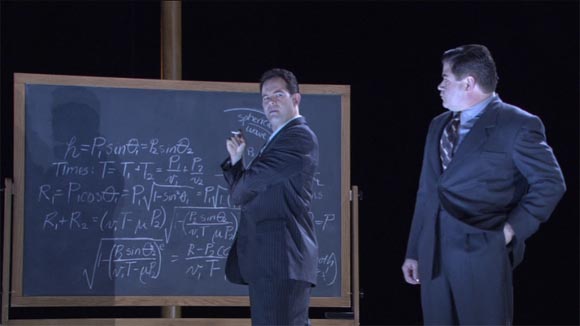
Gerald Finley (Oppenheimer) and Richard Fink (Teller) do physics

Continue reading

Best of 2011

Herewith a personal take on the best things that came my way operatically in 2011.

Live performances

It was a pretty good year for live opera in Toronto. I’m certainly not going to complain about two Robert Carsen productions in the same calendar year. Good though the Gluck was though top honours in the fully staged opera in a real theatre go to the COC’s Ariadne auf Naxos. Neil Armfield’s production was fairly conventional but the music making was superb. Adrienne Pieczonka, Jane Archibald and Alice Coote headlined with strong support from Richard Margison and a whole bunch of past and present Studio Ensemble members. The orchestral playing too was absolutely first class and Sir Andrew Davis conducting looked like he was enjoying it as much as the audience. Later in the year I think we had a bit of “a star is born moment”. Christopher Alden’s Rigoletto was challenging enough that I wanted to see it a second time so took the chance to get a cheap ticket for the B cast. Thus I got to see the extraordinary chemistry between two very fine young singers; David Lomeli and Simone Osborne. Go see them if you get a chance. Actually, nothing at the COC seriously disappointed in 2011 (well maybe the The Magic Flute had a bit of a 200th performance of my career feel to it.) It looks like we are moving at last into an era when Toronto gets consistently high class singers and conductors in decent or better productions. It’s a shame there are only seven productions per year.

As for smaller venues, highlights included Against the Grain’s funky La Boheme in the highly outlandish setting of the Tranzac Club and Queen of Puddings’ world premiere of Ana Sokolov’s Svadba – Wedding; an hour long piece for six unaccompanied female voices. There were also any number of excellent free lunchtime concerts in the Richard Bradshaw Amphitheatre.

DVD

The surprise highlight of the year for me was the restored print of the 1961 Rosenkavalier from Salzburg. Everything about it is surprising and wonderful and undermines a great deal of received wisdom about opera in that era. Other personal discoveries were the Salzburg King Arthur (who knew Germans could be funny?) and Calixto Bieito’s truly disturbing Wozzeck starring Franz Hawlata at his very considerable best.

Personal epiphany

I started the year thinking I didn’t really like John Adams much. I had hated the Met broadcast of Doctor Atomic and while I liked some of the non-operatic stuff rather more I wasn’t a fan. After watching Nixon in China twice in 24 hours (COC on the Friday night followed by the Met broadcast on the Saturday) and attending a lunchtime concert of arias introduced by the composer and sung by Peter McGillivray and Betty Wayne Allison I was converted. I even went back and watched the Amsterdam production of Doctor Atomic on DVD. I still think Doctor Atomic has its weaknesses but Nixon in China is pretty much a masterpiece.

On-line stuff

I started this blog as a way of keeping up writing analytically while I wasn’t working. It’s helped keep me sane. Through this and Twitter and other on-line stuff I’ve met some really cool people in 2011; some in meatspace including Lydia of Definitely the Opera, Cicely Carver from COC, couturier Rosemary Uhmetsu and up and coming soprano Simone Osborne. On-line folks who have helped this year along are really too numerous to mention individually but thanks anyway!

Other stuff that happened

I met Lawrence Brownlee and Leonardo Vordoni in the cinema at a MetHD broadcast! I discovered that baritone Brett Polegato (one of the funniest people in opera) has a little grey cat called Lady Jane Grey just like my little grey monster.