Kupfer’s Der Fliegende Holländer

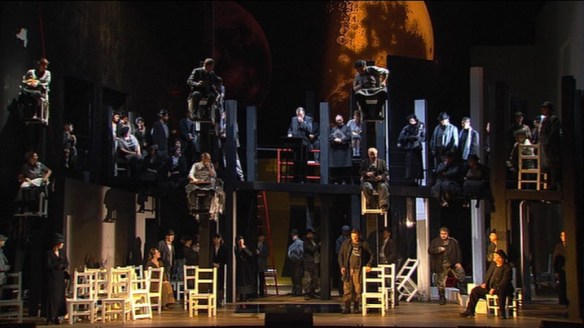
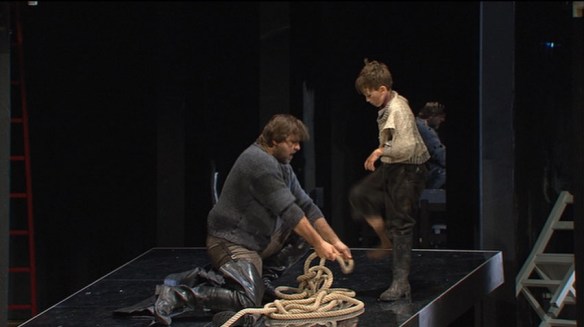
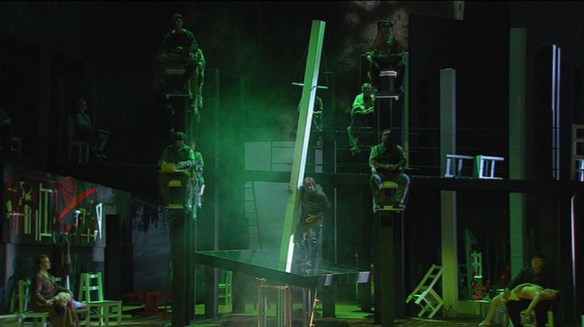
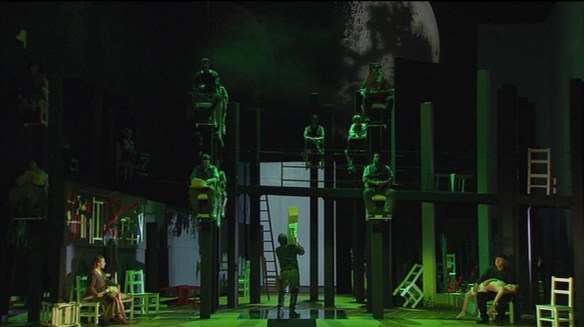
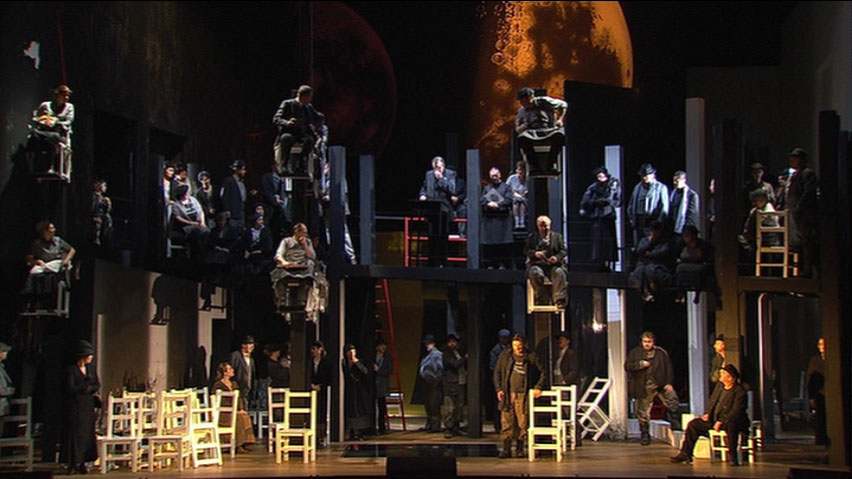
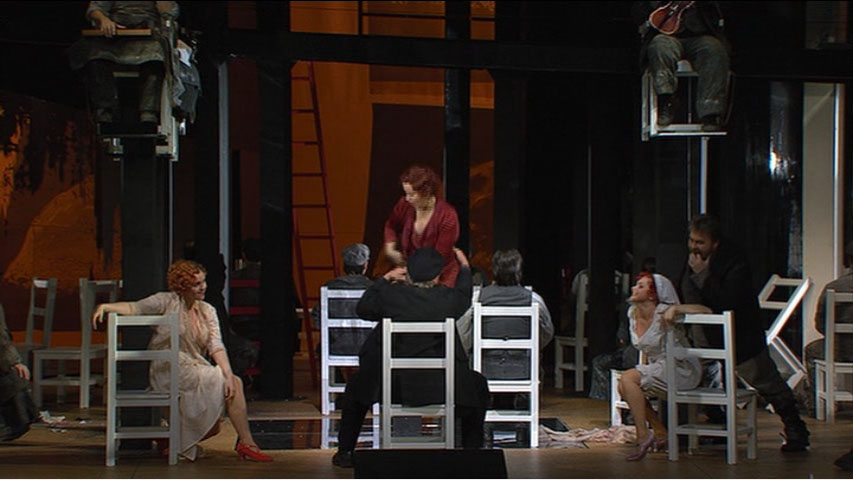
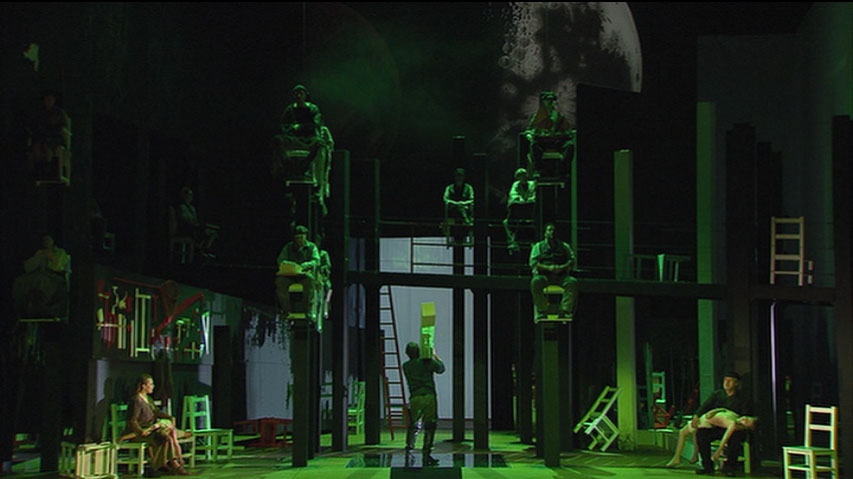
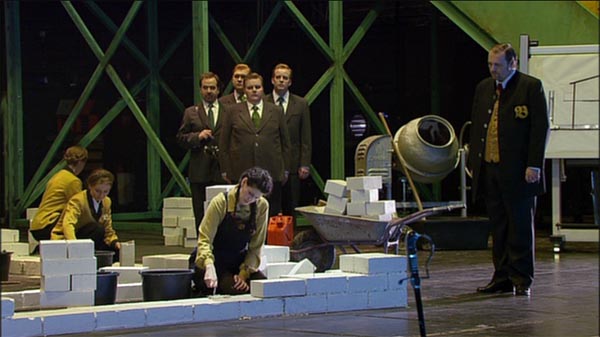
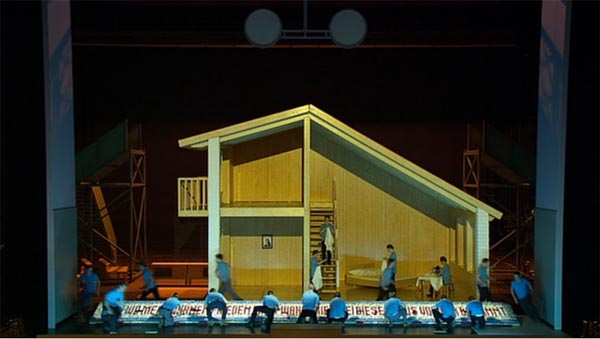
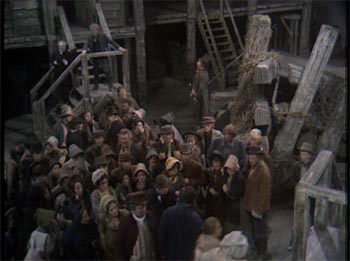
I was really impressed when I first watched the DVD version of Wagner’s Der Fliegende Holländer recorded at Bayreuth in 1985.  It’s been some time since I last watched it so another look seemed in order.  The production, directed by Harry Kupfer debuted in 1978 to both applause and brickbats.  The concept is that the Dutchman exists only in Senta’s imagination.  She is fixated on the Dutchman as her route out of the repressed bourgeois environment she is trapped.  It’s a tormented, even hysterical, version of Senta that finds a fine interpreter in Lisbeth Baltslev.  Kupfer reinforces this idea of Senta by having her on stage all the time.  During the overture she retreats to a sort of cage at the top of a staircase with her precious picture of the Dutchman which she will hang onto throughout the drama.  She will remain in this cage high to one side of the stage watching the action below her throughout the first act.

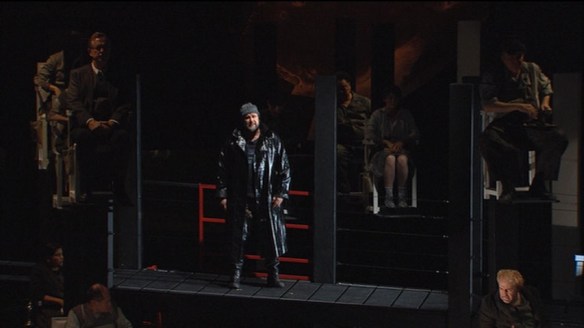
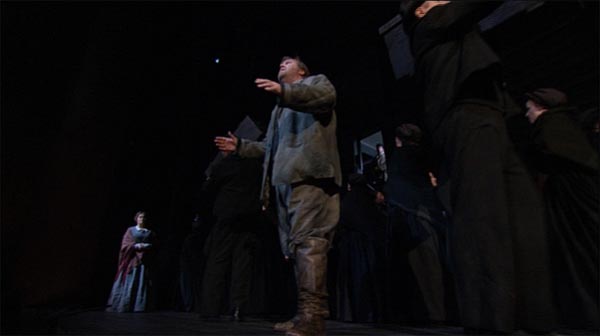
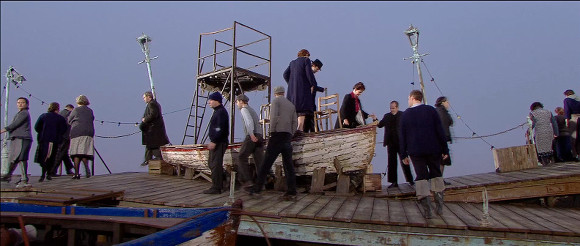
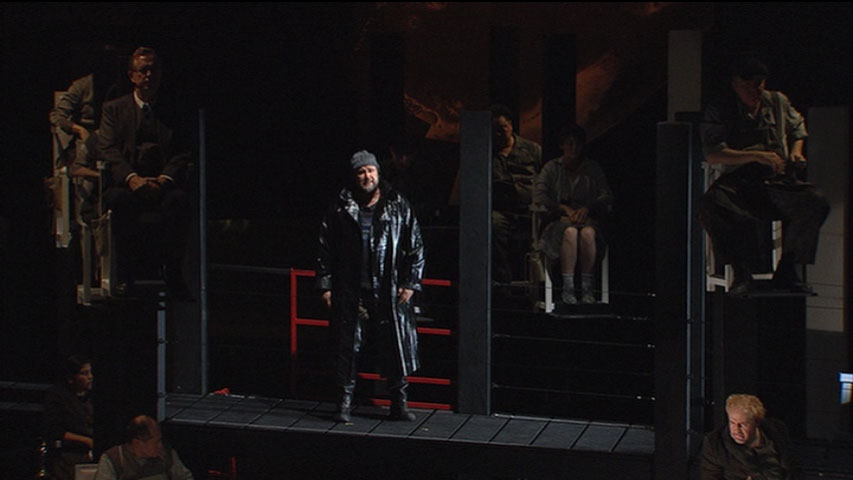
It’s a very strong first act musically and visually  The Dutchman’s ship makes a spectacular entrance and the finger like timbers of the bow open up to show the Dutchman chained in a crucifixion pose.  Simon Estes as the Dutchman is suitably elemental.  His singing and acting have a frightening intensity without ever becoming unmusical.  Matti Salminen’s Dahland is perfectly adequate and conveys the grasping bourgeois rather well.

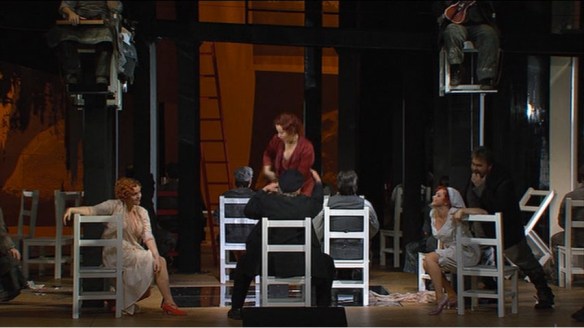
Act 2, of course, opens in the Spinning Hall.  Anny Schlemm’s Mary exemplifies the dull conventionality of the place.  We are in the world of Strindberg or maybe Babette’s Feast.  The intensity of Balslev’s performance cuts right through this.  Johohoe! Truft ihr das Schiff im Meere an is as eerie as it is powerful.  Against this obsession the rather dull Erik of Robert Schunk is doomed from the start.  Things warm up with the arrival of Dahland and the Dutchman.  Salminen is in very good voice with Mögst du mein Kind, den fremden Mann willkommen heißen.  Senta is pinched looking or frightened almost throughout this scene.  There is great ambiguity while the Dutchman sings Wie aus der Ferne längst versangner Zeiten.  The Dutchman of Senta’s imagination sings from the gorgeous fantasy hold of his ship while the shadowy figure who arrived with Dahland is still on stage.  Senta is slow to buy into what is happening but she finally dissolves into a state that is more madness than delight.

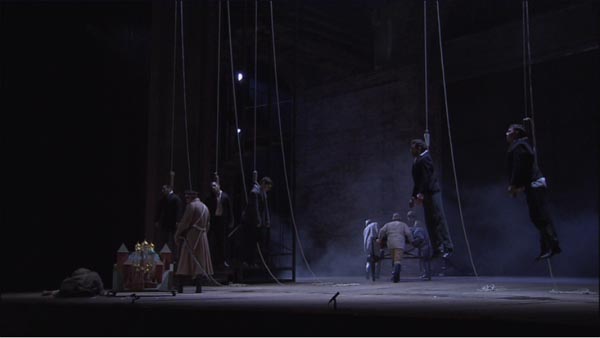
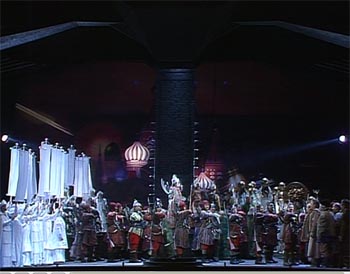
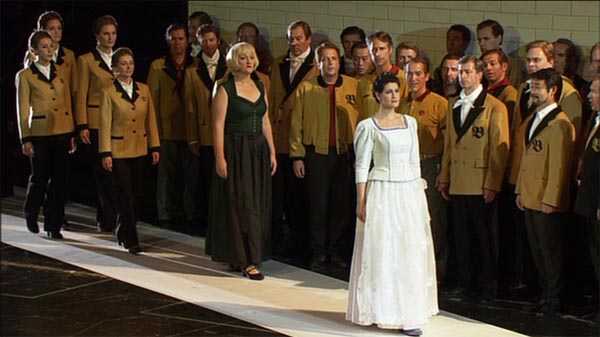
Act 3 opens with Senta watching her own wedding feast from the cage.  The townspeople and Dahland’s crew are almost as unnatural as the Dutchman’s.  It’s quite chilling and sinister all through until the Dutchman’s crew drive everyone off stage leaving Senta alone for her confrontation with Erik.  Then we get the big scene where the Dutchman, chained up again in the infernal version of his ship,  thinks that Senta has betrayed him and leaves her.

This is, obviously, crucial to the plot but it has never really made much sense to me in a normal interpretation.  Here it does.  This obsessed Senta needs to be “faithful unto death” not to have a happy ending.  It’s equally apt that her suicide is just that.  There is no hint of redemption for her or the Dutchman.  It’s the end.  The people turn their backs on her corpse leaving only Erik, in despair, still with her.

So dramatically it works as a piece held together by really intense performances by Balslev and Estes and, lest I forget, Woldemar Nelsson conducts and keeps things moving along briskly.  At times the orchestral playing is quite thrilling and the chorus is excellent too.

A couple of other things about the production are worth pointing out.  Although the booklet sets the scenes out in the conventional three acts it is actually played through (as I understand Wagner intended and as it was played at the COC a couple of years ago).  Scene changes are dynamic and slick.  There’s some real stage craft here.  It’s also very dark, as I recall most 1970s productions being.  This makes on stage detail hard to pick up and, I’m sure, affected the video direction.

This production was directed for video by Brian Large (surprise!) and it seems to have gone straight to video with no TV broadcast.  That said it looks like it was directed for the “small screen” which one might expect in 1985.  This is problematic given the crucial role of the spectating Senta, as most of the time she is out of shot.  Large tries to compensate for this with superpositions, fades and dissolves and is fairly successful.  All in all, I think he gives us as good a picture of what Kupfer put on stage as one could reasonably expect.

Picture quality is a bit soft grained as you might expect for the time and it’s 4:3.  Sound options are PCM stereo or DTS 5.1 which is a post process of the original stereo capture.  It’s very good indeed.  There are English, French, German, Spanish and Chinese subtitle options.  There’s nothing much in the way of bonus material but the booklet has a full track listing and an informative essay by Erich Rappl.

All in all I think this disc can be highly recommended. It’s a landmark production, well executed on stage and captured for DVD remarkably well for its era.

If you want a preview the whole thing is available in ten minute chunks on Youtube but the quality is a bit off putting.

Authentic? Opera Atelier’s Persée on DVD

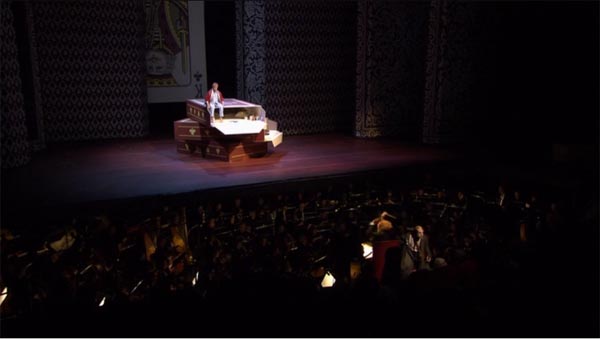
I’ve been attending performances of Opera Atelier for over twenty years off and on but until viewing this recording of Lully’s Persée I’d never seen them on DVD. I was curious to see how the unique Opera Atelier style would come over on DVD and to what extent watching a recording, which I could compare fairly with other DVD performances, would affect my views of Opera Atelier’s strengths and weaknesses.

Continue reading

Zodiac Trio

Yesterday’s free concert was given by the Zodiac Trio. They are a young group consisting of Kliment Krylovsky (clarinet) Vanessa Mollard (violin) and Riko Higuma (piano). The programme was titled Music from a Silenced Nation: Soviet Composers and it was presented, appropriately enough, on the greyest, dreariest day of the season so far. They brightened it up considerably. The programme opened with a virtuosic rendering of Stravinsky’s L’Histoire du Soldat followed by the first movement of Denisov’s Sonata for Solo Clarinet. This latter is a very strange work for its time and place. It experiments with quarter tones and is generally the sort of thing that would get one sent to the gulag. Next came the Allegretto from Shostakovich’s Sonata for Violin and Piano, Op 134, composed for David Oistrakh. This piece places huge physical and technical demands on the players which Mollard and Higuma really came through on. The final item on the programme was Galina Ulstvolskaya’s Trio. This I must listen to again. Why is this woman not better known? She was a pupil of Shostakovich and her work has many of the qualities that make her teacher so great. It was played beautifully with special props to Higuma who was required to get a very wide range of effects out of the piano. They encored with an uncredited tango of considerable bravura.

I would say that the Zodiac Trio are exceptionally committed to what they do and show great musicianship and serious musical erudition. Go see them if you get a chance.

Another edition of the Armida and Rinaldo show

I really don’t know how many operas there are more or less based on Tasso’s story of the Christian knight Rinaldo and the Muslim sorceress Armida. Certainly there are versions by Rossini and Lully which I’ve seen. Then there’s Handel’s Rinaldo which I watched in David Alden’s production for the Bayerischer Staatsoper in 2001. Alden at least manages to avoid obvious Monty Python and the Holy Grail references which is more than either the Metropolitan Opera and Opera Atelier managed with the Rossini and the Lully. In fact Alden manages to avoid all the usual cliches of both Handel in general and this piece in particular though at the expense of giving us a version that is quite hard to interpret. The action is moved to maybe the 1950s to judge by the costumes and the Christians are decidedly wimpy and ostentatiously pious (except for the Rinaldo of David Daniels). Crucifixes, surplices and bibles crop up at odd times and in the final scene the Christian army is a line of Jesus statuettes of the kind one can pick up at Honest Ed’s or one’s friendly neighbourhood Catholic tat store. The Muslims are much earthier and in Act 1 Argante (Egilis Silins) seems to terrify the Christian trio of Goffredo (David Walker), Almirena (Deborah York)and Eustazio (Axel Köhler). Also Noëmi Nadelmann’s very sexy Armida is much earthier than Deborah York’s rather etiolated persona. Note that by casting Goffredo as a countertenor we end up with four countertenors which is more than I’ve seen on stage at one time for sure.

Whatever the overall concept, Alden does pretty much what Handel did with the original production; give us a succession of arresting visual images and effects and some very funny moments. There’s probably more flesh on display too than Handel could have got away with in 1711. There is, as the cliche would have it, never a dull moment with giant dolls dropping their pants, an army of aliens, severed limbs and a David Lynch like giant face. It all puts considerable demands on the athletic and acting abilities of the cast and here Nadelmann has the toughest time and does really, really well. Her physical acting and timing are excellent and she’s not at all hard on the eye which helps. Everybody else is pretty good too. David Daniels face, as he gets felt up by both the girls, is a picture.

Musically, the stand out is David Daniels. No surprise really. Here he sings stylishly throughout and delivers a really lovely “cara sposa, amante cara”. Nadelmann gets full marks for being accurate and musical even while acting her head off. She sings “Furie terribili!” with Argante’s head clasped between her thighs! At least for “Lascia ch’io pianga” York is stationary though in quite an awkward pose. I think she sounds a bit over challenged by some of the high passage work in act 1 but she seems to improve as things progress. As the one low voice on show Silins is a good contrast. I’ve heard more agile bass-baritones in Handel but his fairly bluff reading is appropriate to the way the part is portrayed here. Harry Bicket directs the Bavarian State Orchestra and plays continuo. No worries there.

Brian Large directed for the small screen and does his usual thing of giving us lots of close ups which is a shame as there is lots going on that we miss and it’s obvious that Alden and his designer, Paul Steinberg, have put a lot of thought into the overall composition of scenes which is mostly lost on the DVD. The DVD itself is pretty basic. It’s on the Kultur label in North America though it originated as a Euroarts release in Europe. Kultur have stuck the original two DVDs onto a single disc and while they have included the useful documentary essay Handel, the Entertainer it means the only sound option is Dolby 2.0 and the only subtitles are English. The picture (16:9 anamorphic) and sound quality is perfectly OK but not stunning. The only documentation is a chapter listing.

All in all well worth a look

Kinky boots and all

Die Entführung aus dem Serail is probably the major Mozart opera I know least well so I don’t have too many comparators for this performance from Amsterdam by De Nederlandse Opera from 2008. So I can’t say that this is better or worse than other available productions but I can say I enjoyed this one immensely.

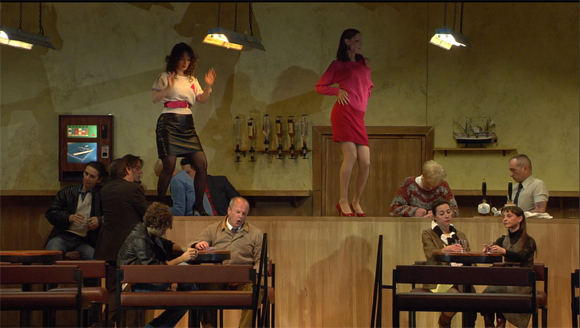
1.osminThe production, directed by Johan Simons, uses fairly uncluttered sets and costumes that switch between pantomime Aladdin and, most of the time, modern dress. The take on the characters is interesting. Osmin is pretty much the classic infatuated old Turk, played brilliantly by Kurt Rydl, but the infatuation is reflected by the distinctly dominatrix like Blonde played by the rather lovely Mojca Erdmann in kinky boots, a tight short skirt and a belt that she’s quite prepared to use on the men in her life. At least in the first two acts there’s plenty of ambiguity in Laura Aikin’s Konstanze. Is she actually at least a little bit in love with Bassa Selim, played very well by Martin van Westmeulen. Certainly she has him twisted around her little finger and in Martern aller Arten seems to be very much “topping from the bottom”. To round the cast out, Michael Smallwood is a cheeky chappy Pedrillo, very much under Blonde’s thumb and Edgaras Montvidas is a suitably sappy Belmonte. It’s mostly fast paced good fun but does strike a more serious note in the final scenes. Funny how that always seems to happen with Mozart “comedies”.

2.bootsMusically it’s pretty good too. Constantinos Carydis conducts a fast paced and nimble reading from the Netherlands Chamber Orchestra. The vocal star is clearly Laura Aikin who has the difficult coloratura parts of Konstanze’s music nailed. This is particularly praiseworthy as she does it while doing some pretty intense physical acting. It can’t be easy to nail Martern aller Arten with Bassa Selim firmly lodged in your cleavage. The men are perfectly adequate. I thought Michael Smallwood was particularly sweet toned. The one weakness, and I hate to say this, was Mojca Erdmann. Her upper register is a bit harsh and shrill. This is surprising as most reviews of Ms. Erdmann praise her beauty of tone. Maybe she was just pushing a little too hard in this performance. The ensemble work was generally first class.

3.maaThe recording is available from Opus Arte on DVD and Blu-Ray. I watched the latter using the Dolby TrueHD 5.0 soundtrack. The picture is 1080i HD 16:9. It looks and sounds great on my system and would doubtless look even better on a more modern TV. Definitely worth a look.

4.boys

How to do Purcell

A while ago I had the misfortune to watch a thoroughly misconceived version of Purcell’s King Arthur. I have now had a chance to watch a version from the 2004 Salzburg Festival and it’s a lot better! This production by Jürgen Flimm takes Purcell and Dryden’s work and treats it respectfully but not solemnly. As originally intended, it’s given as a series of scenes spoken by actors interspersed by songs which are sung by five singers who change role as needed. The dialogue is in German but the singing is in English which seems a bit odd at first to an English speaker but one soon gets used to it. Flimm uses Dryden’s text for the most part but interpolates some scenes, notably where Merlin, disguised as an investment banker’s wife, enters via the auditorium and delivers a diatribe about Regietheater and how Salzburg has gone all to Hell. It’s just like being at a typical COC Opera 101. It’s staged in the appropriately baroque Felsenreitschule and the set mirrored the arcades of the building with a brightly painted wooden arcade structure set behind the stage. The orchestra is in a sunken pit in the middle of the stage so the action takes place all around them. There is clearly some heavy duty projection equipment behind the set because the production uses a wide range of, often spectacular, lighting effects.

1.sacrifice


Continue reading

Nimm sie hin denn, diese Lieder

Today’s free lunchtime concert in the Richard Bradshaw Amphitheatre was given by Canadian bass, Robert Pomakov and the Gryphon Trio (Annalee Patipatanakoon – violin, Roman Borys – cello, Jamie Parker – piano).

First up we got Parker and Pomakov performing Beethoven’s An die ferne Geliebte.  Pomakov has a big voice as I knew from having heard his Monterone twice this month at the Four Seasons Centre.  I was impressed by how well he could scale back his volume and even more impressed by the wide and appropriate range of tone colours he deployed.  He doesn’t sound entirely secure at ppp but for a voice of his type he was pretty good!  Next the Gryphons gave us the Elegia from Arensky’s piano trio.  I don’t know this work at all but they sounded very accomplished and musical.  The finale was Mussorgsky’s Songs and Dances of Death in Gary Kulesha’s arrangement for voice and piano trio.  This time Pomakov could let rip with all his considerable power accompanied with equal fervour by the Gryphons.  The whole thing was very impressive and very loud!

The scary thing is that Pomakov has only just turned thirty and already has this huge sound.  Apparently he’s had it for a while because he’s sung in twenty COC productions going back ten seasons. I did check out Youtube to see if I could find Pomakov and there is one clip of him singing the Russian National Anthem at the World Cup of Hockey in 2004. Here it is.

Terry Gilliam’s The Damnation of Faust

Last Friday the BBC broadcast the English National Opera production of Berlioz’ The Damnation of Faust directed by former Python Terry Gilliam. This was filmed back in May at the Coliseum and got positive to glowing reviews for its visual inventiveness. So how well did it come over as a TV broadcast?

The bottom line is “probably less well than in the theatre”. Gilliam’s approach to staging this almost unstageable “opera” is to treat us to a visual romp through German history from the late 19th century through WW1 to Auschwitz and in between we get lots of Nazis and Jews. There is heavy use of projection, film and special effects and one imagines it must have been incredibly spectacular in the theatre. Unfortunately much of this is lost in the filming for TV. There are certainly some arresting moments but not enough to keep one locked into the action and the director’s vision. And, once when starts to ‘lose the plot’ the more inconsistent and incongruous much of it seems. It doesn’t help that there are long passages where the orchestra is playing and action is going on on stage and it all feels a bit more like a movie soundtrack than an opera. Also, of course it being the ENO, it’s in English. The broadcast subtitled the chorus but not the soloists which was a bit odd and certainly made things harder to follow. The biggest dramatic problem I had was with the treatment of Marguerite. She’s Jewish but seems to have a serious “Aryan wannabee” complex. There’s a bizarre scene where she comes home, lights a menorah, puts on a blonde, pigtailed wig and swoons over a giant poster of a ideally beautiful Hitler Youth on the wall of the building opposite. She then takes Faust, who looks more like George Bernard Shaw on an off day, as her lover, apparently as some sort of substitute. Marguerite is then carted off to Auschwitz and death but there’s no sin here. She’s killed because she’s Jewish along with hordes of others. So there is nothing to redeem which makes the final scene really weird. Marguerite ascends to (Christian) heaven to words that are overtly Christian sung by a chorus of gassed Jewish corpses. So spectacular but a bit incoherent and on TV the incoherence tends to overwhelm the spectacular. I really would pay to see this in the theatre though.

Pretty good performances on the whole. Peter Hoare is Faust and he is convincing though somewhat overchallenged by some of his higher passages. Christopher Purves is near perfect as Mephistopheles (though surely the Prince of Darkness would not be caught wearing a clip-on tie!). He’s sardonic, funny and vocally and dramatically assured. Christine Rice is vocally excellent and does her best with the odd Marguerite she has to project. I wish Edward Gardner in the pit had managed a bit more drama in the orchestral passages. With Nazis on stage executing Communists, smashing Jewish shops and staging the odd Nuremberg rally it was far too easy to forget there was any music going on.

Here’s Marguerite with her pigtails and menorah

And, to emphasise the subtlety of it all, here’s Faust crucified on a swastika with Adolph going nuts in the background.


Anna Bolena – MetHD broadcast

Today’s Metropolitan Opera “Live in HD” broadcast was Donizetti’s Anna Bolena. I was not overly impressed although whether this was a result of issues associated with the broadcast or what was happening in the house I’m not entirely sure. One issue was that, again, the cinema was forcing its sound system well past the point at which it could consistently and accurately reproduce music. It may be OK for car chases and explosions but they need to throttle the volume back for the opera broadcasts. I’m guessing that they could drop the sound 6dB and still be louder than it would sound in the house. Driving the speakers and amps at 25% of the pressure level they are currently flogging them at would surely reduce the harmonic distortion. This was particularly an issue because this was very “heavy” Donizetti. I don’t know the work well enough to know whether it has to be done this way but the Met cast large voices in almost all the major roles and Marco Amiliato in the pit seemed to be demanding a very loud and strident sound from the orchestra. It was quite dramatic but emphatically not bel canto; more like forte shouto really. The only singer who sounded idiomatic to me was Tamara Mumford as the page, Smeaton. It did get better after the interval and the big duet between Anna (Anna Netrebko) and Giovanna Seymour (Ekaterina Gubanova) was really quite affecting. Also as far as I could tell Netrebko was singing really well in the “mad scene” (which really isn’t all that mad as these things go) but unfortunately the person in the seat behind me was having extremely audible “gastric distress” and both the lemur and I were having the hardest time not dissolving into giggles during perhaps the most solemn part of the opera. And I thought the coughing at the Four Seasons Centre was bad.

Continue reading