Siegfried ex Machina

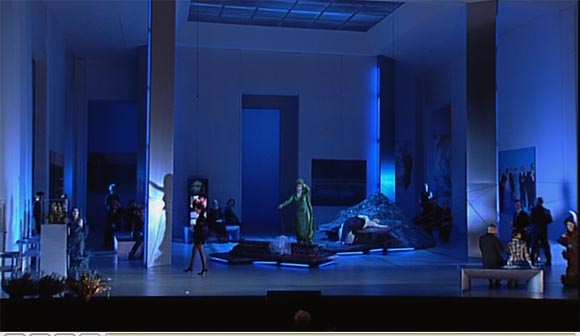
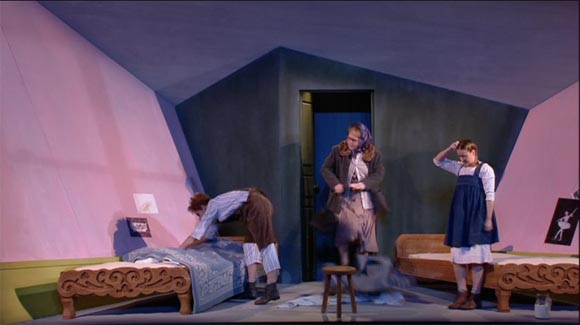
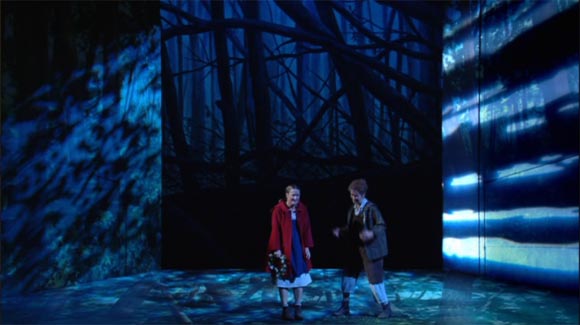
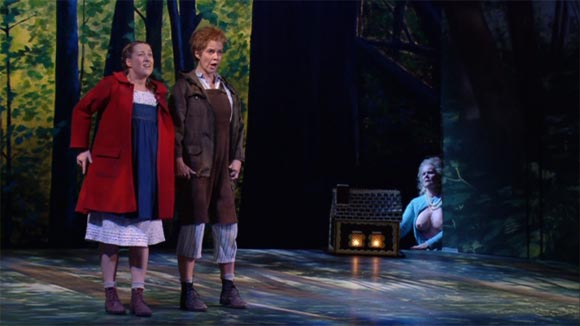
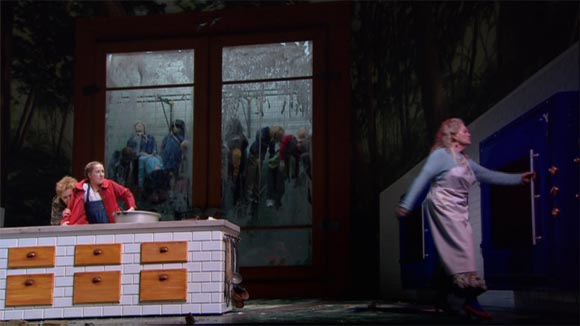
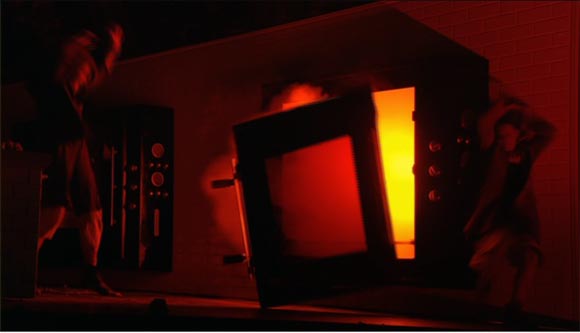
I had very mixed feelings about today’s HD broadcast of Siegfried from the Metropolitan Opera. Early reviews and comments by friends had been largely negative about the staging and there was a widespread view that “the machine” was intrusively noisy. As it turned out I was pleasantly surprised. For once Gary Halvorson’s relentless close ups were a boon. From what little we could see of them, the first and second act sets were both uninteresting and gimmicky. The 3D leaf scattering, the crudely pixellated woodbird and the laughable Wurm were just among the sillier features. To be fair , the beginning of the third act made effective use of the set but that was the only place that it did work well. So focussing on the singers made a lot of sense.

Continue reading

Mozart and sheep puppets

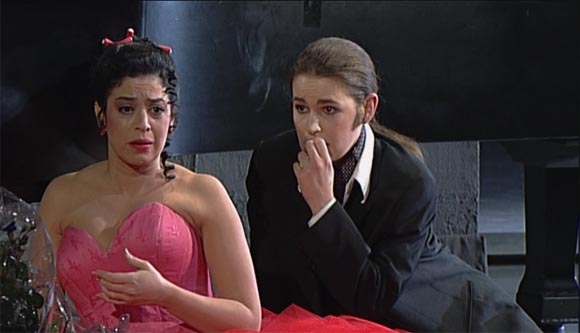
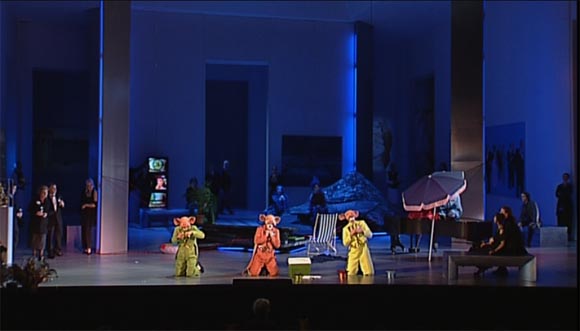
When the Salzburg Festival decided to do all 22 Mozart operas for the 25th anniversary in 2006 there must have been a fair amount of thought put into to what to do about the lesser works. I have to say that the solution they came up with for Bastien und Bastienne, written when Mozart was twelve, and Der Schauspieldirektor is most ingenious. The director, Thomas Reichert, came up with the ingenious idea of combining the two singspiels and performing them with puppets in the Salzburger Marionettentheater. The work breaks into three parts; a largely spoken prologue based on Der Schauspieldirektor where Frank (Alfred Kleinheinz) and Buff (Radu Cojocariu) audition the puppets for the roles in Bastien und Bastienne. The puppetry in this section is quite wonderful. The decision is made to split cast Bastienne which sets up the soprano rivalry for the final part of extracts from Der Schauspieldirektor. In between we get the performance of Bastien und Bastienne with Cojocariu singing the magician Colas on stage with the puppets while Bernhard Berchtold, Evmorfia Metaxaki and Aleksandra Zamojska sing from the pit. It’s charming complete with puppet sheep. The finale well exploits the difference in voice between the fuller, more mature Zamojska and the brilliant coloratura of Metaxaki. It’s lots of fun with some good gags and excellent singing from the young cast, especially Cojocariu. The orchestra is the Junge Philharmonie Salzburg conducted by Elisabeth Fuchs.

The video direction is by Stefan Aglassinger. He does a good job of producing a coherent video which is not easy because the action takes place on stage, in the pit and around the auditorium. It was filmed in HD and the picture is an excellent 16:9. Sound options are PCM stereo and DTS 5.1. There are English, French, German and Spanish subtitles. The disc includes a reasonably interesting “Making of” documentary.

Curiously bland Brecht/Weill

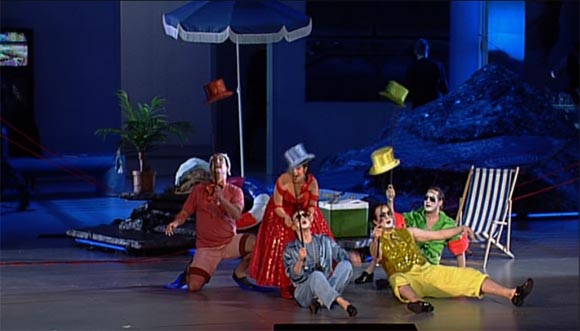
Brecht and Weill’s Rise and Fall of the City of Mahagonny is an awkward work for an opera company. It’s been said, rightly I think, that one can/must situate it in a triangle of which the vertices are opera, musical theatre and Brechtian theatre. John Doyle’s 2007 production for Los Angeles Opera is strong on the opera and musical theatre dimensions but decidedly unBrechtian. Despite a good idiomatic translation by Michael Feingold this production seems unwilling to skewer capitalism in the manner Brecht intended. It’s the polar opposite of the Salzburg recording that left no Marxist cliche unexplored. Maybe it’s a failure of nerve. Maybe capitalism in LA is already such a parody of itself that further skewering is impossible. Who knows? Even Act 2, which is all about the commoditization of basic human pleasures doesn’t really fire. Sure we get excess and commoditized sex but there’s no sense that the commoditization is dehumanising or transgressive. Sex for sale? Of course! It does get a bit darker in the final act with the trial and execution of Jimmy and finishes strongly on “Still we only built this Mahagonny” but by then it’s very much too little, too late. The lack of edge is reinforced by the orchestra under James Conlon. It’s all just too civilized. There’s none of the spiky dissonance one is used to in the score and the brass, in particular, sound like they are playing in the Palm Court of the Hilton.

It’s a shame because the singing performances are mostly very good. The leading female roles are played by Patti LuPone and Audra McDonald who both have Broadway backgrounds. LuPone sounds like that’s where she’s from too though McDonald manages a much wider range and pretty much steals the show. It helps that she is very good looking and practically naked. The guys are mostly from opera backgrounds; notably Anthony Dean Griffey as Jimmy McIntyre and Donnie Ray Albert as Trinity Moses. Both sing well and idiomatically. The sets are sort of Vegas lite with none of the inexplicable weirdness of the Salzburg production but not much interest either. Again things look up a bit in the last act with effective use of a giant video screen in the trial scene and moving slogans over the finale. Blocking is very Broadway, especially the big chorus numbers that look more Rodgers and Hammerstein than Brecht and Weill.

Video direction is by Gary Halvorson and it’s judicious. There’s often not much set to look at so we might as well have close ups of Ms. McDonald. The technical package is solid. The picture is high quality 16:9. The sound choices are PCM stereo, DD 5.1 and DTS 5.1. The last is nicely balanced and clear There are French, German and Spanish subtitles. There’s a useful essay in the booklet which gives full track listings and a 20 minute interview with the director.

Dido as dance

I guess another way of dealing with the dance elements in baroque opera is to dance the whole thing. That’s what Mark Morris Dance Group do with this 1995 version of Purcell’s Dido and Aeneas. The work is performed as a modern dance piece with the singers off stage. As it’s a film rather than a record of a live performance, the singers can be, and are, occasionally pulled into the visuals.

The piece is played out on an elegant blue and grey stage and backdrop with a (very) few white props as required and all the dancers are dressed very simply in black so the look is very spare but very elegant. The choreography (by Mark Morris) is of a school of modern dance that I don’t really understand. It’s almost like a parody of one’s idea of modern dance. At times overly literal, at others very jerky and inelegant. It certainly doesn’t have much in common with ballet, even of the more abstract modern variety. In this case it’s not helped by Morris himself dancing both Dido and the Sorceress. Some might find this bold and exciting. I think he just looks like a very unconvincing transvestite and I’ve see more than a few of those! So, no, this approach doesn’t work for me.

Musically it’s not bad. Jennifer Lane sings Dido and the Sorceress. She’s fine as Dido though not in the same class as Connolly or Ewing. She, along with the two witches, witch it up more than I care for in the witchy bits. Russell Braun is Aeneas and he’s more lyrical and less gruff than is often the case. The Belinda is Ann Monyious and, to be honest, she doesn’t sound entirely secure in the role. Mercury is sung by a soprano (uncredited) which is a bit odd and jarring. Tafelmusik supply the orchestra and chorus and are as good as you might expect. I think Jeanne Lamon is conducting but it’s not entirely clear from the disc or the package.

The filming is very good with the singers and chorus being effectively, if infrequently, inserted into the picture. The video quality is standard DVD with hard coded English subtitles. Dolby 2.0 is the only sound option. Documentation is minimal.

I think this one is strictly for the Mark Morris fans.

Burnt Toast

So this has to be the weirdest opera related thing I’ve seen in a while. It’s a 2005 CBC production of eight very short comic operas (the whole thing only lasts an hour) going through the stages of a relationship from Attraction to Starting Over via Marriage and Murder. The characters are mostly played by actors lip-synching while someone else sings. The music is by Alexina Louie and the libretto by Canadian comic, Dan Redican. Each piece is introduced by Redican as a mad toast scientist and the cast includes some of the best known names in Canadian theatre and opera including Colm Fiore, Isabel Bayrakdarian and Russell Braun. It sounds like a great idea but unfortunately it’s pretty ordinary. The music is mostly dull but it livens up a bit when it’s more obviously pastiche. The humour is a bit lame though the piece about a woman slicing her husband’s head off then disembowelling and liquidizing him for leaving the toilet seat up has its moments; especially her acquittal by an all female jury. Also you get to hear Isabel Bayrakdarian sing about kitty litter and Russell Braun do a version of Der Hölle Rache.

All in all, it’s as Canadian as moose jokes and about as funny.

toast

ETA February 1, 2016

So it’s been four years since I last watched this and the funny thing is that in that time I’ve come to know, one way or another, most of the singers involved in this thing who include Michael Colvin, Krisztina Szabó, Shannon Mercer, Peter McGillivray, Barbara Hannigan and Doug McNaughton.  It does make it more fun but I guess that doesn’t really work for a general audience.  It also makes me a bit baffled about who got to be played by an actor and who got to sing and act.  There are some pretty good actors involved here who never get seen.

Dido on film

Long before I got my hands on the Royal Opera House/Royal Ballet Dido and Aeneas, the film version from 1995, directed by Peter Manuira and with Maria Ewing in the title role, was my go to version. How does it stack up today?

Some things that strike me.  It’s very naturalistic. It seems to be set in and around a Tudor mansion and the costumes are vaguely that way too. The interludes that are normally danced are filled in with “busy” scenes that try to inject some feeling but aren’t nearly as effective as Wayne McGregor’s dancers. The hunt scene has dogs and spears and a real boar’s head (which Aeneas touchingly present to Dido in her bath). There is a lot of fire including a full blown pyre at the end. For all that it doesn’t seem any more “true” than Wayne McGregor’s much sparer vision. It’s also very emotionally restrained. It’s not really until the final confrontation between Aeneas and Dido that any real emotion intrudes and even then it’s quite restrained This is actually very effective and Maria Ewing is truly affecting in the final couple of scenes. Ewing is good throughout both in the singing and acting department and her looks help (OK I know not everyone goes for Ewing but I think she’s gorgeous!). Karl Daymond is fine as Aeneas. We get a sort of composite Belinda/Second Woman set up with some of Belinda’s music given to the Second Woman and them doubling up on other bits. While Rebecca Evans and Patricia Rosario are fine there really isn’t enough musical or emotional contrast between them and Ewing. Richard Hickox conducts the Collegium Musicum and it’s all a bit low key in common with much else. It’s worth watching for Ewing’s performance in the final act but is otherwise a bit of a snooze.

Technically it’s very 1995. The 16:9 picture is hard letterboxed in a 4:3 frame and it’s pretty soft grained. Sound is adequate LPCM stereo. There are English, French and German subtitles.

Let the triumph of love and of beauty be shown

One of the trickiest things about opera productions; baroque opera anyway, is what to do about the dance elements. Time was when opera and ballet were joined at the hip but not so much nowadays beyond sharing premises. In 2009 the Royal Opera House made the bold decision to have choreographer Wayne McGregor direct the combined forces of the Royal Opera and the Royal Ballet in a production of Henry Purcell’s pocket masterpiece Dido and Aeneas. The result was broadcast by the BBC and subsequently released on DVD and Blu-Ray by Opus Arte. It’s a fascinating and rewarding production.

Sets and costumes are very spare. Aeneas and the chorus are in greatcoats and wide trousers. The ladies are in unfussy gowns. The dancers are in singlets and booty shorts (both sexes). Carefully detailed direction of the singers and their gestures, bold choreography and imaginative lighting carry the visual side of the production. The use of top quality dancers and a top notch choreographer allows the dance elements to realise their full potential (and not a castanet in sight!). The result is visually stunning.

Now add a superb singing cast. Lucy Crowe almost steals the show as Belinda. She’s fresh and vivacious and her clean sound is just right for Purcell. But it is “almost” because we have Sarah Connolly’s monumental Dido to set against it.(1) She is one of the great Didos. I have heard Kirkby, Te Kanawa, Ewing and Baker in the role and even Flagstad but none exceed the combination of searing intensity and pathos that Connolly brings to the role. She is superb. Other elements of the singing are also admirable. Lucas Meachem is a hunky Aeneas and manages the tricky low notes better than most. The sorceress and witches; Sara Fulgoni with Eri Nakamura and Pumeza Matshikiza playing Siamese twins, don’t do the camped up distorted thing that is so often inflicted on the role. Fulgoni sings with quite a lot of vibrato which is sufficient to create some musical distance between her and the non infernal characters. The minor roles are all pretty good too. The regular Covent Garden orchestra is replaced by the Orchestra of the Age of Enlightenment under Christopher Hogwood. This is a move that other large houses might think about for earlier repertoire.

All this goodness builds to a searing climax in which Dido slits her wrists with the “tushes far exceeding those that Venus’ huntsman slew” and dies while a haunting projection of a horse plays back of stage. All in all it’s an hour of magic.

Video direction is much better than average. Close ups are minimised and we get to see the choreography in its broadest sense. The picture is superb 16:9 anamorphic (1080i on the Blu-Ray) and sound options are PCM stereo and DTS 5.1 (PCM 2.0 and PCM 5.1 on Blu-Ray). There are English, French, Spanish, German and Italian subtitle options.

Highly recommended.

(1) I do think the balance of voice types between Belinda and Dido is important. It’s like Carmen and Micaëla. If the voices are too similar much texture is lost. Crowe and Connolly are an ideal combination.

If I ruled the world…

… or at least if I ruled the COC and could design a fantasy season what would I do?

Design parameters:

  • Seven productions (because that’s what COC does).
  • Has to be balanced in the sense that it can’t all be obscurities I want to see.
  • Has to appeal to a reasonably wide audience but I’m not giving in to the sort of people who want to see Zeffirelli direct La Traviata every year.
  • Not constrained by some productions being long and expensive.

Continue reading