A blast from the past

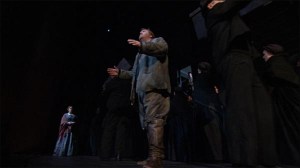
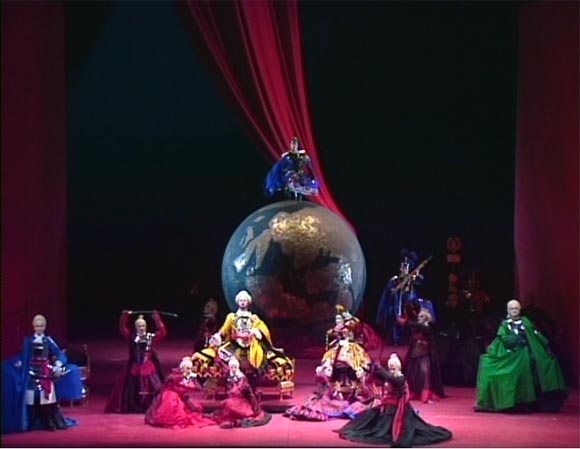
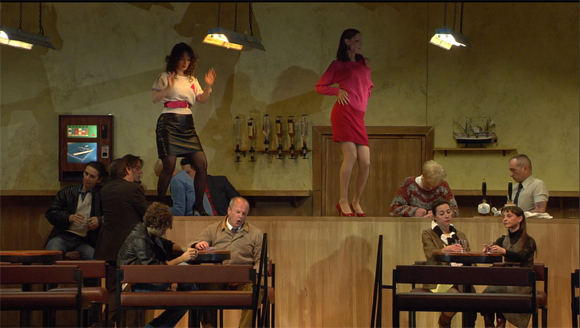
One of the first opera DVDs I bought was John Eliot Gardiner’s Le Nozze di Figaro recorded at the Chatelet Theatre in Paris in 1993. This is a pretty early example of period performance of Mozart. Gardiner was in the middle of his run of recordings for DG Archiv and it was only two years after Opera Atelier’s breakthrough Magic Flute which I saw only because one of my clients was sponsoring it and couldn’t shift the free tickets. This Figaro is pretty traditional in design and features “original instruments” and period singing style without going the whole Opera Atelier style baroque route (there are no castanets). Sets are flats plus bits of furniture. Costumes are breeches, crinolines and wigs. Olivier Mille directed but I’m not sure anybody noticed. At one point the Count looks exactly like Prince George in Blackadder the Third. The buffo characters are over made up and over the top. Regie has no place here.

The cast is excellent. 28 year old Bryn Terfel plays Figaro and already sounds on the big side for a period performance of Mozart. Susanna is the sadly under-recorded Alison Hagley; an ideal Susanna both as singer and actor. Rodney Gilfry plays the Count with a perpetual sneer and other Gardiner regulars such as Hillevi Martinpelto, as the Contessa, are prominent. In the future star department we get Sarah Connolly as one of the contadine. Pacing is a bit breath taking. Terfel in particular takes his recitatives so fast it’s hard to tell if he is actually singing. Despite looking rather old fashioned and having a bit of a feel of period performance for the sake of it, the production does come off really well.

The production for DVD is a bit odd. The opera was filmed as 16:9 but it’s hard coded to disk as 4:3 so if you watch it on a widescreen TV it’s letterboxed both ways. The picture is adequate DVD quality. The only sound option is LPCM stereo and there are IT/EN/DE/FR/ES/CHI subtitle options. The documentation includes a long essay on how they decided to order some of the numbers differently from the autograph score. All in all, an interesting artefact as a very early DVD capturing a very decent performance.

This Youtube clip is of abysmal video quality but it does give a fair idea of the production.

Svadba-Wedding revisited

Back in June I attended and wrote up the world premiere of Ana Sokolovic’s Svadba-Wedding. Today it was given again in a concert performance by the original cast in the Richard Bradshaw Amphitheatre at the Four Seasons Centre. I’m not going to repeat what I said in the earlier review but focus on my reactions to seeing it again. First off, it works very well as a concert piece losing less than a more obviously narrative work might. Second, I was struck by the interesting way the piece weaves two very different musical strands together; the high tempo, almost percussive, onomatopoeic elements as referred to before but also a more lyrical element where a long, slow, folk derived line is introduced and then a second and maybe a third or even a fourth melody are woven in to create a rather dense harmonic texture. This second element is particularly apparent in the final number “Farewell”. The contrast is very effective. Finally, Jacqueline Woodley sounded even more like a young Dawn Upshaw. Her ability to sing powerfully with next to no vibrato is very compelling in this sort of music. [Image by John Lauener is from the staged production at Berkeley Street and was lifted from today’s performance flyer]

Thomas Allen appointed Chancellor of Durham University

I saw Thomas Allen sing Ned Keene in Peter Grimes at the Royal Opera House in July 1975, some two months before I became an undergraduate at the university he is now Chancellor of. He follows in the footsteps of some distinguished predecessors including Margot Fonteyn and Peter Ustinov.  The photo on the left is from the programme for that Peter Grimes.

Fidelio – Metropolitan Opera 2000

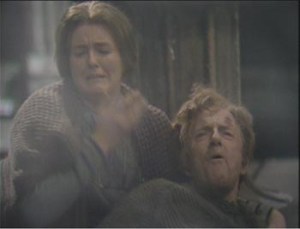
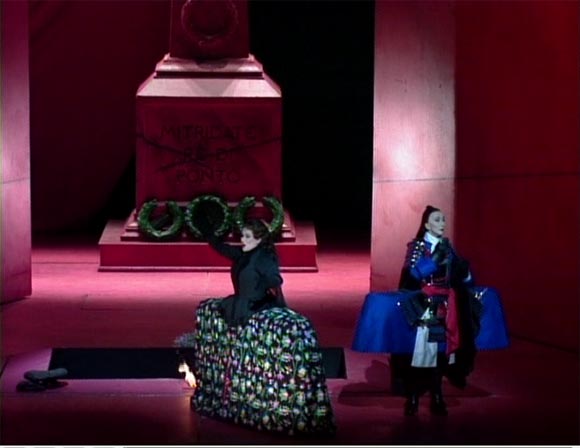
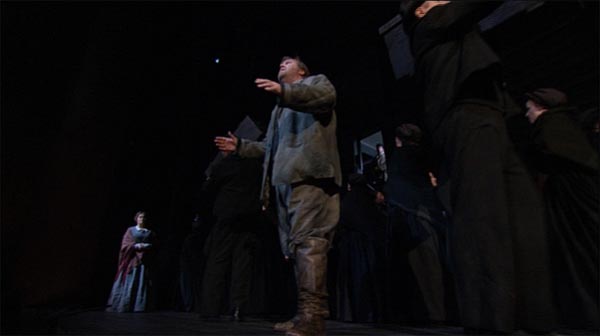
Apparently the 2000 production of Beethoven’s Fidelio at the Met was controversial. It’s very hard to see why. Although Jürgen Flimm has moved the setting to the mid 20th century and some unspecified country that looks vaguely Germanic the storyline is followed to the letter, bar a few changes to dialogue, and there is no risk at all of any dangerous ideas surfacing. It’s actually a very good example of what the Met does when it’s on form; assemble an all star cast, stick them in an inoffensive production and let the music do its thing. Here we have an enviable cast. Leonora/Fidelio is sung by Karita Matila who looks and sounds spectacular (although maybe the fact that she’s the only “male” among the principals with no facial hair should have triggered a little cluefulness). Vocally she is most assured and never seems under any strain at all. She acts well too. Ben Heppner, as Florestan, is also vocally solid and even quite lyrical in the big trio “Euch werde Lohn in besseren Welten”. The acting though is best passed over in discrete silence. René Pape is fascinating as Rocco, the gaoler. I’m used to seeing Pape playing magisterial roles like Boris Gudonov or Sarastro. Here, the big voice is coupled with almost bumbling acting as he plays a morally weak character. It’s most interesting. A young Matthew Polenzani, one of my favourite tenors, sings Jacquino and he sings quite beautifully. Marzellini is Jennifer Welch-Babidge who I had never heard before but was sufficiently impressed to go look her up. It seems she’s busy with four kids in Utah and doesn’t spend much time at all in opera houses these days. It’s rather a pity. Falk Struckmann’s Don Pizarro is appropriately villainish and musically solid like everyone else. James Levine conducts and right from the overture launches us into a very intense, muscular reading of the score backed up by a very high standard orchestra. Musically and dramatically this is very satisfying albeit in a thoroughly conservative way.

The production was recorded for TV broadcast and it shows. The sets are already pretty claustrophobic but Brian Large’s video direction amplifies that. One gets the feeling that this is being directed for a 27 inch screen and it looks a bit lost on anything much larger. That said, the picture is more than decent and the DTS 5.1 soundtrack is top notch (Dolby 5.1 and LPCM stereo are also offered). The English subtitles are a bit odd. For some reason “Gouverneur” is translated as “Colonel” and “König” as “President”. I didn’t check the French, German, Spanish or Chinese subs for similar oddness. Bonus material is minimal but the documentation is fairly decent. All in all it’s a typical Deutsche Grammophon release of its period.

This excerpt from Act 1 (Gut, Söhnchen, gut) is pretty typical.

Beautiful simplicity

I don’t think I’ve ever been to an opera with higher expectations than last night. The show was a piece I love; Gluck’s Iphigénie en Tauride. My favourite director, Robert Carsen, was directing. The cast; Susan Graham (Iphigénie), Russell Braun (Oreste), Joseph Kaiser (Pylade), Mark Doss (Thoas) with solid young singers in the minor roles, was as starry as I have seen at the Four Seasons Centre. How could it live up to my expectations? All I can say is that it did.

The stage design for Carsen’s production is about as minimalist as it gets. The raked stage is enclosed by three plain grey walls in the form of a regular trapezoid. Occasionally a rectangular slab (altar) appears centre stage. The chorus chalk the words AGAMEMNON, IPHIGENIE, KLYTEMNESTRE on the walls and later Iphigénie erases them. The rest is done with lighting (Peter van Praet). Even the lighting plot is spare. The palette is predominantly blue-grey with orange/red appearing to symbolise the Furies and the violence of the history of the house of Atreus. Only at the very end does the gloom and claustrophobia lift. Within the gloom though van Praet creates ominous giant shadows of the characters which enormously enhance key scenes.

To play out the drama in this gloomy space Carsen uses dancers and places the chorus in the orchestra pit. Occasionally this leads to minor balance issues between the soloists and chorus but it is a small price to pay for the action on stage. In one particularly effective scene, the Furies carry Oreste and force him to walk sideways across the text of KLYTEMNESTRE. In another they turn into writhing serpents who back Oreste into a corner. In the final scene the “dea ex machina” element is handled about as well as I have ever seen it done. Diana (Lauren Segal) sings, unlit, from what sounded like Ring 4 stage left. The characters on stage are frozen. She resolves the drama and the stage walls rise about six feet to flood the stage with very white light. Unfussy and effective. All in all one feels that Gluck’s ideal of a “beautiful simplicity” is achieved. The one place where the minimalism is a bit of an issue is that all the characters pretty much look the same to the point where it isn’t always obvious who is singing. A good pair of opera glasses, a decent seat and knowing what the main singers look like helps here. I think the approach works in part because the drama moves ahead at a breathless pace. Wagner would need about fifteen hours to get through a story that Gluck manages in less than two hours.

Musically the evening was about as good as it gets. Pablo Heras-Casado pushed things along at a pretty fair pace but didn’t lose the drama. He was helped by some gorgeous woodwinds. The soloists were all quite excellent. Susan Graham owns this part, her rather bright mezzo suits the role and she sounded utterly in command. Joseph Kaiser and Russell Braun worked really well together in a reading that wasn’t as obviously homoerotic as some I’ve seen. Kaiser has a lovely Mozartian tenor and Braun has power and beauty of tone to spare. Mark Doss was appropriately violent as Thoas and I’d really like to see what he could do with something more lyrical. The minor roles were all more than adequately covered by local singers who will be familiar to anyone who frequents the Four Seasons Centre.

So, my unrealistic expectations were met and I thoroughly enjoyed one of the best evenings I’ve spent in an opera house. I’m late to the party though. If you want to catch this show Susuan Graham is singing just one more time on October 12th and there is a final performance with Katherine Whyte in the title role on October 15th.

Rigoletto revisited

Last night I went back to the Four Seasons Centre to take another look at Christopher Alden’s Rigoletto. I was up in Ring 5 this time so quite a different viewpoint and it was the opening night cast singing. I now have a better understanding, I think, of what Alden is driving at and some of the stage action that was just puzzling first time around made more sense. Certainly the role played by Giovanna (Megan Latham) makes much more sense seen as the count’s procuress. The interpretation of Sparafucile is also interesting; part commedia perhaps and reminiscent of the quack in L’Elisir d’Amore with a sinister twist. If we take as valid Alden’s assertion that Rigoletto’s separation of personal and public life is a delusion then having all the action played out in “public” makes a certain kind of sense, though then I have to ask why, uniquely, the scene where Gilda confesses to her father what we (and he) already know, that she has been debauched by the duke, has to be between the two of them is a bit of a mystery. So, all in all, I still think it’s an interesting and very beautiful but not quite “of a whole” production. I much prefer that the COC take some chances even if not everything comes off 100% and I shall look forward to Mr. Alden’s next production here.

Musically there wasn’t a lot to choose between this cast and the one I saw on Friday. Quinn Kelsey is a very powerful Rigoletto and he was a little more restrained in the acting department than Lester Lynch. All in all a very fine performance. Dmitri Pittas was solid as the duke but I think David Lomeli has a more Italianate sound. Ekaterina Sadovnikova is a rather different Gilda to Simone Osborne. Her voice is lighter coloured and perhaps more classically suited to this role and there were none of the top end insecurities that some commented on on opening night. She did seem a bit underpowered in the duets with Kelsey but was fine singing solo. Once again I was pleased/surprised by how good the sound is up in the nosebleeds.

Bottom line, I still think this is a production worth seeing. The house wasn’t full either night I went and, in particular, there were plenty of seats last night in Ring 5. I got a second row dead centre seat as a “rush” ($22) and there were still OK seats available for that price half an hour before curtain.

Artists of the University of Toronto Opera Division

Today’s lunchtime concert at the Four Seasons Centre was given by singers from the University of Toronto’s Opera Division. This is described as the university’s programme for professional singers but what that means in a city that has a professional opera company with a young artists programme and a conservatory I don’t quite know. Certainly the standard today was generally below what I’ve experienced from singers at the RCM and not close to the same league as the COC Studio Ensemble. Many of the singers sounded as if they were forcing their voices beyond their comfort zone in an attempt to sound “operatic” but were only succeeding in producing the sort of sound that persuades people they don’t like opera. Enough negativity, let’s turn to the highlights. I thought the best of the singers was baritone Josh Whelan. He stood out in an otherwise undistinguished rendering of the sextet from Lucia di Lammermoor and was very presentable in an excerpt from Menotti’s The Telephone. In the latter he was partnered by soprano Eliza Johnson who was pleasant to listen to in a rather undemanding piece. Mezzo Alexandra Beley and soprano Rosanna Murphy also sang quite nicely in a couple of excerpts from Cosi Fan Tutte though both tended toward scenery chewing which seems out of place in a piano accompanied recital (this seems to be a division characteristic). Once again I was struck by what a wonderful accompanist Sandra Horst is.

I hate to be negative about young singers but, all in all, this was rather disappointing.

Thurday members of the Ensemble Studio are performing French art songs. It looks good and I had planned to go but it now looks like I have a refereeing gig that afternoon. Maybe I can get the lemur to guest blog it.

Lynch, Lomeli and Osborne rock Rigoletto

Last night was the second performance of the COC’s new Rigoletto and the first featuring the alternate leading role trio of Lester Lynch (Rigoletto), David Lomeli (Duke of Mantua) and Simone Osborne (Gilda). The rest of the cast was as on opening night.

Musically this was a really splendid evening. Everybody sang really well. I like Lester Lynch’s idiomatic playing of the title role and he managed to combine a not inappropriate amount of scenery chewing with being thoroughly musical. Lomeli lived up to the “dragged from obscurity by Placido Domingo” hype. I think there is a true Italian tenor emerging here. He nailed his arias with lovely ringing high notes and plenty of swagger. Osborne, on role debut, was lovely. Caro nome was one of the highlights of the evening and ,in general, she sounded very secure across some pretty tough music. The chemistry between the three was pretty good although the production maybe put more emotional distance between Gilda and Rigoletto than is sometimes the case. In any event the voices blended well and seemed well balanced. Among the other roles I was particularly impressed by Kendall Gladden’s Maddalena. She has a really smoky mezzo that created a pleasing contrast with the brighter voices. She’s a pretty fine actor too so it’s easy to see why she gets cast as Carmen! I also liked Philip Ens’ Sparafucile. He was a sinister presence and a genuine bass with a thoroughly solid lower register. All in all, the casting managed to combine very good individual singers into an ensemble that had a really good balance of tone/timbre. The orchestra and chorus were at their usual high standard and Johannes Debus kept things together very nicely and didn’t distract from the singing and I do think this is very much a singers opera.

The production and design (Christopher Alden and Michael Levine) was very decorative. All the action plays out in a lavishly panelled and furnished “gaming room” looking something like the smoking room at one of the better London clubs in the mid/late 19th century. It does duty for the duke’s court, Rigoletto’s home and Sparafucile’s inn. In a sense this creates a kind of unity; all of these spaces are misogynistic theatres of corrupt power and delusion. On the other hand it requires the audience to suspend disbelief more often and more willingly than usual. It’s an odd kind of secret that can be sung mezzoforte in front of the people it’s supposed to be secret from! The male dominated Victorian aesthetic seems to produce a kind of emotional coolness too. We never quite get enough emotional charge in the Gilda/Rigoletto dynamic to fully feel his loss (i.e. I didn’t cry at the end). The final scene though is splendidly and very effectively done.(*)

So summing up, I enjoyed the show.  Musically it is first rate.  The production was interesting but I don’t think the concept was quite able to carry the piece emotionally.  It’s not a disaster and there’s nothing to shock the traditionalist.  Maybe if I had seen Rigoletto a million times before I’d be more positive.  Go see the show and judge for yourself!

The production runs until October 22nd and there is a choice of the cast we saw or Quinn Kelsey, Dmitri Pittas and Ekaterina Sadovnikova as Rigoletto, the duke and Gilda.

(*)Spoiler follows… Continue reading

Opera 101 – Rigoletto

The second Opera 101 of the season took place at the Duke of Westminster last night. The panel were tenor David Lomeli, director Christopher Alden and designer Michael Levine. Once again the event was moderated by Brent Bambury. Alden kicked off with describing his overall concept for the production which he sees as being about how people balance their public and private lives in a world of constraining and essentially corrupt power structures. We got a fair amount about the history of the production which originated with a version in Chicago that got very mixed reviews. Michael Levine also talked about his view that people today see differently from people in Verdi’s time (the argument turns on the relationship between painting and stage aesthetics) and therefore he designs to meet our visual perceptive expectations. Inevitably at this point we got into the perpetual Opera 101 debate about it being all about the singing and can we have our traditional productions back please. It actually was almost a caricature of that debate with Alden saying that if he didn’t get booed he hadn’t done his job. Sometimes I almost (almost!) sympathise with the traditionalists. It’s obvious that the aesthetic Powers That Be really despise them. I suppose I do too really.

Gears changed a bit when emphasis turned to David Lomeli and his discovery as an “unknown” by Placido Domingo. Articulate as Lomeli was (far more articulate than Alden or Levine), it didn’t ring quite true. I think there are genuine discoveries of kids who knew nothing about opera growing up but I’m not sure that can be true for someone whose grandmother sang with Di Stefano and spent seven years as a professional singer at the opera in Mexico City. He was interesting and funny on how he reacts as a singer to different production concepts. As always, I think this boils down to a singer takes what they are given until/unless they become a superstar and then they get to pick and choose. He did do a neat demonstration of how an operatic tenor treats high notes versus how a mariachi singer does. He nearly blew the lid off the pub in the process.

I got to ask Christopher and Michael if there were more obscure or neglected works (rather than reinventing war horses) that they would like to bring to the stage. I was surprised but heartened that they both wanted to do new, contemporary work. Alden said there were a couple of younger American composers he was interested in but wouldn’t name names.

Umbrellas and underpants

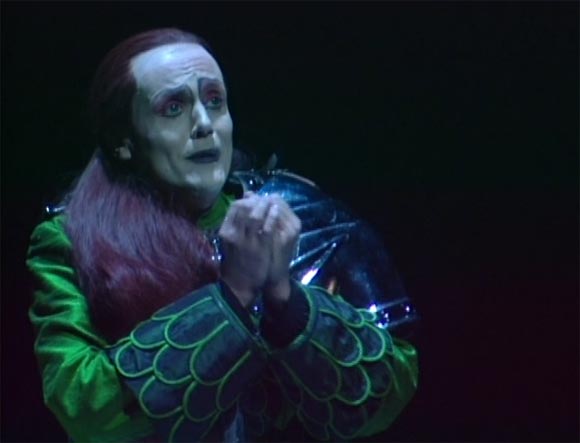
I’m not a huge fan of French baroque opera but I am a huge fan of Robert Carsen which is why I had a look at the DVD recording of his 2003 Paris Garnier production of Rameau’s Les Boréades. I’m still not a huge fan of French baroque but Carsen certainly makes the most of the work on offer.

1.leaves Continue reading