Arma virumque canunt

Berlioz’ Les Troyens is widely considered to be his masterpiece and it does have a lot going for it both dramatically and musically, especially when given the full on star studded treatment that it got at the Chatelet in 2003. That said, it’s dramatically rather odd, it’s very long (well over four hours) and it requires huge forces; twenty soloists, massive chorus, dancers, supers, acrobats, jugglers etc. It also has preludes, ballets and masques on a scale that seem more appropriate to the 17th than the mid 19th century. Act 4 is particularly marked in this respect. It’s perhaps no wonder that it was never played complete in Berlioz’ lifetime. The story is taken from Books two and four of Virgil’s Aeneid; the first dealing with the wooden horse and the fall of Troy (Acts 1 and 2) and the second with the Trojans at Carthage (Acts 3-5). The problem is that there isn’t much connecting them. In the first part the drama centres around Cassandre. By the end of Act 2 she’s dead and we move on to Carthage where Didon makes her first appearance. The Trojan hero Énée links both halves but he’s a pretty minor presence in the first bit.

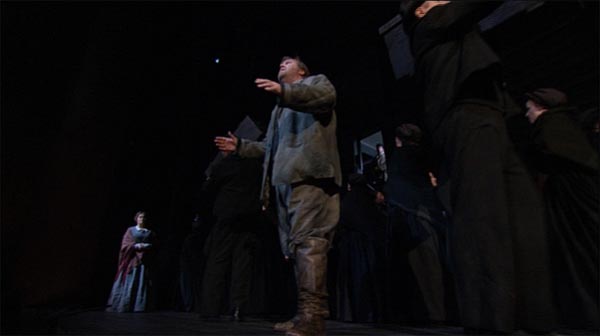
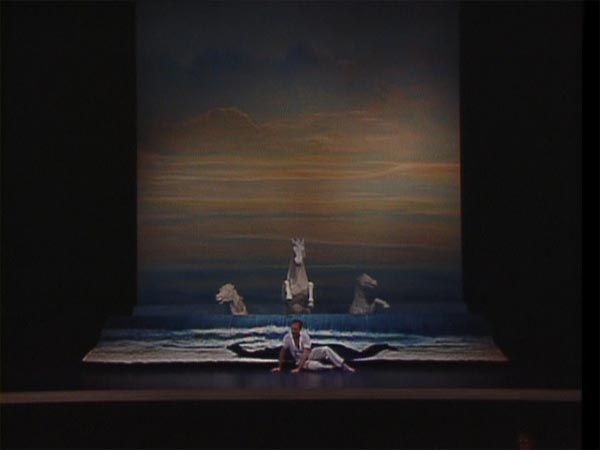
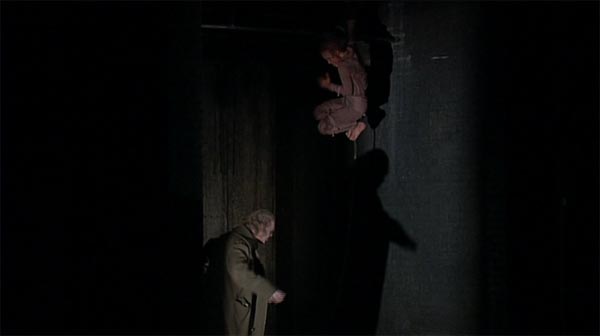
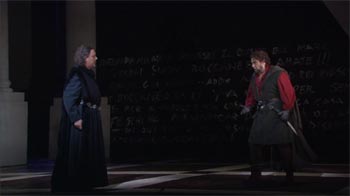
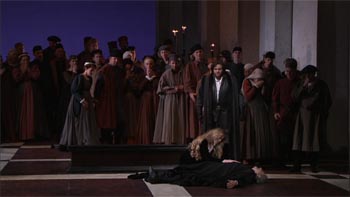
In Acts 1 and 2 Troy is a sparse stage with a reflector above it projecting much of the action onto a backdrop of an Italianate cityscape of Troy. It’s a good idea as for most of the act there are a lot of people on stage and it’s not easy to take it all in. Occasionally the cityscape dissolves into some kind of symbolic back projection as with the the horse itself which is just a rather grim projection of a horse’s head. It works pretty well. A similar approach is used to introduce the scene where Hector’s ghost tells Énée he’s got to rebuild Troy in Italy. The camera work for the DVD switches between stage and backdrop with the usual close ups and just occasionally pulls back to let us see what the theatre audience is seeing. All in all I think Peter Maniura is giving us as good a look at Yannis Kokkos’ staging as could reasonably be done on DVD.

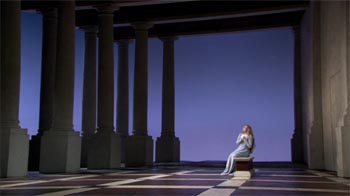
Vocally, the first part is all about Cassandre, here played by Anna Caterina Antonacci. She’s stunning. She gives a totally committed performance as the prophetess who everyone thinks is mad until it’s all too late. She stands out visually in a simple white dress against the rest of the Trojans who wear greatcoats of mixed military provenance and otherwise look generally scruffy giving an effect somewhere between Colditz and Les Miz. Her singing and acting are both quite mesmerizing. She is well backed up Gregory Kunde’s Énée although he doesn’t have too much to do. He manages to sound like a bel canto singer while upping the heft to cope with some pretty dense orchestration.

Here’s a clip of Antonacci which gives a pretty good idea of the overall idea.

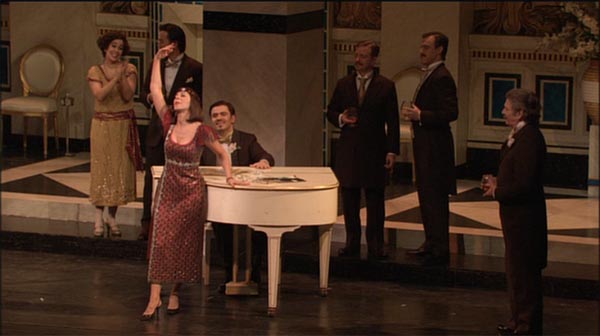
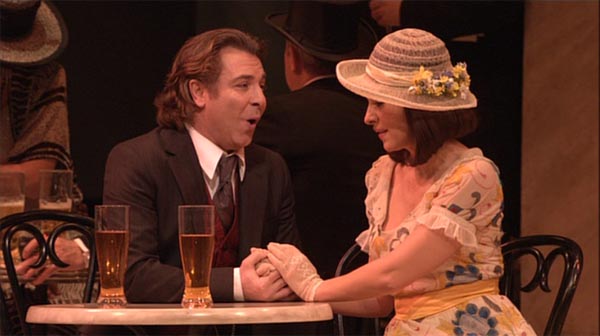
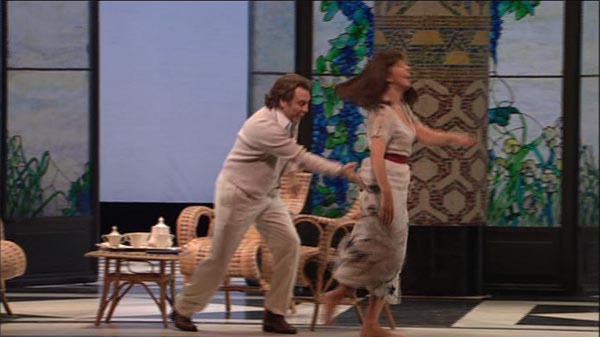
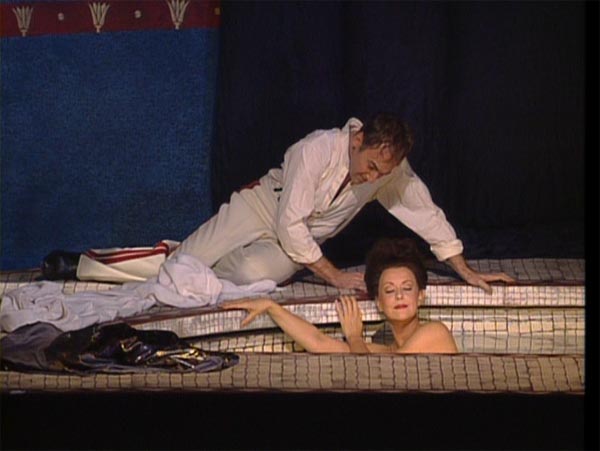
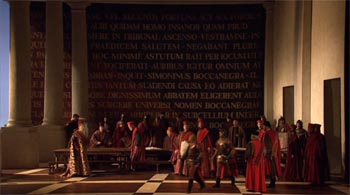
Act 3 involves a total shift of dramatic and aesthetic gear. Now we are in Carthage where Didon (Susan Graham) is presenting the results of the first Five year Plan to what looks like a cross between a Druidic gorsedd and a meeting of the Carthage Soviet of Workers and Peasants. The plan has met its targets but their idyllic existence is threatened by the king of Numidia who wants to marry Didon and is marching on Carthage. Énée appears and offers to save the peace loving Carthaginians (nb these are not the baby burning, general crucifying Carthaginians I remember from history) by doing the fighting for them. This is followed by a longish section where Didon’s sister Anna (the very fetching Renata Pokupić) tries to persuade her that hooking up with Énée would be a smart move. This continues into Act 4 which rather drags. There’s a long, almost Wagnerian, prelude after which Didon enters, obviously head over heels in love. We can tell this from her little interpretative dance and her spending the next half hour looking like a contented hamster watching several ballets complete with jugglers and acrobats.. The entertainmet concludes with singing, dancing Nubians who could have come straight out of National Geographic c. 1950. Finally we get going again and Didon decides that maybe the Énée thing isn’t such a bad idea after all. She and Énée sing the gorgeous duet “Nuit d’ivresse”. Kunde and Graham are very fine indeed in this as you can see below. Both these acts are played out on a brightly lit stage with lots of bright whites and colours.

The act concludes on an ominous note as Mercure reminds Énée of his Italian destiny.

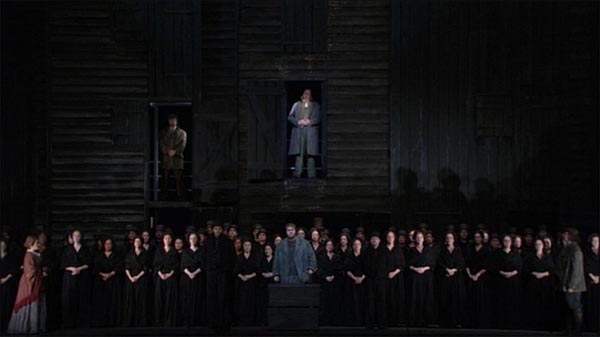
In Act 5 we are back dramatically and aesthetically more or less where we started. It’s dark, Trojans in greatcoats, the reflector. The ghosts of the dead Trojans remind Aeneas of his quest. He decides to obey. Most of the rest of the act is Susan Graham going through a full gamut of emotions; anger, grief, vengeance, resignation. It gets a bit over the top but she is elemental and always musical. Graham steals the show in the final three acts but she is very well supported by Pokupić’s Anna and Laurent Naouri’s Narbal as well as Kunde. Cassandra (or her ghost) get the last word but nobody is going to believe her.

John Eliot Gardiner conducts the Orchestre Révolutionnaire et Romantique. He pushes things along well without sacrificing grandeur at the needed points. The period instruments give some pleasing variation of tone colour. The chorus is the ever excellent Monteverdi Choir. No problems in those departments.

Peter Maniura’s screen direction maintains its high standard through the second half. So what of the disk package? It’s an Opus-Arte production and it was filmed in high definition. The 16:9 anamorphic picture is superb even on DVD (which is what I watched) but it is also available on Blu-Ray which should be even better, especially as the Blu-Ray is cheaper and two discs versus three DVDs. Sound is LPCM stereo or DTS 5.1 (DTS HD on the Blu-Ray). The DTS track is really good with real depth. There is even adequate documentation and an hour long “Making of” documentary. All in all, it’s what an opera DVD/Blu-Ray release ought to be.

And so it begins again

Today was the opening concert of the season for the free concert series in the Richard Bradshaw Amphitheatre at the Four Seasons Centre. As has become standard practice it was a recital by the artists of the COC Studio Ensemble. All the members sang except for Ambur Braid who was ill and Ileana Montalbetti is singing in Elektra in Rome at the moment. I have to say it was great to be listening to live, unamplified singing again after a summer of mostly DVDs. I was most interested to hear newcomer Philippe Sly who I had not heard before. He sang one of the Count’s arias from Figaro. He has a very pleasant voice with plenty of power though I think he lacks a bit of variety and drama. He’ll learn that quickly enough in the Ensemble Studio program. The other newcomer was Mireille Asselin, who I had heard before. She sang a rather weird aria from Poulenc’s Les Mamelles de Tiresias. No lack of drama or humour in her performance! The other standouts for me were Adrian Kramer and Simone Osborne. Adrian sang “Mein Sehnen, mein Wähnen” from Die tote Stadt. His diction and acting are superb and he managed an absolutely gorgeous floated pianissimo on the final “Zurück”. Simone gave us one of Norina’s arias from Don Pasquale. She just gets better. She has quite a powerful, rich voice with really strong, sweet high notes. The progress from even a year ago is obvious. She can act too. There is no question that she is one to watch on the opera scene. Fortunately, that’s exactly what I will be doing in ten days time when I shall see her role debut as Gilda in the COC’s production of Rigoletto. The season is off to a good start.

Handel for the Handelians

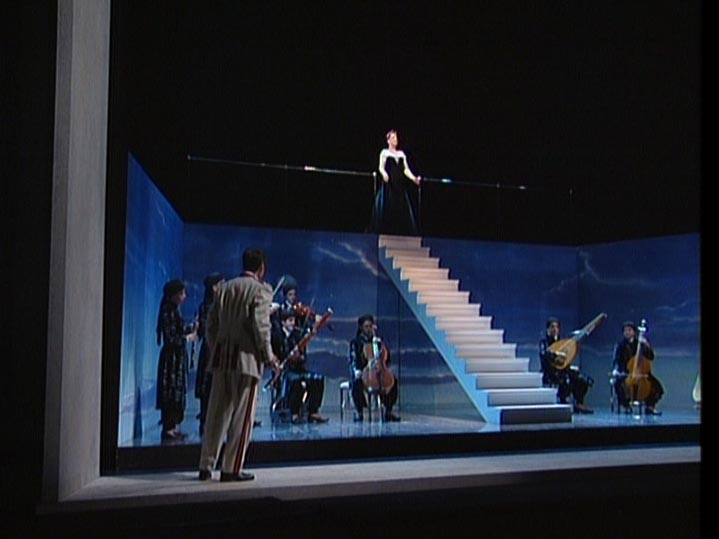
I think maybe Handel’s Rodelinda is one for the hard-core Handelians. It’s got some lovely music but it’s long (200 minutes), not very dramatic (it’s based on Corneille) and, structurally, is a succession of recitative and da capo arias. There is no chorus and I only recall two numbers that weren’t solos; the concluding quintet and a rather lovely duo between Rodelinda and Bertarido at the end of Act 2. Jean-Marie Villégier’s 1998 production for Glyndebourne rather tends to emphasise the leaning to elegance rather than drama. The basic look and feel is “silent movie era”. Sets and costumes are near monochrome and that tends to be emphasised by the lighting. At least when there is a any. Much of this production is very dark, as was fashionable at the time.

r1

Continue reading

My love/hate relationship with Wagner

There’s this part of me that thinks I ought to like Wagner. In some ways I do. The Rhinegold was one of the first operas I saw live when Goodall was conducting at ENO and I loved it. I like most of the Ring and I’m very fond of Der Fliegende Holländer but I also see the essential truth in the two great Wagner witticisms:

Anon to Evelyn Waugh – “What was Crete (i.e. the battle of) like?”
Waugh – “Like German opera; too loud and too long”

and…

Wagner lover – “There are some amazing moments in Wagner”
Wagner skeptic – “And there are some damn dull half hours in between”

This really comes to a head for me with Tristan und Isolde. If ever fifteen minutes of plot were compressed into five hours this is it. Essentially nothing much happens; very slowly; and very loud. I think it’s only ever performed because (a) it’s Wagner and (b) that chord. Five hours is an awful lot of bum numbing to experience one moment of musicological history. Maybe this is why directors try so hard to make it look like something is going on? This surely reached utter desperation point in the Met’s HD broadcast, when I thought I was watching a game of Tetris, though the current fugly Bayreuth production runs it close. I know I’m not the only one who has this problem as witness Julia Spinola’s essay Der Kunst der Langsamkeit. I just lack the ability to put my thoughts into German Higher Bollocks. Or maybe my Imperial wardrobe detector kit is more sensitive than hers.

I’m not giving up on Wagner. I like the music in Lohengrin for example and I’d really like to see the current Bayreuth production. Most operas are improved by rodents in my experience. I don’t know Tannhäuser or Parsifal at all well so there’s some exploring to do there. I think I’m done with Tristan though.

More Carsen genius

I’m a big fan of Robert Carsen. His Orfeo ed Euridice was one of the highlights of last year’s COC season and his Iphigénie en Tauride promises to be one of the events of the upcoming season. So, as you can imagine, I had high expectations for the DVD of his 2002 Paris production of Dvořák’s Rusalka with Renée Fleming in the title role. I wasn’t disappointed. The production is pure magic. It’s almost a mathematician’s production. In Act 1 he gives us symmetry in the horizontal plane. There’s a bedroom reflected horizontally floating above the water sprites’ abode which resolves itself into the bedroom that is the setting for Rusalka’s initial encounter with the prince. In Act 2 we get the same bedroom but in a left right symmetry and the movements of the characters are also mirrored with non singing actors mirroring the singers. The symmetry continues with Rusalka balanced against the foreign princess. It’s very cool. I’m guessing that Carsen is suggesting the distance between the world of the sprites and the human world diminishing then opening up again. In Act 3 we get geometrical chaos as Ježibaba’s hut is presented at crazy angles poised above the stage and all sorts of dissolution goes on before we again get the symmetrical bedroom in which the final tragedy plays out. The general concept is supported by a superb lighting plot (Carsen and Peter van Praet) that brilliantly brings out the moods of the different scenes. And there’s no clutter. Scene follows scene pretty much seamlessly. It’s terrific stagecraft.

1.upsidedown Continue reading

Stylish gender bending

I guess Serse gets performed as often as any Handel opera but there only appears to be one DVD version in the original Italian available. It’s a 2000 production from the Dresdner Musikfestspiele. Michael Hampe directs a cast of, then, fairly young singers, few of them familiar to me. Christophe Rousset conducts Les Talens Lyriques and the Ludwigshafener Theaterchor. It’s a really good DVD. The costumes and sets, by Carlo Tommasi, are a sort of mid 19th century European with “exotic” touches. There’s a consistent palette of black, white, grey and silver with a little deep blue and cream intruding. It’s all very elegant. The direction is more than competent. The relationships between characters are explored and Sandrine Piau, as Atalanta gets to exploit her considerable comic talents. To cap it all off we get a few, very apt, pyrotechnic surprises right at the end.

The singing is uniformly excellent. Paula Rasmussen, a mezzo, is cast in the castrato title role. It’s a role where personally I’d prefer a David Daniels or a Lawrence Zazzo but she manages to look and sound masculine enough. The same is true for Ann Hallenberg as “his” brother Arsamene; a genuine mezzo role. Patricia Bardon sings Amastre, Serse’s discarded lover who spends 9/10 of the opera disguised as a man. Ms Bardon manages the difficult feat of acting a woman pretending to be a man convincingly which is obviously quite different from a woman acting a man. I won’t try and describe the singing performances individually because I would just end up using “stylish” way too much. These are all thoroughly idiomatic Handel performances with tasteful decoration, lovely legato and accurate coloratura. The two sisters Romilda and Atalanta are played by sopranos Isobel Bayrakdarian and Sandrine Piau. It was a real pleasure to be reminded of what a fine Handelian Bayrakdarian was right at the start of her career. Her singing is just gorgeous. Piau is great too. She has great comic timing in a role that really needs it and she also gets the most coloratura fireworks which she handles very well indeed. The guys who play guys are Marcello Lippi as girls’ father, Ariodate, and Matteo Peirone as the servant, Elviro. These are both essentially buffo roles and both men are well up to them. I don’t think I’ve heard M.Rousset and his Les Talens Lyriques before but they are as good a Baroque band as I have come across. The chorus doesn’t have much to do but it does fine with what it does have. All in all, it’s very satisfying musically and dramatically.

Direction for TV/DVD is by Philip Behrens and it’s OK. There aren’t too many intrusive close ups though it’s a 4:3 picture so some of that is a bit inevitable. Picture quality is pretty typical of TV to VD productions. Sound options are PCM stereo or Dolby 5.1. The surround version sounded very good. There are no extras on the disk and the documentation is pretty basic. It’s a Euroarts production.

There’s a ten minute trailer up on Youtube that gives a really pretty good idea of what to expect though it’s a bit short on comedy and there’s no Sandrine Piau. Here it is.

And here’s some Sandrine Piau.

Just for Fun 1/n

Nude actors wearing Mickey-mouse masks walk past opera singer Adina Aaron as Amelia (L) as they perform on stage during a rehearsal of Giuseppe Verdi’s opera “Ein Maskenball” (“Un Ballo in maschera” / “A masked Ball”) directed by Austrian Johann Kresnik, on April 9, 2008 in the eastern town of Erfurt. The production will have its premiere on April 12, for which Kresnik hired some 30 seniors to take part in the opera. (Photo credit – JENS-ULRICH KOCH/AFP/Getty Images)