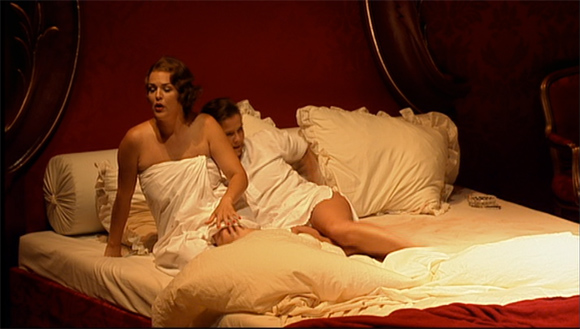
Tancredi in Schwetzingen

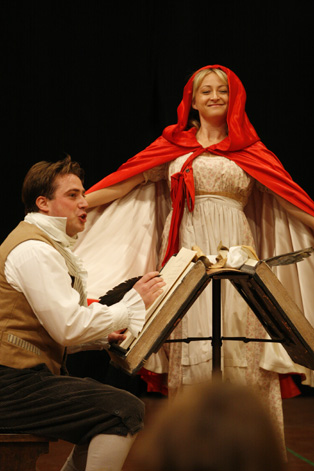
Rossini’s Tancredi isn’t performed particularly often but it was Stendhal’s favourite opera and it’s not hard to see why both these things are true.  It’s got some really lovely music but the plot is pretty thin and it’s hard to cast.  It needs a very versatile low mezzo/contralto for the title role and a crackerjack soprano and tenor too.  I watched it in a well cast 1992 production from the Schwetzingen festival and enjoyed it despite some frustrations with the staging and the implausibly drawn out plot of the second act.  Continue reading

Broken down by age and sex

The COC board reviews ticket sales data

Broken down by age and sex – that’s what they say happens to statisticians over time but this one retains his fascination with data and will happily torture it in search of a conclusion or three.  In this case the data is contained in an interesting round up of the Canadian Opera Company’s 2011/12 season.

Continue reading

Turandot in the Forbidden City

Being an opera lover would probably be easier if I liked Puccini more, given how much air, DVD and stage time his works get, but I really struggle with him.  I think it’s that concepts like “subtlety”, “elegance”, “verisimilitude” and “cultural sensitivity” completely passed him by.  In an Italian setting his bombast and melodrama are somewhat made up for by the catchy tunes but move him to China or Japan or the United States and my ability to override my reality chip fails me.  Which is a long winded way of saying Turandot is not my favourite opera.

Continue reading

Patchy Zauberflöte from Ludwigsburg

The Gramophone Guide describes the 1992 Ludwigsburg Festival production of Die Zauberflöte as a “life-enhancing experience” so I thought I’d take a look.  I think the folks at The Gramphone Guide are rather over-egging it but it is a pretty decent production.  It’s very much geared to Ludwigsburg’s small stage and limited scenery handling capacity but it makes good use of the space and clever lighting, including a willingness to black out the stage, and some deft stage craft make up for the limitations. Continue reading

One acters

There a quite a few operas that are too short to make up a full evening’s entertainment. Most of these are one acters but there’s the occasional on that’s not such as Dido and Aeneas.  In any event they pose the problem of what to combine with what.  For example, I’ve seen Gianni Schicchi paired with Zemlinsky’s A Florentine Tragedy, Rachmaninov’s The Miserly Knight and even with Salome as well as with its original partners in Il Trittico.  I suppose there are a few almost canonical combinations like  Duke Bluebeard’s Castle and Erwartung but mostly I think the shorter works get neglected because it is hard to find good combinations that make aesthetic sense and are marketable.  So that’s my question for today; what combination of shorter operas would you like to see at your local opera emporium?

My contribution would be Stravinsky’s Oedipus Rex and Golijov’s Ainadamar.  I’ve never seen either staged and both interest me musically a lot.

22 minutes of Monteverdi

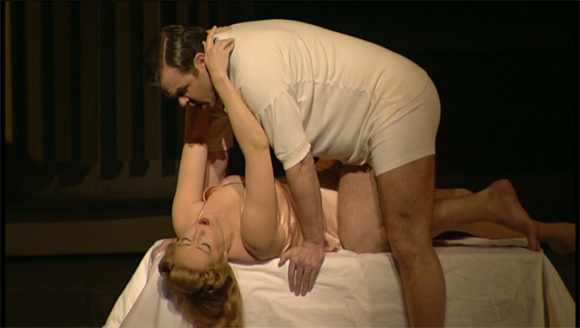
Monteverdi’s Il combattimento di Tancredi e Clorinda must be, at twenty two minutes, one of the shortest operas around.  In typical Monterverdi style though it crams a lot of music and emotion into a very short space.  Based on a story by Torquato Tasso, it concerns a Christian knight, Tancredi, and a Moorish princess, Clorinda.  Somehow they have managed to fall in love but are still fighting on opposite sides  They meet on the battlefield but as each has their visor down they don’t recognize each other.  They fight a long and bloody single combat in which Tancredi mortally wounds Clorinda.  When their helmets are removed they recognize each other and Clorinda asks Tancredi to baptize her so they can be united in heaven.  It’s pretty dodgy theology but great theatre.

Continue reading

Netrebko and Villazon in Manon

Massenet’s Manon is a glitzy 19th century set piece. It’s very French and very much a star vehicle.  In this 2007 production from the Staatsoper Unter den Linden, director Vincent Paterson’s decides to to stage it in the 1950s and make Manon somewhat cinema obsessed, in a narcissistic way, which works rather well.  It’s a self consciously glitzy affair with a bright gold curtain and technicians with Klieg lights following Manon much of the time.  Even the “squalid” bits are treated with glamour.  The only jarring element, deliberately I guess, is the use of giant reproductions of 19th century paintings as backdrops; notably Liberty Leading the People in Act 3.

Continue reading

Kupfer’s Orfeo

I’ve owned a VHS tape of Harry Kupfer’s 1991 Royal Opera House production of Gluck’s Orfeo ed Euridice pretty much since it came out.  I really can’t bear to watch VHS anymore so I haven’t watched it in ages and was intrigued when I managed to get my paws on a DVD copy and was able to see what I thought after all this time. Continue reading

Il Viaggio a Eurovision

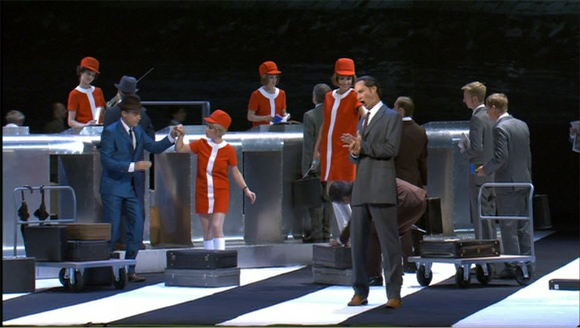
Rossini’s Il Viaggio a Reims is a curious work.  It was written as part of the celebrations for the coronation of Charles X of France, a leading contender in a relatively large field for the title of “most utterly useless king of France”.  It doesn’t really have a plot and, in a sense, is a three hour riff on “An Englishman, a Frenchman and a German go into a bar”.  It also has a huge cast; twenty solo roles of which ten or twelve are quite substantial and require no little virtuosity.  It’s small wonder that it’s not seen all that often.

Continue reading

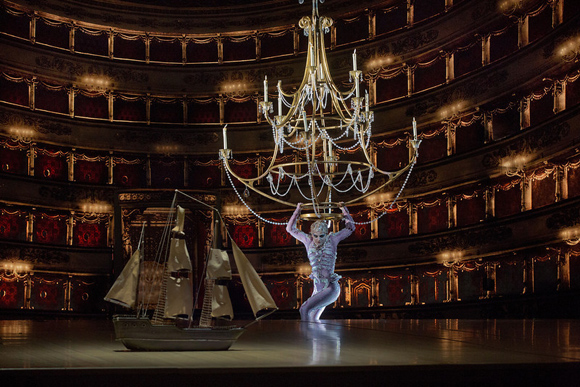
Poppea without passion

I’m not sure whether it was director Pierre Audi’s intention or a lack of chemistry between the principals but the 1994 Amsterdam production of Monteverdi’s L’incoronazione di Poppea, while extremely elegant, lacks gut punch.  The stage has been extended to mostly cover the pit leaving the band (only seventeen musicians) in a triangular space cut into the extended stage.  Much use is made of a staircase into the pit for entrances and exits.  The large stage area is sparsely furnished with objects suggesting, rather than being, rocks, furniture etc.  The costumes, by Emi Wada, are odd indeed ranging from a nurse who appears to be wearing sculpture to a Seneca who wears what looks like an old bedspread that the cat has used as a scratchy toy.  Within this fairly artificial and abstract concept Audi manoeuvers his singers in complex ways (or at least he seems to when the video director lets us see) supported by a complex and atmospheric lighting plot.  It really ought to be terrific but it just doesn’t get there. Continue reading