The Enslavement and Liberation of Oksana G.

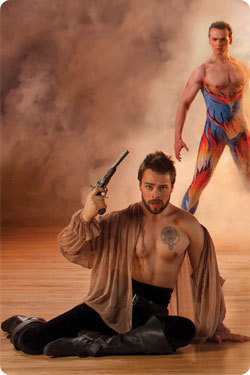
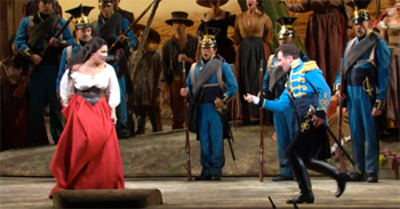
Last night saw the first of two workshop performances of Act 2 of The Enslavement and Liberation of Oksana G., a new full scale opera with music by Aaron Gervais and libretto by Colleen Murphy.  Act 1 was similarly workshopped last year.  It’s being produced by Tapestry New Opera in the Ernest Balmer Studio at The Distillery.  The second performance is tonight.

The piece is about sex trafficking.  Oksana is a Ukrainian girl tricked, raped and forced into an Italian  brothel controlled by Russian organized crime.  At the beginning of Act 2 she has escaped and is living at a refugee shelter run by a Canadian priest in Brindisi.  The story concerns her relationship with the priest, her desire to return to her family and her pimp’s determination to get his hands on her again.  It’s dramatic, emotionally charged and ends badly.  It’s neither overly melodramatic nor crushingly intellectual and it works very well as an opera libretto.  Somewhat oddly it’s written in four languages; English, Italian, Russian and Ukrainian, apparently for essentially “naturalistic” reasons.  I think the logic is off but it didn’t reduce my enjoyment of the piece. Continue reading

Laura’s Cow

I had mixed feelings about attending something billed as a “children’s opera” but Laura’s Cow turned out to be quite a lot of fun. The piece was created for the Canadian Children’s Opera Company by composer Errol Gay and librettist Michael Patrick Albano.  It’s a 70 minute long, somewhat wry take on Laura Secord and the War of 1812.  It manages not to be too sentimental and pokes fun at the Tea Party, coyotes and Americans; which is a bit harsh on coyotes.  Writing for a children’s opera company obviously places some constraints on the composer.  There have to be simple choruses for the younger children.  There have to be not too demanding short solos for promising older singers and so on.  Within those limits Mr. Gay managed to create a score with quite a lot of musical interest especially in the orchestral writing.  The sets and stage direction were effective too especially given the logistics of handling a large cast in a fairly restricted stage area. Continue reading

Big contemporary opera weekend in Toronto

Considering the opera season in Toronto usually pretty much wraps up in May there’s a lot on over the next few days.  I guess the big ticket Is Philip Glass’ Einstein on the Beach which is running tonight, tomorrow night and Sunday afternoon/evening.  Unfortunately it’s extremely long and I have early reffing gigs both Saturday and Sunday so that pretty much rules it out.  It’s also at one of my least favourite performance spaces; the Sony Centre.  Also on this weekend is the Canadian Children’s Opera Company performance of a new work by Errol Gay called Laura’s Cow. based on events in the War of 1812  That’s on at the Enwave and I managed to score a couple of comps so I shall be going to that.  Then on Monday and Tuesday evenings Tapestry New Opera are workshopping Aaron Gervais’ The Enslavement and Liberation of Oksana G. at the Distillery.  Most all opera in Toronto happens within walking distance of the Kitten Kondo but that one is scarcely five minutes away.  The lemur is rehearsing so I’ll be on my own at that one. Busy times!

Queen of Spades

Yuri Temirkanov’s 1992 Kirov Opera production of Tchaikovsky’s Queen of Spades is extremely traditional but not dull.  It’s given the default Catherine the Great setting and there are opulent ball rooms, gold braid, wigs and crinolines aplenty.  There’s also careful direction of the action and some good acting so it’s far from a “park and bark” snoozefest, though it has nothing new or original to say.  The lighting for the supernatural bits is especially atmospheric.

Continue reading

DVD review statistics

Just for fun, here are a couple of statistics.  They show the language and location of performance of the 100+ DVDs reviewed by this blog.

Perhaps unsurprisingly Italian is well in front but then of the Italian language operas eleven were written by an Austrian and seven others by other non-Italians.  It was a bit of a surprise that English featured so prominently.  Only two of the English language performances are ENO shows in translation.  When one thinks about it, it’s a bit remarkable that only six languages figure in total although I suppose there is some Chinese in Tan Dun’s The Last Emperor.

I was surprised by how geographically spread out the performances were.  I expected the Met to be much more prominent though my taste in directors probably biases the list away from the Met and towards Paris and Salzburg.  I really can’t account for the prominence of Glyndebourne though it may be partly Handel and Janáček related and partly a label preference towards Opus Arte.  The forty four assorted ones are a really mixed bag ranging from Perth to Los Angeles to Helsinki.


Dusty Capriccio

The 1993 San Francisco Opera production of Strauss’ Capriccio is about as literal a take on the work as one could imagine.  Stephen Lawless’ production sticks to the stage directions as laid down with an almost fetishistic fidelity.  This is backed up by highly decorated costumes and sets firmly placed in a slightly over elaborated 1775.  The traditionalists dream?  I suppose so if one thinks that Strauss and Krauss meant the work to be taken literally.  I don’t.  This is an opera about an opera about opera.  It begs to be deconstructed and the time and circumstances of its composition tend to reinforce the idea that all is not as it seems.  To take it at face value is actually a bit absurd but that’s what happens here and the result is rather dull and unsatisfying. Continue reading

I vespri Siciliani

Mid period Verdi in a highly traditional La Scala production isn’t usually my cup of tea but I thought that if the usually excellent Opus Arte label thought the thing was worth a reissue it might be worth watching.  With caveats, it was, even for someone who is as allergic to this kind of production as myself.
Continue reading

Flashbacks

I’ve been banished from the living room and so the home theatre by the lemur practicing for a dance recital.  As a result I’m listening, on my iPod, to Solti’s recording of The Ring, which I was introduced to nearly four decades ago.  Listening to Das Rheingold again today after a long lay off I’m struck by how utterly brilliant it is.  Gustav Neidlinger’s Alberich is a marvel.  He’s singing lyrically not snarling or barking and it sounds quite lovely.  Solti’s command of rhythm is astonishing.  One could dance to this!  And has John Culshaw’s sound engineering ever been bettered?

Still wonderful as it is it’s having much the same effect as Proust’s madeleine.  I first heard this recording (on vinyl of course) courtesy of the man who taught me Applied Maths for ‘A’ level .  He was a rather sad old chap but he introduced me to Wagner, Quad electrostatic speakers and gin.  He’s long dead of course.  So it goes.

Cool and refined Barbiere

Emilio Sagi’s 2005 production of Il Barbiere di Siviglia is incredibly elegant and restrained. It looks like something by Robert Carsen.  The sets are all constructed and transformed in full view and just about everything is black and white until the final scene.  There is a lot of background action and commentary from a talented group of dancers who give a very Spanish feel to the piece.  The final scene bursts into vivid, even loud, colour and the finale is just gorgeous to look at. The direction of the actors is well thought out too though they do seem to sing from on top of furniture a lot of the time.

Continue reading

Boobs in Venice

Johann Strauss’ Eine Nacht in Venedig is a pretty slight piece.  In fact it makes Die Fledermaus look like Parsifal.  It’s set during Carnival.  There’s a visiting duke who is out to bed the last woman in Venice he hasn’t already slept with, the young wife of a doddery senator, but she’s being impersonated by her maid and her foster sister for reasons of their own while she gets off with her nephew.  The duke fails to seduce anyone.  Ash Wednesday arrives and everybody, on the surface, returns to her proper partner.  All this serves as an excuse for lots of boob and thigh flashing, some big dance numbers and lots of, by Fledermaus standards, rather dull music. Continue reading