Death, in Venice

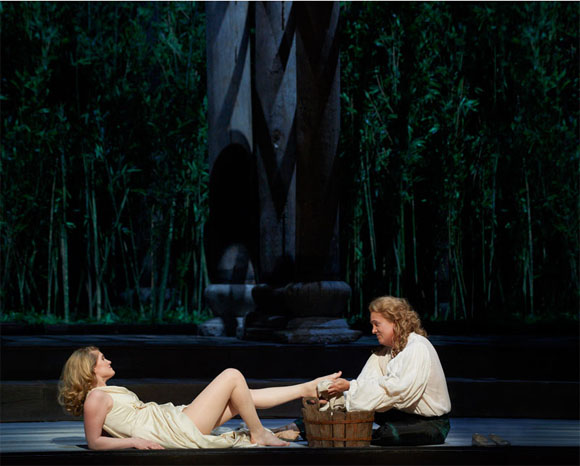
If I have a beef with Britten’s Death in Venice it’s that it’s a bit cerebral and bloodless, at least as it has come down in the Aldeburgh-Glyndebourne-ENO performing tradition.  I think it’s fair to say that in its bloodlessness it mirrors the Thomas Mann novella (and indeed a lot of Mann’s other writing) but, for me, it’s a challenge to engage with the piece and, especially, with Gustav von Aschenbach.  So, it was with surprise and growing pleasure that I watched Pier Luigi Pizzi’s production for, appropriately enough, Venice’s La Fenice.  His take is bold and seems to centre less on Aschenbach’s relationshsip with the Polish boy, Tadziu, and more on the conflict between Dionysian and Apollonian ways of thinking and doing and I think it’s clear that Pizzi is a Dionysian.

1.beginning Continue reading

For pity’s sake

I’ve been involved in a lot of on-line discussions about various productions; live and DVD, of La clemenza di Tito.  Oddly perhaps, none of them have ever referenced the 2005 Zürich recording with Jonas Kaufmann in the title role.  Today I think I found out why.  Basically it’s rather dull, except where it’s unintentionally funny.

1.sestovitellia Continue reading

Pelléas for dummies

The most obvious feature of Sven-Eric Bechtolf’s Pelléas et Mélisande is the use of dummies to double up the characters.  Much of the time these doubles are lying around or being pushed around the set wheelchairs by the singers.  Most of the time the singers address themselves to one of the dummies even when the “real” version of the person they are addressing is on stage.  I guess it’s designed to create a kind of emotional distancing or dehumanising that does seem in keeping with the piece and, when the convention is broken, ie; characters interact directly, that seems to heighten the drama at that point.

1.wheelchairs Continue reading

Monochrome Poppea

Monteverdi’s L’incoronazione di Poppea was the “shabby, little shocker” of the 17th century.  It’s about lust, obsession, murder and revenge.  So, it’s a bit surprising that all too often it comes off as elegant but deadly dull.  That’s rather the case with Pierre Luigi Pizzi’s production filmed at the Teatro Real in 2010.  Despite having Danielle di Niese, something of a specialist Roman sex kitten, in the title role it’s all rather bloodless.  It starts off OK with the gods and goddesses of the prologue being wheeled about on platforms but after that he gets rather static.  Sets and costumes are almost unrelieved grey/silver tones (including a rather fetching pair of silver lamé booty shorts for Damigella) although Nerone himself seems to be dressed as a giant black chicken in Act1 (know you of such a bird, Baldrick?).  The only real breaks in the (literal) monotony are the bright red robe Ottone borrows from Drusilla for the attempted murder and the sparkly gold outfits  that appear for Nerone and Poppea at the end.  It’s also rather dark most of the time.

1.poppeanerone Continue reading

Bicycle Opera Project

The Bicycle Opera Project has announced dates and rep for their 2014 Ontario tour which will take seven contemporary Canadian operas to 14 towns and cities across Ontario. The singers are soprano Larissa Koniuk (founder of the Bicycle Opera Project), mezzo Stephanie Tritchew (newest member of Calgary Opera’s young artist program), tenor Christopher Enns  and baritone Geoffrey Sirett. They will be joined by instrumentalists: Wesley Shen (music director/piano), Chelsea Shanoff (saxophone) and Tristan Durie (flute). Liza Balkan will direct.

bicycleopera Continue reading

Midnight Marschallin

In 1985 the Royal Opera House staged film director john Schlesinger’s production of Der Rosenkavalier to mark the 25th anniversary of Sir Georg Solti’s house debut.  It’s an essentially traditional production.  We are in 1740s Vienna and both costumes and set are highly elaborate.  The opening scene stars one of the largest beds ever seen on an opera stage.  That said, it’s well put together.  The chemistry between the principals is good and the nonsense at the beginning of Act 3 is deftly handled.  There are a number of small touches that help set the tone too.  For example, at the beginning of Act 2 fake books are being installed in the Faninal “library”.

1.marschallin and octavian Continue reading

traviata et nous

traviata et nous is a documentary by Philippe Béziat about the creation of the 2011 Aix Festival production of Verdi’s La Traviata.  The stars are stage director Jean-François Sivadier and his leading lady, Natalie Dessay.  It’s two hours long and is much more insightful than the average “making of” bonus feature.  This really gets inside the heads of the director and the performers (we see a fair bit of Charles Castronovo and Ludovic Tézier as well as Dessay) as they begin to understand and then elaborate on the director’s ideas.  Dessay comes across, as one would expect from her performances, as an exceptionally intelligent, thoughtful and hard working person.  Sivadier too is très sympa; worlds removed from the caricature of a German Regie director ruthlessly imposing his ideas on libretto and performers alike.  I found it interesting that when Sivadier is working with Dessay or Tézier  French is spoken but at pretty much all other times the working language, even in a French house like Aix, is English.

1.natalie Continue reading

Up close with Aschenbach

Death in Venice is a curious opera.  Based on a Thomas Mann novella, it concerns the aging writer Gustav von Aschenbch and his meditations on aging and art, as well as his obsession with a Polish boy encountered at his Venice hotel.  Very little actually happens.  Aschenbach has a series of encounters with quotidien characters such as the hotel manager and a hairdresser but mostly he observes and what we hear are a series of inner monologues.  To work as theatre Aschenbach must capture our interest and our sympathy.  If he doesn’t the piece can be incredibly boring and irritating.

1.aschenbach Continue reading

When the Sun Comes Out

tkIt’s World Pride Week in Toronto and as far as I know Tamar Iveri isn’t in town.  What is, is the Toronto premier of When the Sun Comes Out by Leslie Uyeda and Rachel Rose presented by Queer Innovative Theatre; a group of LGBTTIQQ2SA (WTF BBQ!) performers.  Unsurprisingly the piece treats of same sex relationships.  It’s a love triangle with a twist.  Solana (Teiya Kasahara) is a foot loose wandering lesbian who has fallen in love with a married woman, Lilah (Stephanie Yelovich) who, unfortunately, lives in a dystopia where same sex relationships are a capital offence.  Their relationship, and their lives, are threatened by Lilah’s jealous husband Javan (Keith Lam).  But he too has a secret in his past.  They also have a daughter who neither will give up making simple resolution of the relationship issues impossible.

Continue reading

Summer Opera Lyric Theatre 2014

Summer Opera Lyric Theatre is a summer study and performance programme for young artists directed by Guillermo Silva Marin.  This season they will present (in English) three fully staged works with piano accompaniment.  The offerings are Mozart’s The Magic Flute (August 1st, 3 rd(mat), 6th (mat) and 9th), Puccini’s Madame Butterfly (August 2nd (mat), 5th, 7th and 9th (mat)) and Barber’s Vanessa (August 2, 6th, 8th and 10th (mat).  All performances are at the Robert Gill Theatre, University of Toronto, 214 College St. (entrance on St. George). Single tickets are $28, students and seniors are $22. For tickets, call 416-366-7723 (Mondays to Fridays 12 to 6 pm).