Land of Smiles

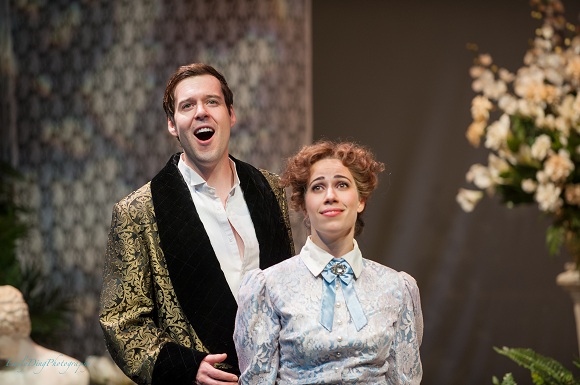
Lehár’s Das Land des Lächelns must have seemed old fashioned even when it opened in 1929 in a Berlin that had already seen Wozzeck and Die Dreigroschenoper.  With its waltzes and gentle chinoiserie it looks back rather than forward musically and makes few demands on its listeners.  Similarly, the plot; a bittersweet romance between an Austrian aristocrat and a Chinese prince had nothing in it to disturb contemporaries though modern audiences might find the cultural appropriation a bit hard to take.  However, if Turandot doesn’t bother you this likely won’t either.

Continue reading

AtG’s Messiah

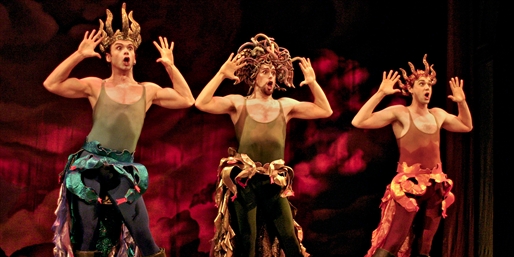
Expectations could hardly have been higher for last night’s first performance of Against the Grain’s new production of Handel’s Messiah.  By and large they were met.  It’s become quite the thing to stage Handel’s oratorios and, for the most part, that’s fine.  They are really operas in disguise and work well when liberated from the concert setting.  Messiah is trickier.  Rather than a linear narrative there are a series of Biblical texts selected by librettist Charles Jennens to promote a literal and conservative evangelical Christianity.  There is no obvious staging solution.  One possibility is to invent a narrative and spin the story around it as Claus Guth did at Theater an der Wien in 2009.  AtG’s Joel Ivany’s solution is to stage it as a choreographed performance and use movement to bring depth to the words.  Here he is aided and abetted by choreographer Jennifer Nichols who has created a movement language tailored to the abilities and limitations of the singers.

Continue reading

Chestnuts roasting on an open fire

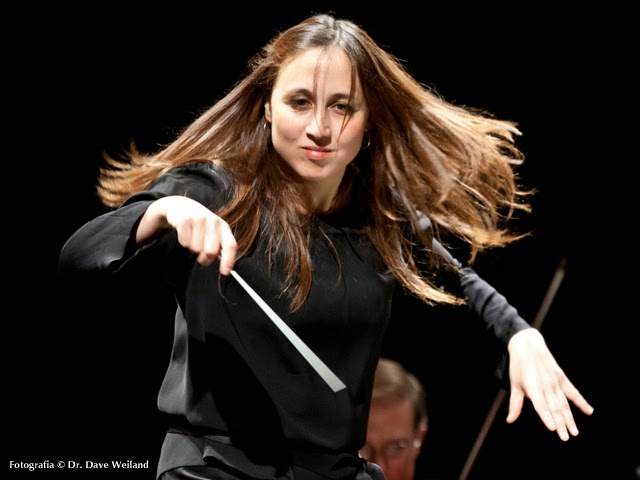
margison090122Well there wasn’t actually an open fire at Koerner Hall last night, though one would have been very welcome on a very cold Toronto evening, but there were plenty of old chestnuts at the Great Songs of Italy concert given by the Ontario Philharmonic Orchestra under Marco Parisotto with tenor soloist Richard Margison.  The concert consisted of a mixture of opera extracts; vocal and instrumental, a couple of Neapolitan songs and Tchaikovsky’s Capriccio Italien.  It was a bit like eating one of those giant Toblerone bars all at once but I don’t suppose anyone really expected it to be any different and the audience for the most part loved it.

Continue reading

Innovation

Needing something suitable to celebrate Britten’s 100th birthday I decided to go and see the National Ballet’s new show Innovation which premiered last night and included a piece set to the Four Sea Interludes from Peter Grimes.  A Pergolesi Stabat Mater with Emma Kirkby and Daniel Taylor was a considerable additional attraction.  I’m not a dance expert so take any comments on that subject that follow as the impressions of a complete non-expert.

Continue reading

Die Frau ohne Schatten at the Met

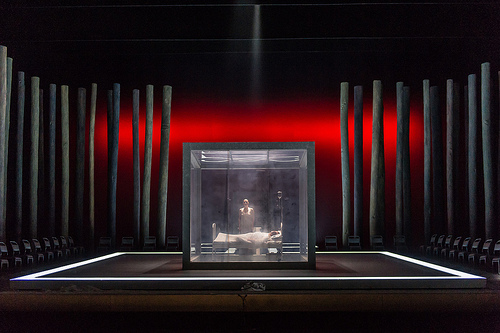
We caught Richard Strauss’ Die Frau ohne Schatten at the Met on Wednesday night.  Expectations were high.  It’s Strauss, and rare Strauss at that.  It was our first time at the Met.  The on-line opera world was abuzz with Christine Goerke’s performance as the Dyer’s Wife.  By and large we weren’t disappointed.

frau1 Continue reading

Korngold’s Silent Serenade at the Glenn Gould School

Joel Ivany

Joel Ivany

Korngold’s Silent Serenade is, to put it mildly, odd.  The plot could have been taken from Dario Fo and the only possible excuse for the schmaltzy music is that Korngold initiated many of the saccharine clichés he relies on.  Last night the students of the Glenn Gould School under the direction of Joel Ivany and the musical leadership of Pieter Tiefenbach bravely tried to rescue it from well deserved obscurity.

The plot concerns a dressmaker who is accused of breaking into the bedroom of, and trying to abduct, one of his clients; an actress who happens to be engaged to the Prime Minister.  In Naples this is a hanging offence.  Meanwhile someone has made an unsuccessful attempt to assassinate the unpopular Prime Minister with a bomb.  The king is dying and, we learn from his confessor, wishes to make a great act of mercy before he finally snuffs it.  He wishes to pardon the bomber.  Unfortunately the police don’t have a suspect.  The solution is obvious.  The dressmaker must confess to both crimes so that he can be pardoned and hanged for neither.  Unfortunately the king dies before signing the pardon and so the dressmaker must hang.  Following this so far?  Fortunately for him the unpopular Prime Minister is killed in a popular uprising and he is installed in his stead much to the annoyance of the anarchist who did plant the bomb.  They agree that the dressmaker will return to his salon and the actress, who has now fallen in love with him and is, conveniently, no longer engaged.  There’s also a subplot concerning a newspaper reporter and an aspiring actress.

Continue reading

Transfigured: Transcribed

Yesterday’s Amici Ensemble concert featured four works transcribed for different combinations of instruments than the composer originally intended.  First up was Berg’s Adagio for violin, clarinet and piano.  This is from the Kammerkonzert originally scored for violin, piano and thirteen assorted wind instruments.  Unsurprisingly it doesn’t get played often in that arrangement.  It’s pretty typical second Vienna school; twelve tone but quite accessible and very pleasant to listen to.  It was expertly played by Serouj Kradjian (piano), David Hetherington (cello) and Joaquin Valdepeñas (clarinet).

amicirecordings Continue reading

In which I get a plague and miss one

Last night I was at the Arts and Letters Club for the opening night of Opera 5’s Edgar Allan Poe themed show In Pace Requiescat. I had hoped that I had kicked the thing that has been afflicting me since Wednesday but I was over optimistic.  I spent the first half of the show either in a coughing fit or trying desperately to avoid one and then had to leave at the interval thus missing Cecilia Livingston’s new piece The Masque of the Red Death.

in Pace Promo Picture 1What I did see; Daniel Pinkham’s The Cask of Amontillado and Debussy’s La Chute de la Maison Usher, was, as best I recall, pretty good.  Staging and costumes are appropriately creepy and there was some very good singing from Adrian Kramer and a brief appearance from Lucia Cesaroni that made me want to see more.  If I can shake this thing before the end of the run I’ll go back and do a proper review.  There are further performances on Wednesday and Thursday.

ARC Ensemble

c-t“Culture Days” is a weekend long festival in Toronto where various arts organisations put on free events.  This year it included a concert in Koerner Hall by the ARC Ensemble with guests Baritone Peter Barrett and cellist Se-Doo Park.  The main draw for me was Respighi’s Il tramonto; a setting for baritone and string quartet of an Italian translation of Shelley’s The Sunset.  This was indeed very well executed but was far from the most interesting part of the afternoon.

It was actually the final piece that was the revelation; Castelnuevo-Tedesco’s Piano Quintet No. 1.  It’s a really fun piece in high romantic style with tons of melodic ideas and lots of colour.  It was given a truly virtuoso performance by Erika Raum, Benjamin Bowman, Steven Dann, Se-Doo Park and Dianne Werner.  I think I’ll be looking for more examples of Castelnuevo-Terdesco’s work.