Balancing on the Edge

Balancing on the Edge combines the talents of A Girl in the Sky Productions and the Thin Edge New Music Collective.  It’s a challenging and exciting blend of New Circus and Contemporary Music (for some definition of both/either).  The circus element included aerialists, juggling and clowns while the music varied from Cage and Xenakis to pieces composed for the show.  There were live projections too.  The show was divided into six “acts” with some clowning interludes and other breaks for set up but mostly it was pretty fluid.  The performance space, the Harbourfront Theatre, was pretty much cleared down to a single ring of seats at ground level with more seating in the galleries, which allowed plenty of space for the various rigs employed.
bote3

Continue reading

Cendrillon in Viardot’s salon

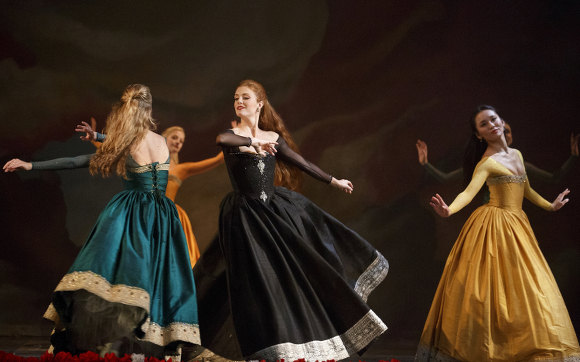
The Glenn Gould School at the Royal Conservatory of Music opened a two performance run of Viardot’s Cendrillon last night at Mazzoleni Hall.  The conceit was that we and the performers were all guests in Mme, Viardot’s salon and to this end we were all given a slip of paper with our character name on it but I promptly lost mine and it wasn’t actually needed for anything,  Cute idea though.  It also allowed for a production that fitted with the acutely limited staging resources of Mazzoleni.  The piece is heavy on dialogue and it was presented in English, in an updated translation that had its moments.  I doubt the Viardot household had ever heard of “organic, non GMO, fair trade” coffee.

Photo: Nicola Betts

Continue reading

Naomi’s Road

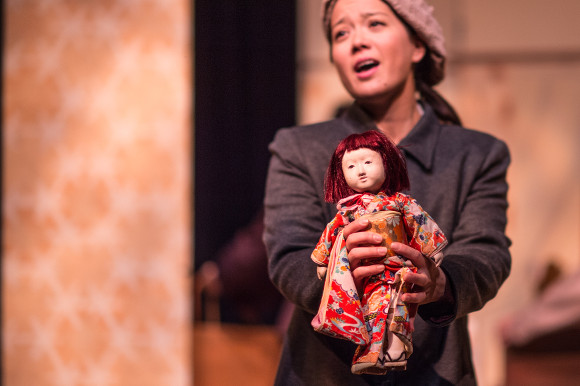
Naomi’s Road; music by Ramona Luengen, lbretto by Anne Hodges, has been around as an opera for ten years or so and it got its Toronto premier last night at St. David’s Anglican Church in a production directed by Michael Mori for Tapestry Opera.  It’s based on Joy Kogawa’s novel for children of the same name which tells the story of Naomi and her brother Stephen; Japanese-Canadian children torn from a comfortable middle class Vancouver home by the WW2 era Canadian government’s policy of interning Canadians of Japanese descent as “enemy aliens”.  It’s a shameful story and one that Canadians need to know about in an era when fear of the “other” is being stoked on all sides.  Perhaps we like to look down our noses at the antics of our neighbours to the south but our own history has its dark side and we need to remember.

naomi1

Continue reading

Four Seasons of Mother Russia

Off Centre Music Salon’s opening concert of the season featured a largely Russian, largely 19th century program.  There were plenty of songs by Glinka, Tchaikovsky and the like sung by an interestingly contrasted mix of Ilana Zarankin, Joni Henson and Ryan Harper with Inna Perkis and Boris Zarankin accompanying.  It was good to hear Joni in this program in the warm acoustic of Trinity St. Paul’s.  I think I’ve mostly heard her in the RBA which is notoriously hard on dramatic sopranos.  Here the combination of the acoustic and Russian vowel sounds resulted in a very pleasing richness of tone rather than stridency.  She also blended well with Harper’s very tenorish tenor and made an interesting contrast with the much lighter, brighter Zarankin.  Nice work all round.

maxresdefault

Continue reading

Deb Voigt in recital

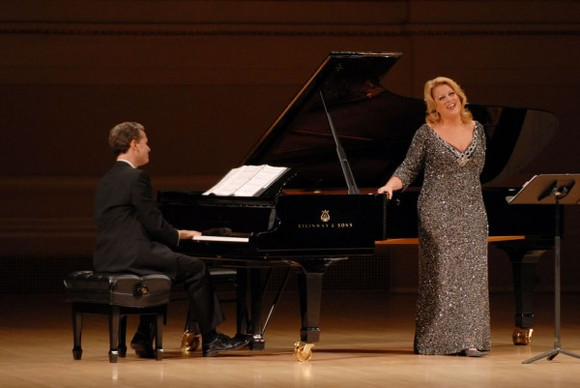
Deborah Voigt appeared with Brian Zeger at Koerner Hall last night.  I guess I was expecting something rather more ebullient from Ms. Voigt but what we got was a perfectly decent, slightly low key, recital with a heavy emphasis on American repertoire and very little banter, though she did unwind a bit toward the end of the program.

3865voigt_202c_fw-600x401

Deb Voigt and Brian Zeger at Carnegie Hall 2007

Continue reading

An evening with Osvaldo Golijov

Against the Grain Theatre’s latest production, Ayre, continues their run of innovative, site specific shows.  This time it was a presentation of four works by Argentinian Jewish composer Osvaldo Golijov at the Ismaili Centre; part of the Aga Khan complex on Wynford Drive.  The “appetisers” were three short works presented in three of the public spaces of the Centre.  Yiddishbbuk, for string quartet (Jennifer Murphy, Barry Shiffman, Laila Zakzook, Drew Comstock), was inspired by apocryphal psalms and is a fractured piece employing a lot of extended techniques to create a three movement work “in the mode of Babylonic Lamentations”.  Lua Descolorida, with Adanya Dunn as soprano soloist, sets a 19th century text in Gallego.  It’s a folksy, Arab inflected piece over a kind of string “ground” with pizzicato cello.  Short but rather beautiful.  For Tenebrae the quartet was joined by clarinetist Brad Cherwin and soprano Ellen McAteer.  It’s a beautiful piece with a melismatic vocal  line culminating with multiple repeats of the single word “Jerusalem”.

ayre3

Continue reading

Arias and Maqams

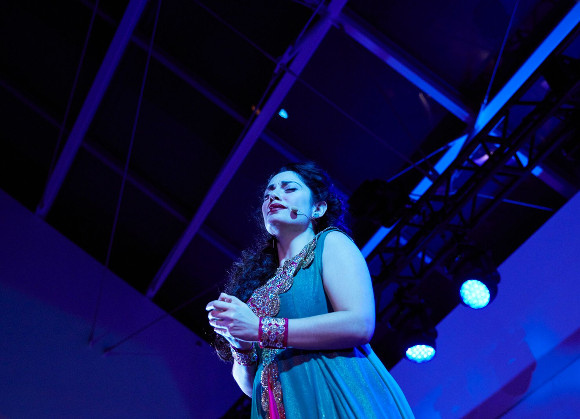
To the Aga Khan Museum last night for a program of Syrian and Western music by Lubana Al Quntar and friends; Eylam Basaidi on violin and April Centrone on oud and percussion..  It was my first time at the museum and the auditorium there is just gorgeous.  In a city with some pretty spectacular performance spaces this may just be the most beautiful.  It’s just a pity it’s so hard to get to on the TTC.  The program was distinctly heavy on the “Syrian” side of “Syrian and Western”.  There were Syriac hymns, muwasshahat, specifically waṣla of Aleppo and Syrian folk songs in a tradition sung by the women of Damascus (I believe).  I’m no expert in this music but it was possible to hear developments and continuities.  The hymns (in Aramaic) clearly influenced the later classical music though the former were basically modal while there was a lot more tone bending in the later pieces.  I hesitate to speculate on the relationship between the waṣla and the folk songs.  I know from my own experience with the folk music of the British Isles how influences go back and forth and how folk songs sung by a classically trained singer may not always reflect how they sound when performed more demotically.  Still, the audience lapped this bit up with much singing along and clapping accompaniment.

akm-dusk_f_1246x620

Continue reading

Welcome and Adieu

23_nathalie_paulinThe first concert in this season’s Mazzoleni Songmasters series featured sopranos Nathalie Paulin and Monica Whicher with pianists Peter Tiefenbach and Robert Kortgaard in an eclectic program of English and fFrench songs on the theme of coming and going.  First up was a set of Purcell songs which is always going to score brownie points with me.  I’ve never heard Sound the Trumpet or Be Welcome, Then, Great Sir sung by female voices so that was interesting.  The duet was really nice and Nathalie sang quite beautifully in the welcome ode.  Monica followed up with fine versions of Dear Pretty Youth and An Evening Hymn.   Continue reading
Singing Stars of Tomorrow

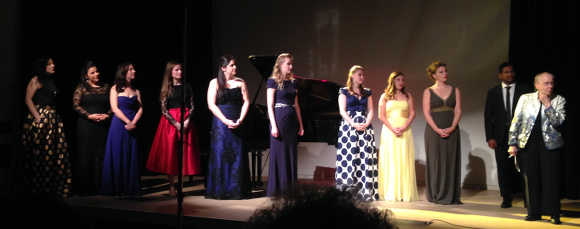
Last night ten singers who had taken part in an intensive class/coaching with Sondra Radvanovsky showed us what they could do.  The program was organised and presented by the International Resource Centre for Performing Artists at the Alliance Française.  It says quite a lot about the current state of supply and demand in the opera world that nine of the ten singers were female and seven were sopranos.  We were given one aria per singer and a lot, inevitably I suppose, of Donizetti, Bellini and Rossini with one aria apiece for Verdi and Puccini.

ssot

Continue reading

A funny thing happened on the way to Carthage

Opera Atelier’s  production of (mostly) Purcell’s Dido and Aeneas opened last night at the Elgin.  I say “(mostly) Purcell” because director Marshall Pynkoski had decided to add a Prologue.  As he explained in his introductory remarks nobody reads Virgil’s Aeneid anymore so it was necessary to play out the back story in a prologue.  I find this pretty patronising.  It’s not a particularly convoluted story and I would have thought that the gist of the story is well enough known to most opera goers and, you know, some of us have read the Aeneid.  Besides, even without detailed knowledge of the back story there’s nothing remotely hard to understand.  FWIW the dumbing down carried over into the surtitles with, for example, “Anchises” rendered as “his father”.  Anyway we got a prologue spoken by Irene Poole while the orchestra played other Purcell airs followed by a bit of extraneous ballet and poor Chris Enns (Aeneas) and Wallis Giunta (Dido) running around making the stock baroque “woe is me” gesture.  I guess it made the piece (plus Marshall’s speech) long enough to justify an intermission, which was taken after what is usually Act 2 Scene 1, but the prologue was neither necessary nor welcome and I think the ensuing intermission was an unnecessary break in the flow of the action.

161018_39848

Continue reading