Ariodante in Spoleto

Musically, the 2007 Spoleto Festival recording of Handel’s Ariodate is very good indeed.  Unfortunately the production, at least as rendered on DVD, is a bit of a snooze.  Director John Pascoe has chosen to set the piece in 1957 to celebrate the 50th anniversary of the festival.  The court of the king of Scotland is supposed to evoke the “glamour” of the court of the young Elizabeth II.  There is also a partially twisted mirror that is supposed to remind us of the deception and self-deception intrinsic to the plot.  I only know this because of the bonus interview with Pascoe as  video director Matteo Ricchetti completely ignores it.  There’s also a recurrent appearance of an image of Ginevra (Handel having fortuitously stumbled upon le nom juste for a character supposed to remind us of Margaret Windsor) framed by the garter ribbon and motto.  Subtle. Continue reading

A grim and gritty Rusalka

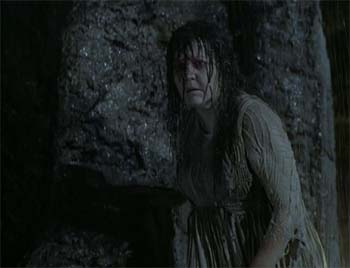
Martin Kušej’s 2010 production of Dvořák’s Rusalka at the Bayerisches Staatsoper is exactly the sort of production traditionalists fume about over their port and cigars.  It’s loosely based on the Fritzl and Kampusch imprisonment/child abuse cases.  The Water Goblin, aided by his wife, Ježibaba, have their children; Rusalka and her sisters, imprisoned in a wet cellar under their house.  The Water Gnome is clearly indulging in sexual abuse of the girls to the total indifference of his wife.  Rusalka dreams of a life among humans and of love.  She begs her mother to make her human/set her free.  This happens and Rusalka, mute and tottering on red heels, is free to pursue her romance with the prince.  Is this literal or all in Rusalka’s imagination?  Does it matter?  Continue reading

Fear and loathing in Mycenae

OK, I have shamelessly stolen the title of this post from the DVD booklet because it’s just a perfect description of Götz Friedrich’s 1981 film version of Strauss’ Elektra.  It’s one of those lip-synched films where the soundtrack is recorded in the studio and then the filming is synched to the sound track.  Mercifully the singers are also the actors.  I hate it when they use body doubles. Continue reading

But in me life has halted

It’s perhaps odd that somebody like me, who got into Janáček’s music as a teenager, should have taken so long to discover his operas but I’m so glad I did.  The latest discovery is Věk Makropulos in a 2011 recording from the Groβes Festspielhaus in Salzburg with Angela Denoke as the 337 year old diva Emilia Marty.  It’s a strange work dramatically; a sort of fantastic detective story.  Apparently it’s based on a comedy (by Karel Čapek, the guy who coined the modern meaning of “robot”) though how it got from a comedy to the opera is a bit of a mystery.  It’s weird, compelling and creepy but not at all funny.  It also has a terrific score. Continue reading

Claus Guth’s Cosí

In 2009 Claus Guth wrapped up his Da Ponte cycle for Salzburg with Cosí fan tutte.  I really like his Le Nozze di Figaro and after seeing this Così I’ll certainly be seeking out the Don Giovanni too.

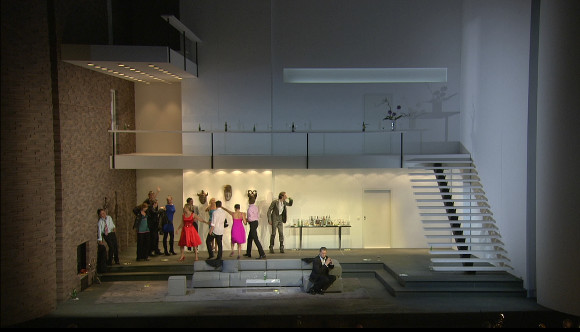
1.apartmentThis production was staged in the Haus für Mozart and uses a single set.  It’s the girls’ apartment; a very expensive looking two level loft with a broad staircase that recalls the Figaro.  The setting is contemporary and it opens on the aftermath of what appears to have been a rather good party.  The men are preparing to leave when Don Alfonso issues his challenge.  It’s the edgiest version of the scene I’ve watched with quite an undertone of violence.  This is clearly not going to be a light comedy.  By Una bella serenata the characteristic feathers of the Figaro have appeared.  The edginess continues throughout the first act with many deft touches, especially a power cut staging of Come Scoglio.  When the “Albanians” appear there is only the most perfunctory effort at disguise.  No slapstick moustaches here. Continue reading

Thomas Allen and Eva Jenis in The Cunning Little Vixen

Once in a while a video recording comes my way that’s just pure delight.  The 1995 recording of Janáček’s The Cunning Little Vixen from the Théâtre du Châtelet is one.  The creative team of director Nicholas Hytner (director), Bob Crowley (designer), Jean-Claude Gallotta (choreagrapy) and Jean Kalman (lighting) created a spectacle that is as much ballet as opera with vivid costumes and simple sets  It’s a rather splendid and touching adult fairy tale. Continue reading

Chacun à son goût

There’s lots to like in the 2003 Glyndebourne recording of Die Fledermaus.  Let’s start with Stephen Lawless’ production.  It’s attractively designed, quite slick and has a few good new gags without going overboard.  The sets are designed with striking diagonals and staircases and gantries.  Rotation is used both as a device to change the setting and as an element in the scene composition.  The overall effect is that the scene changes from drawing room to a sort of “gilded cage” for Orlofsky’s party – which opens out to create space for the action – to a prison with minimum disruption to us or the action.  Spots are used to create stagey effects and at one point Jurowski in the pit ostentatiously upstages the actors on stage.  Lawless never lets us forget this is a “show”.  Continue reading

We’ve already got one you see

Last night I tried to watch Parsifal – The Search for the Grail.  Ostensibly it’s a documentary about the origins of Wagner’s opera and to give it opera cred they roped in one Placido Domingo as narrator.  Valery Gergiev is also involved.  What a load of tosh!  It’s basically a rather weak history of the Grail as portrayed in popular culture complete with Monty Python, Indiana Jones, real Nazis as well as fake ones, pitiful reconstructions of crusader battles and on and on.  Mind numbing cliché follows mind numbing cliché.  Nul points!  What was Domingo thinking of associating himself with this dreck?

Idomeneo at the Met

The 1982 Metropolitan Opera recording of Mozart’s Idomeneo will likely please those who like their Mozart on the well done side.  The story telling is straightforward (though there are some design quirks), the orchestra is big, the tempi are not too sprightly and the vocal talent is starry if not especially Mozartian.  To reinforce this James Levine has made a number of cuts and interpolations from different early performances to structure things a bit more like a grand opera and less like a tragédie lyrique. Continue reading

La Belle Helène in Paris

When I reviewed the 1997 Zurich production of La Belle Helène about a week ago the commentariat was strong in the belief that I should take a look at the 2000 Paris-Châtelet production.  So I did and they were right.  It’s excellent.  It also reinforced my belief that operetta; English, French or German, works best when it’s taken seriously by which I mean using the best available singer/actors, a good director and a top notch orchestra, chorus and conductor.  All of these are in place in this Paris production. Continue reading