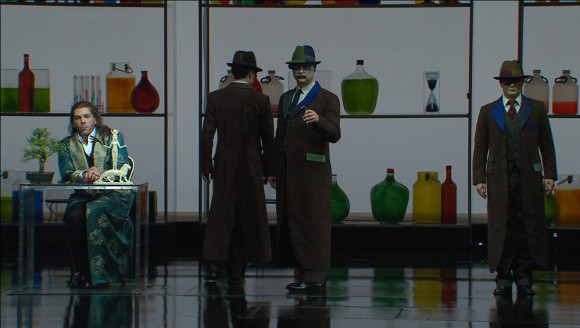
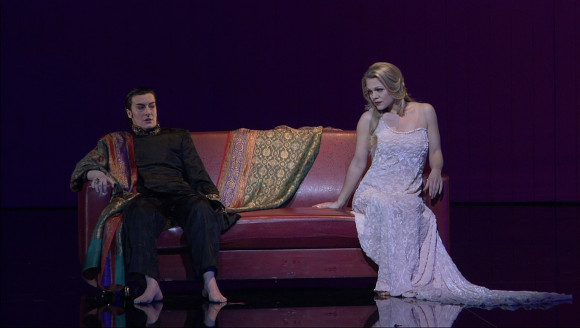
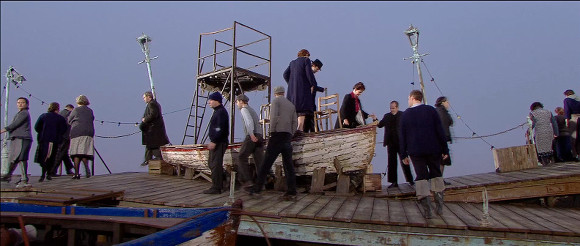
A performance of Peter Grimes in Aldeburgh to celebrate the Britten centenary seems loike one of those things that had to happen. The snag, of course, being that none of the performance venues there is remotely suitable. The idea of staging it on the beach was a brilliant, if problematic, idea and it’s good that it was captured on film and is now available on DVD and Blu-ray.
Continue reading
Category Archives: DVD review
The Scottish opera
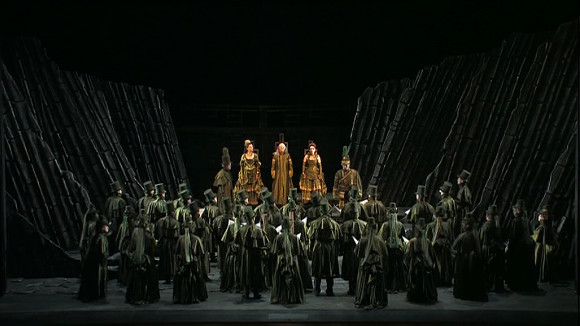
Verdi’s Macbeth is one of those early works where he seems to be trying to grow out of bel canto but not quite making it. There is some splendidly dramatic music and some that just seems completely incongruous given the subject matter. The witches’ chorus at the beginning of Act 3 is a case in point. That said Phyllida Lloyd’s production for the Royal Opera House takes the piece seriously and does a pretty good job of presenting the drama in a straightforward but visually attractive way.
Le Roi d’Ys
It’s perhaps surprising that Lalo’s Le Roi d’Ys isn’t performed much more often than it is. Most people probably only know it for the tenor aria Vainement, ma bien-aimée which crops up from time to time in recitals and competitions. Sure, it’s not strikingly original. The plot is a love triangle with overlays of revenge and divine retribution and the music is, with the exception of the rather fine overture, a bit on the rumpty tumpty side. But, let’s face it, there are plenty of standard repertoire works with implausible romantic plots and banal, if tuneful, music. I think there’s a large section of the opera audience that would very much enjoy this piece.
Kupfer/Barenboim Ring – 2. Die Walküre
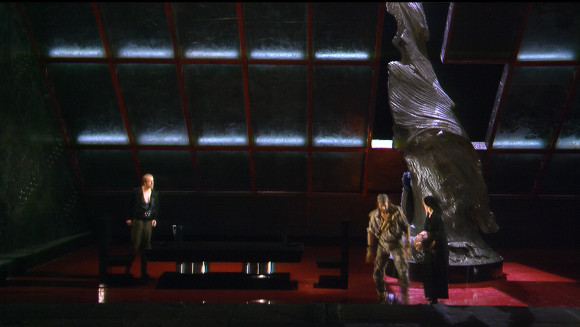
The Kupfer/Barenboim Ring continues very strongly with the second instalment, Die Walküre. It opens in quite a straightforward, more or less realistic way. Hunding’s hall is slightly abstracted with a recognizable tree. It’s quite spare though which creates space for the strong interpersonal dynamics between Siegmund and Sieglinde. Poul Elming is a very physical, almost manic Siegmund and Nadine Secunde’s Sieglinde is almost as physical. It’s all very intense and beautifully sung. Matthias Hölle as Hunding is no slouch either.
Kupfer/Barenboim Ring – 1. Das Rheingold
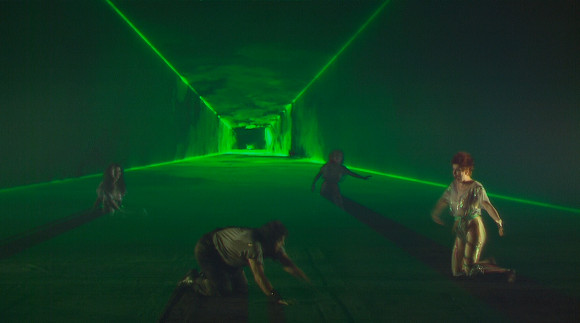
The 1991 Bayreuth Ring cycle is one of those productions that has become a historical landmark, as much as Chereau and Boulez’ 1976 effort, or maybe even more so. For many people it is the Ring. So what is it like? The staging is very bare and much reliance is placed on effects like lasers and smoke. It also makes considerable acting and athletic demands on the singers. It is, in many ways, a very modern production for 1991.
Il Trittico
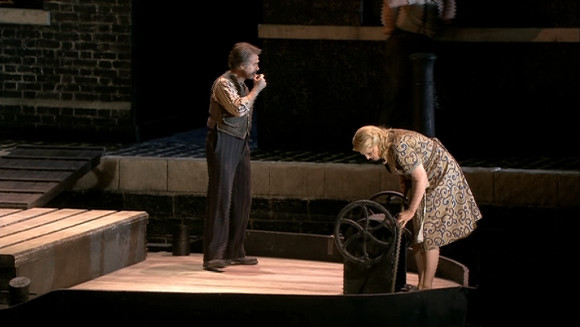
Puccini’s Il Trittico is a collection of three one act operas designed to be performed on a single evening. They rarely are. Perhaps this is because performing all three makes for a rather long evening (and for a huge cast) or maybe it’s because two of the three aren’t all that great. In any event, while most opera goers will likely have seen the comedy Gianni Schicchi, most will likely not have seen the two tragedies that precede it; Il Tabarro and Suor Angelica. However, all three works were performed as a triple bill at the Royal Opera House in 2011. The show was broadcast by the BBC and is available on Blu-ray and DVD. All three pieces were directed by Richard Jones and Anthony Pappano conducted.
Static Elektra
For the performances of Elektra at the 2010 Baden-Baden festival the Powers that Be chose to revive Herbert Wernicke’s 1997 Munich production with Bettina Göschl directing. The production concept seems to have been inspired by classical Greek drama. Sets and costumes are very simple, even austere, and the singers often address the audience directly. On stage this probably worked quite well as the overall effects are visually striking and the relative lack of interaction between the characters is perhaps appropriate for a work that is so much about alienation.
An eternal will
What follows, eventually, is a review of the Blu-ray recording of Busoni’s Doktor Faust recorded at the Opernhaus Zürich in 2008. First I feel the need to digress somewhat about the work itself.
Where’s the Champagne?
It’s really hard to know where to start with Hans Neuenfels’ Die Fledermaus. It’s a prodcuction that enraged the more conventional patrons when it opened at the Salzburg Festival in 2001. It even provoked a “false pretences” lawsuit! There is so much going on that it almost seems to call for a catalogue raisonnée of the various scenes though one fears that would actually be both tedious and unhelpful. Let’s try instead to explore it thematically. Neuenfels takes very considerable liberties with the libretto. A lot of dialogue is cut, a lot is added and numerous non-canonical characters are inserted. That’s just a start.
David Alden’s Poppea
I’m never quite sure what to expect from David Alden. Some things are predictable; striking images, bold colours and a degree of vulgarity, but beyond that it’s hard to be sure. Sometimes he seems to be trying to be deep (his Lucia for example), sometimes more kitschy (Rinaldo) and there’s always a slight undercurrent of him thumbing his nose at the audience. His production of L’incoronazione di Poppea at Barcelona’s Liceu is a curious combination of all these things and I think it works pretty well.