Love polygon

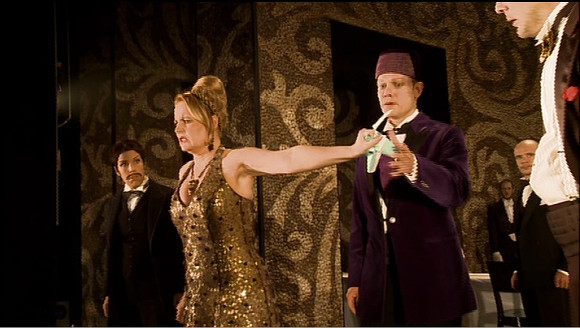
Handel’s Partenope is a bit unusual.  It feels lighter than a lot of Handel’s Italian operas and it is basically a romcom, albeit one that still has a vaguely classical setting.  Handel also plays with opera seria conventions by, for example, writing “heroic” arias for non-heroic texts and putting accompagnato in odd places.  The number of potential match ups that need to be tracked is fairly staggering.  Basically everybody is in love with, or pretending to be in love with, Partenope, queen of Partenope aka Naples.  These include the invading prince of Cumae, Emilio; Arsace, prince of Corinth; Armindo, prince of Rhodes and Eurimene, an Armenia who is really Rosmira, princess of Cypress and formerly betrothed to Arsace.  The only character who isn’t in love with Partenope is the philosophical captain of the guard, Ormonte, who is easy to spot as he’s a bass.  At the start of the piece Partenope is in love with Arsace but Eurimene/Rosmira isn’t having that and engineers a duel with Arsace.  This takes most of two acts but it’s the only essential bit of plot.  In Act 3 Arsace, who really doesn’t want to fight his former fiancée finally comes up with the wizard wheeze of demanding that the duel be fought bare chested.  Apparently this was perfectly normal under Neopolitan duelling conventions.  maybe it’s what gave Patrick O’Brian the idea of having Stephen Maturin always duel bare chested?  Anyway the modest Rosmira isn’t about to do any boob flashing (somewhat ironically as Inger Dam-Jensen, in the title role, has been bosom heaving with the best since the overture) so confesses to being, shock horror, female.  Arsace and Rosmira are reunited and Partenope awards herself as a consolation prize to Armindo.  Got that?
1.partenope Continue reading

Looks better than it sounds

Massenet’s Don Quichotte is one of those works where one does a double take on learning when it was composed.  It dates from 1910 but sounds like it was composed at least 50 years earlier.  It’s lushly romantic and dressed up with elements of flamenco but to nothing like as good effect as in de Falla’s La vida breve.  There’s also plenty of schmaltz.  The intro to Act 5, for example, being highly reminiscent of the Meditation in Thaïs. The plot’s pretty thin too.  Don Quixote loves the unattainable Dulcinea.  He goes off and encounters some bandits who eventually take pity on him and rather than killing him give him Dulcinea’s necklace, which they have stolen.  He returns it to her.  She is grateful but still not interested in marrying him.  He dies.  Great!

1.brothel Continue reading

Vogt and Nylund bring dead city to life

Kasper Holten shows his customary inventiveness in his production of Korngold’s Die Tote Stadt, recorded at Finnish National Opera in 2010.  He places the whole opera inside Paul’s “Marie museum” with a chaotic, higgledy, piggledy model of the the city of Brugge as a back wall.  He emphasises the dream elements of acts 2 and 3 through devices such as having the troupe of players and their boat emerge through Paul’s bed or assorted ecclesiastics popping up randomly in the “city model”.  He also inserts a non-speaking Marie who is present throughout the piece, often to very interesting effect.

1.bed Continue reading

Stark Jenůfa from Madrid

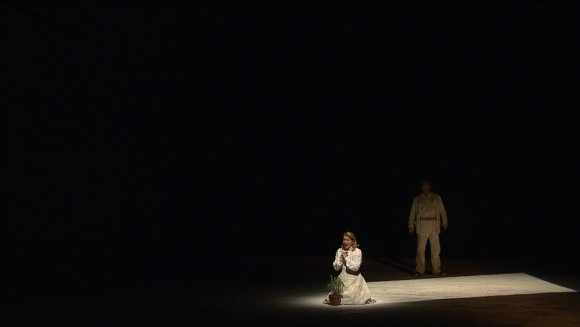
Stéphane Braunschweig’s production of Janáček’s Jenůfa, recorded at Madrid’s Teatro Real, is austere and effective.  The sets are almost empty.  Mill sails appear from a slot in the floor to suggest the family mill, there’s a cot for the baby in Act 2 and some church benches in Act 3.  That’s it.  The rest of the “setting” is carried by a very effective lighting plot.  I don’t think there are any big ideas here but it’s an effective, straightforward way of telling the story.  Braunschweig also makes effective use of the chorus, especially in Act 1.

1.plant Continue reading

Seamen from a distant Eastern shore

Berlioz’ Les Troyens is one of those pieces that really deserves the descriptor “sprawling epic” and, if anyone can make an epic sprawl it’s David McVicar.  This production, recorded at the Royal Opera House in 2012, is typical of McVicar’s more recent work.  It’s visually rather splendid and the action is well orchestrated but it’s short on ideas and long on McVicar visual cliches; acrobats, gore and urchins (but mercifully no animals).  I don’t want to be too hard on McVicar.  This piece is based on the sort of “Ancient History” one used to learn at prep school (British usage) and McVicar pretty much runs with that making no attempt to find deeper meaning, despite superficially translating at least the first two acts to the time of first performance; the era of European colonialism.

1.cassandre Continue reading

Kleiber’s Rosenkavalier

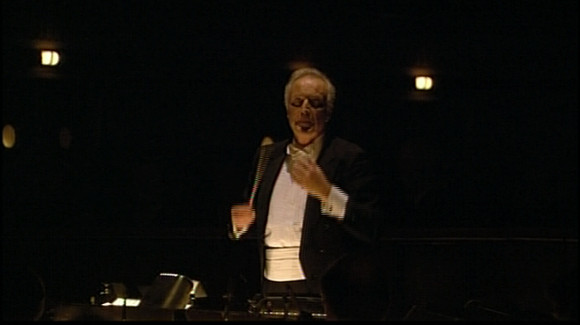
Carlos Kleiber didn’t record much despite enjoying something of a cult following as a conductor.  In 1994, shortly before his death, he conducted four performances of Der Rosenkavalier at the Wiener Staatsoper; the first of which was recorded.  It’s clearly Kleiber’s night.  His appearances at the start of each act are greeted with cheers and wild applause.  One can only guess at the reception he got afterwards because the curtain calls don’t make it onto the recording.  And, yes, it is a masterly conducting performance with fine support for the singers, beautifully shaped lines and an infectious sense of fun.

1.kleiber Continue reading

Kupfer/Barenboim Ring – 4. Götterdämmerung

I think it’s only with the final instalment of the Kupfer/Barenboim Ring that its true power is apparent.  The first three instalments are very fine but Götterdämmerung is devastating.  All the elements that have been progressively introduced are seamlessly combined.  Add to that extraordinarily intense performances from Siegfried Jerusalem (Siegfried), Philip Kang (Hagen) and, above all, Anne Evans (Brünnhilde) and one has something very special indeed.

1.norns Continue reading

O namenlose Freude

Katharina Thalbach sets her Fidelio, filmed at Zürich in 2008, somewhere in the early 20th century.  Most of the costuming suggests very early but Don Pizzaro’s suit suggests 20s/30s gangster.  Maybe he’s just fashion forward. The story telling is fairly straightforward and there’s no big concept.  There are a few, smallish, touches.  For example, the prisoners seem to be playing basketball with Don Pizarro’s head in the conclusion.  The sets are literal but evocatively lit and rather effective.

1.quartet Continue reading

Kupfer/Barenboim Ring – 3. Siegfried

We seem to be in some kind of post apocalyptic wasteland.  Mime’s hut looks like a re-purposed storage tank but the bear and the forest are more or less realistic.  It’s all very dark and there’s quite a lot of use of pyrotechnics.  This is also our first look at Siegfried Jerusalem’s Siegfried and he is very good indeed.  He captures the hero’s youthful vigour and arrogance extremely well.  There is a strong performance too from a rather manic Graham Clark as Mime and John Tomlinson continues as a reckless and wild Wanderer.

1.hut Continue reading

Intense, if a bit weird, Onegin

Mariusz Treliński’s Eugene Onegin originated in Warsaw but was filmed in Valencia.  It’s distinctly on the Regietheater end of the spectrum but it’s intense and oddly compelling.  The sets are spare and almost abstract.  A silent character, O***, is interpolated.  He’s a sort of Commendatore’s ghost who comments on the action and interacts with characters at key moments; with Tatiana during the letter scene and with Lensky before the duel for example.  A lot of action takes place in front of the pit, usually simultaneously with action further back on stage making for quite complex (and hard to film) visuals.

1.forest Continue reading