Routine Don Pasquale

Once in a while one comes across an opera DVD that’s so “ordinary” that it’s extremely difficult to write about it.  The 2002 Cagliari recording of Donizetti’s Don Pasquale is one such.  Stefano Vizioli’s production is set in 1750s Rome and plays the piece about as straight as a madcap comedy can be played.  The singing is rather good and, if the acting is a bit Brian Rix farce that’s hardly inappropriate.  At the heart of the piece is Alessandro Corbelli who must be close to being the ideal Pasquale.  He gets good support from Eva Mei as Norina and Antonino Siragusa as Ernesto.  Roberto de Candia is also quite good as Malatesta but he’s not Mariusz Kwiecien.  The chorus is a lot livelier than the average Italian chorus and the orchestra, from Bologna, might be a bit thin on string tone but isn’t bad at all and Gérard Korsten’s conducting is perfectly OK.

1.trio Continue reading

Colourful Vixen from Glyndebourne

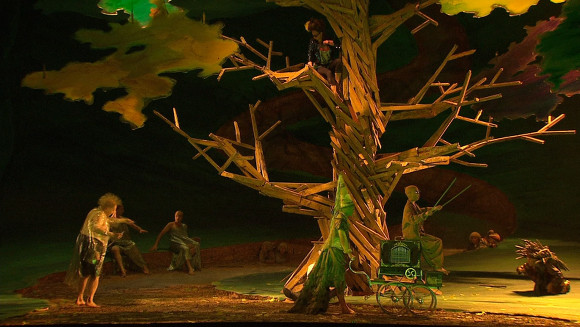
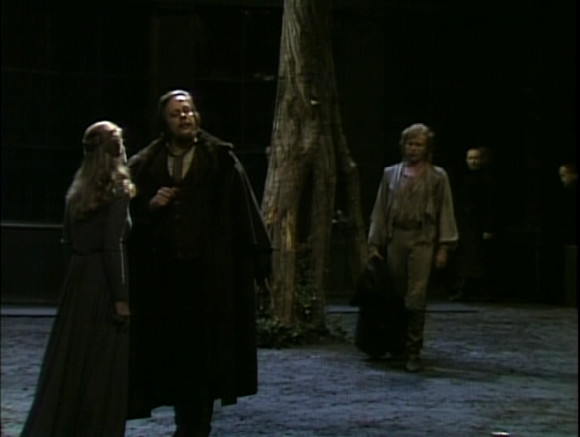
Melly Still’s 2012 Glyndebourne production of Janáček’s Cunning Little Vixen is straightforward and rather beautiful.  Certainly the staging matches the magic of this extraordinary score.  There are really two ideas underpinning the designs.  The animals are very human rather than the furries sometimes seen.  Their specific nature is hinted at rather than made terribly explicit.  They are differentiated from the humans by being very boldly coloured.  In contrast, the human world is a sort of monochrome 1920’s Moravia; all greys and browns.  Within this framework there are some neat touches.  The foxes carry their tales and use them to great demonstrative effect.  The chickens are portrayed as sex workers with the cockerel as, sort of, their pimp.  It’s not overdone and it’s very effective.  The sets are centred round a stylized tree with other structures as needed being erected on the fly with flats so the action never really stops.

1.forest Continue reading

El Niño

John Adams’ El Niño was conceived as an oratorio but thoughts turned to it being staged early in the creative process.  The final result, as staged at Paris’ Châtelet in 2000, defies easy characterization.  There are singers and dancers on stage but they don’t represent unique characters.  So, for example, at one moment Willard White is Herod and at another Joseph.  To further complicate matters video is constantly projected onto a screen above the stage space.  It was specially created for the piece being shot on location in Super 8.  There’s no clear narrative either.  To some extent it tells the Christmas story but it’s at least as much about the feminine experience of giving birth as anything from Isiah or the Gospels.  It also uses a very eclectic mix of texts; from the Bible, from the Apocrypha, from female Latin American poets, from Hildegard of Bingen and so on.  There are lots off Sellars’ trademarks in the staging too; semaphore and so on.  Does it work?  I don’t really know as it’s really hard to tell from the video recording (see para 3).

1.stage Continue reading

Bard of sex and Eros kinky

The sudden death of Italian opera has always intrigued me.  Works, by Italians or to Italian libretti, dominated opera houses, at least in the English speaking world, for centuries.  The Metropolitan Opera even commissioned new work in Italian (Puccini’s La Fanciulla del West, 1910).  But after Turandot (1924) new works in Italian pretty much dried up.  I can’t think of a single one that could be considered a repertory staple and even more recherché pieces like Pizzetti’s Assassinio nella Cattedrale are few and far between.  Indeed, since WW2 at least, the dominant language for new operas has been English with German some way behind and the odd work in French or something more obscure.  So, I was intrigued to get my hands on a recording of Luca Mosca’s 2007 work Signor Goldoni; a commission for Venice’s La Fenice inspired by the 18th century Venetian playwright and librettist Carlo Osvaldo Goldoni.  What’s really surprising is that the libretto (perhaps we should say “book”) by Italian writer Gianluigi Melaga, is in English!  Apparently librettist and composer consider that English is better adapted to the kind of word play they were aiming for than Italian.

1.rafael Continue reading

Dark but straightforward Zauberflöte

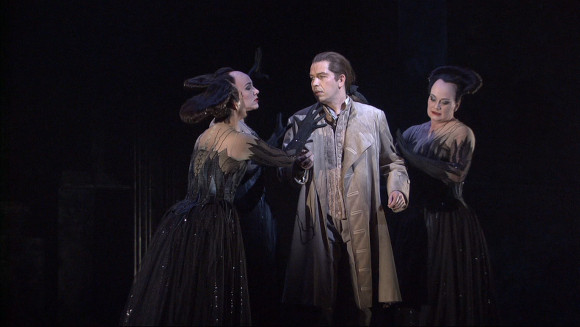
The 2003 Royal Opera House recording of Die Zauberflöte has a terrific cast and it has Sir Colin Davis conducting.  The production is by David McVicar and it’s one of those that make one wonder how he ever got a “bad boy” reputation.  It’s perfectly straightforward though rather dark (emotionally and physically) and has a vaguely 18th century vibe.  In places it seems a bit minimalist, as if the director couldn’t really be bothered with things like the Trials.  The interview material rather suggests that McVicar was a bit overawed by doing Mozart with the great Sir Colin and tried very hard to match his rather old fashioned theatrical sensibilities.

1.tamino Continue reading

Kitchen sink duly chucked

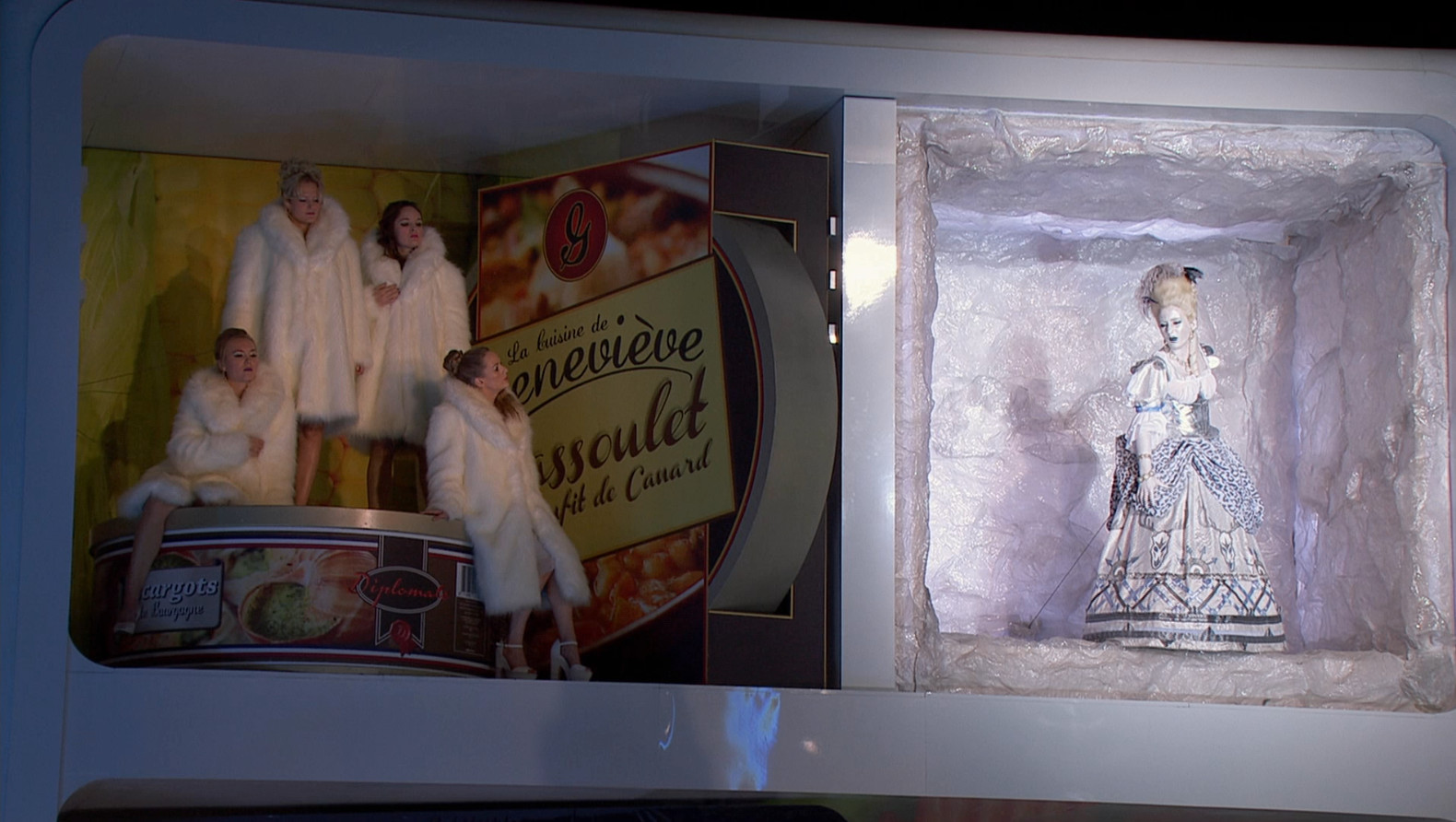
There’s a pretty good “making of” extra with the 2013 Glyndebourne recording of Rameau’s rarely performed Hippolyte et Aricie.  In it, director Jonathan Kent argues that there are essentially two ways of dealing with the French baroque; elegance or “throwing the kitchen sink at it”.  To this one might add a weird pastiche of bare chests, stylized gesture and high camp but that’s another story.  My best experiences with Rameau have definitely been of the kitchen sink variety.  I’m thinking of productions like José Montalvo’s Les Paladins.  Kent is a bit more restrained but still pretty inventive which I think is necessary as Hippolyte et Aricie is rather episodic and fragmented and could use some livening up.

1.fridge Continue reading

Chéreau Ring – Götterdämmerung

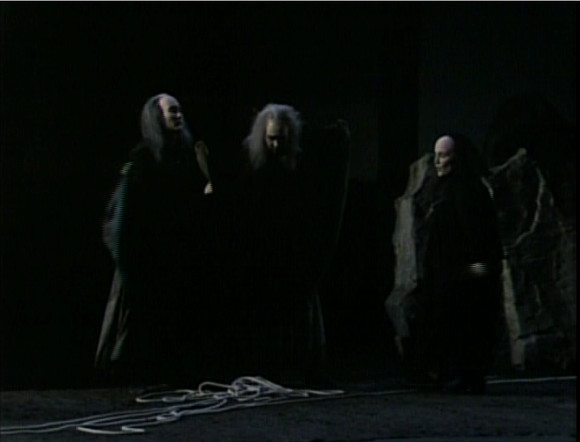
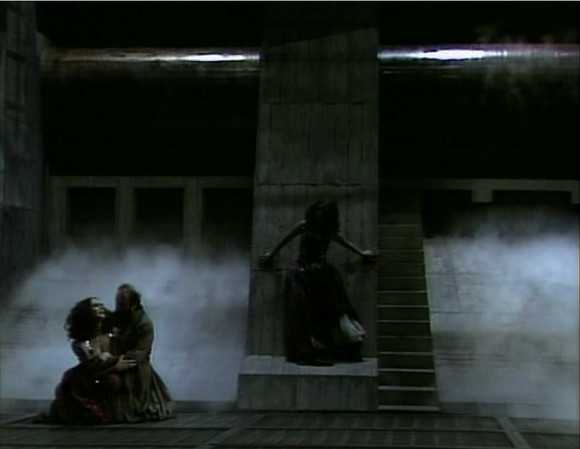
And so, at last to Götterdämmerung.  The scene with the Norns is dark, very dark.  There’s a rope and not much goes on (at least that is visible) but the singing is good.  The “dawn” scene comes off more effectively here than the final scene of Siegfried but it’s still not great.  I think the problem is a combination of Manfred Jung’s dry, rather nasal tone and Boulez rather fast tempu.  It seems rushed rather than ecstatic and the Rhine Journey doesn’t thrill.  I was concerned at this point that I was being unfair to a renowned production so I put on the same scene from Kupfer/Barenboim.  It’s much better.  Siegfried Jerusalem sounds truly heroic, Anne Evans richer tone blends better than Gwyneth Jones’ (though this could be an artefact of the recording) and, crucially, Barenboim gives the singers room to sing before markedly speeding up for the orchestral music.  At least there is no naff attempt to depict a literal Grane in Chéreau’s version.  At the conclusion of this scene Brian Large pulls off the first of his artsy effects.  During the Rhine music he holds a close up of Brünnhilde for a rather long time before pulling out to a full stage shot which he then shrinks until there is just a tiny square of picture  in the middle of a black screen which, when he slowly expands it, has transformed to the Gibichung hall.  He does the same thing a couple more times.  It seems odd to introduce that kind of thing at such a late stage in the cycle.

1.norns Continue reading

Chéreau Ring – Siegfried

Chéreau’s Siegfried is even less obviously “industrial” than his Die Walküre.  There’s a forge of course but there rather has to be.  Other than that we get workshop, forest and lair pretty much as one might imagine until, of course, we end up back at the ruin where Brünnhilde waits.  Brian Large injects lots of smoke at every opportunity.

1.forge Continue reading

Chéreau Ring – Die Walküre

The second instalment of Patrice Chéreau’s 1980 Bayreuth Ring cycle is set, like Das Rheingold, in a sort of industrial bourgeois late 19th century.  One would almost say steampunk if that were not an anachronism.  Actually the “industrial” side is much less evident than in the earlier work.  There’s a sort of astrolabe/pendulum thing in Valhalla but that’s about it.  Setting aside, the story telling is very straightforward; so much so that it takes a real effort of the imagination to get into a mindset where this production could ever have been considered controversial.  It’s quite literal; Brünnhilde has a helmet and breast and back plates (worn over a rather severe grey dress), Wotan has a spear, Siegmund has a sword.  There’s not an assault rifle or light sabre to be seen.  It is though dramatically effective.

1.hundinghall Continue reading

Chéreau Ring – Das Rheingold

So much has been written about Patrice Chéreau’s centenary production of the Ring cycle at Bayreuth that I approached reviewing it with some trepidation.  I have decided to write about it “as is”; i.e. to write about what I see on the DVD and leave the undoubted historical significance, perhaps even revolutionary impact of the production, to others.  Also, it’s apparent that what’s on the DVD, filmed in an empty house as was contemporary Bayreuth practice, must differ from what was seen on the Green Hill in certain key ways.  This is a review of what;s seen and heard on the DVD.

1.rhinemaidens Continue reading