Maometto II on DVD

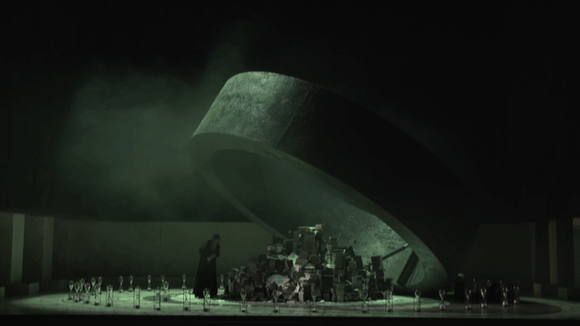
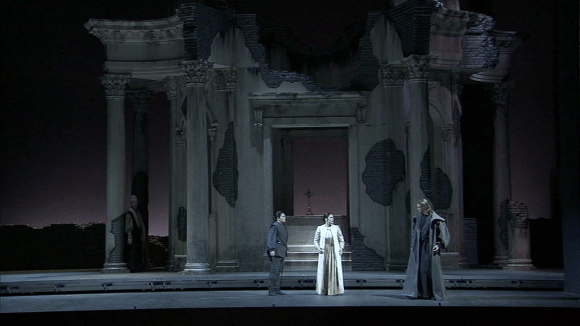
Rossini’s Maometto II is one of those pieces that has a somewhat complex performance history.  The recent David Alden production seen at Santa Fe and the COC was a carefully reconstructed edition of the original Naples production of 1820 which was considered musically radical at the time.  Two years later, for Venice, Rossini produced a new version with cuts, new music and borrowings from other works.  He also changed the ending to a happy one.  The net effect is a far more conventional bel canto opera.  That Venice version forms the basis of the only video recording in the catalogue, recorded at La Fenice in 2005.
2.trio

Continue reading

Faust as you have never seen it before

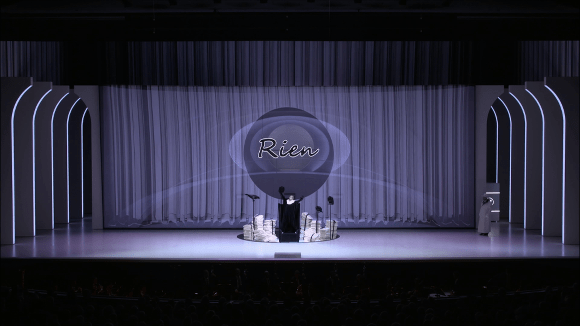
The 2016 Salzburg recording of Gounod’s Faust is challenging.  Perhaps the nine pages of the booklet given over to a concept discussion with the directors should have given me sufficient warning that this was not going to be Faust à la Met.  It’s not.  It’s extremely complex and I’m not sure I fully understand it or whether all the ideas work but I did find it fascinating visually and dramatically, and musically it’s top notch.  That said, traditionalists can save themselves a trip to the ER by walking away now.

1.rien

Continue reading

Spectacular Die Liebe der Danae

Richard Strauss’ Die Liebe der Danae is one of his least performed operas so it’s not very familiar to most opera goers.  I wrote about its performance history and provided a plot summary in my review of a 2011 recording at the Deutsche Oper, which is the only video recording besides the 2016 Salzburg one which forms the subject of this post.

1.turbans

Continue reading

Aesthetic Faust marred by dodgy video editing

I’m ambiguous about Italian regional houses in general but what I’ve seen of the Teatro Regio Torino has impressed.  They have a fine orchestra and a chorus that can sing and act and they are not afraid to take risks.  All of that is very much in evidence on their recording of Gounod’s Faust made in 2015.  The production is designed, directed and choreographed by Stefano Poda and, like rather a lot of his work, it’s long on big architectural statements and large scale stage pictures.

1.books

Continue reading

Monochrome Nabucco

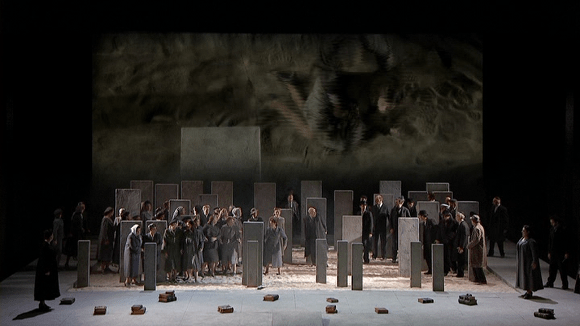
Daniele Abbado’s production of Verdi’s Nabucco, recorded at Covent Garden in 2013 was the vehicle for Placido Domingo taking on yet another Verdi baritone role.  It’s set in the 1940’s because, Jews.  At least it’s costumed that way because nothing else about the production has any kind of sense of time or place.  It’s virtually monochrome and quite abstract.  The Temple is represented by a set of upright rectangular blocks which are toppled at the appropriate moment.  The idol of Baal is a sort of wire frame that comes apart rather undramatically and so on.  There’s also nothing in the direction to suggest any kind of concept.  It’s quite straightforward with rather a lot of “park and bark”.  There’s some use of video projections behind and above the action but it’s rather hard to figure them out on video as they tend to appear in shot rather fleetingly.

1.pillars

Continue reading

Susannah in St. Petersburg

It’s an odd quirk of opera broadcasting that relatively few video recordings of operas get made in North America and those that do are almost all recorded at the Met.  This means that works that are standard rep on the west side of the pond but rarer in Europe may be very slow to get a video release, if they get one at all.  Now Carlisle Floyd’s Susannah is just such a work.  It’s the second most performed US opera after Porgy and Bess but has only just appeared on video for the first time.

sus1

Continue reading

Red blooded Otello

I’m never quite sure what I think about large scale outdoor opera performances but the Macerata Opera festival’s 2016 production of Verdi’s Otello staged in the Arena Sferisterio comes over rather well on video.  It’s a complete contrast with the Salzburg production I reviewed a few days ago.  This is large scale “red in tooth and claw” Verdi.  There is none of the subtlety of the Salzburg performances but it is spectacular and quite exciting.

1.storm

Continue reading

Patchy Andrea Chénier

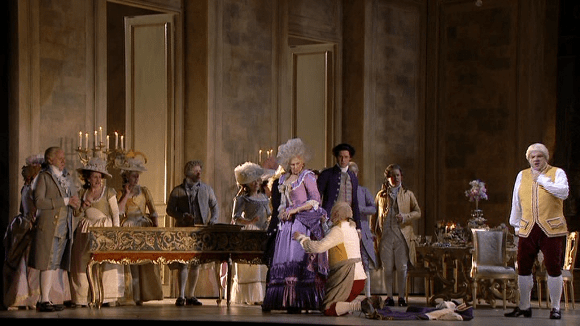
What’s become of David McVicar?  His 2015 production of Giodarno’s Andrea Chénier for the Royal Opera House seems typical of his recent work.  It looks expensive.  It features a starry cast.  He flirts with dramatic risk but in the last analysis it comes off as a bit tame and even sloppy.  Basically when the principals are at the centre of the drama it’s compelling stuff but when they are not it’s not and there are curious inconsistencies.

1.soiree

Continue reading

Elegant and subtle Otello

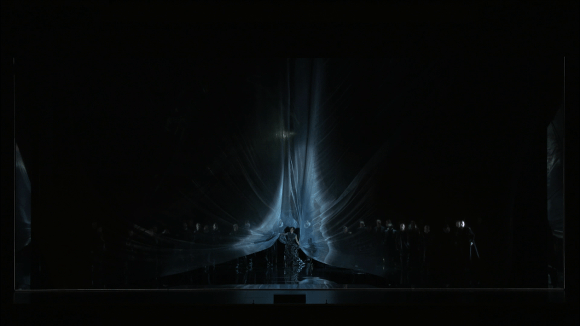
Vincent Brossard’s production of Verdi’s Otello for the 2016 Salzburg Easter Festival is both elegant and subtle; the latter quality being backed up by superb singing and acting from the principals.  In many ways the production is clean and straightforward with a focus on character development but it also makes use of elegant lines and sharply contrasting darks and lights in creating the stage picture.  There’s also a really cool use of mirrors during Già nella notte densa that I can’t quite figure out.

1.storm

Continue reading

Castellucci’s Moses und Aron

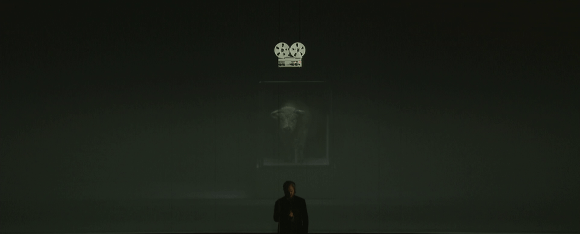
Schoenberg’s Moses und Aron is a very peculiar opera.  It’s pretty much an extended debate about the nature of God cast in highly abstract terms.  So who better to direct it than the almost unbearably cerebral Romeo Castellucci.  Previous encounters with his work have been puzzling, thought provoking (and WTF provoking) but never dull.  All those terms could be deployed to describe the production recorded at L’Opéra nationale de Paris in 2015.

1.tape

Continue reading