The Chocolate Soldier on TV

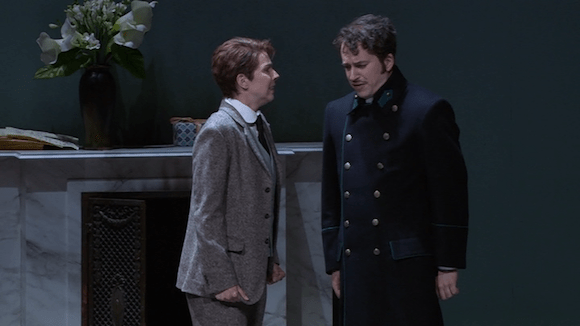
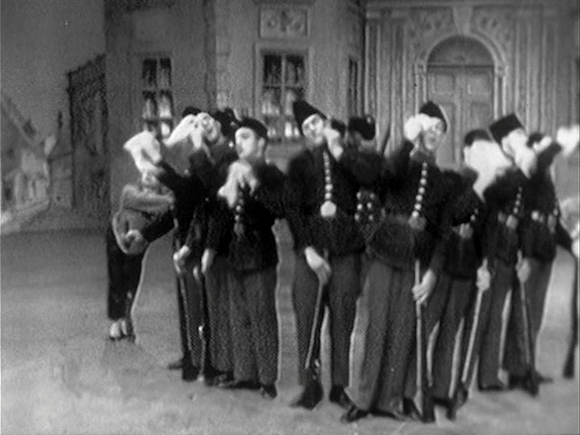
Sometimes curiosity just gets the better of me.  I rather enjoyed Toronto Operetta Theatre’s production of Oscar Straus’ The Chocolate Soldier so I was prepared to take a look at the 1955 made for TV version directed by Max Liebman.  I probably shouldn’t have bothered.  There’s so much weird here.  First off the plot is changed out of all recognition, besides being cut down to 77 minutes.  Nothing much is left apart from the basic idea of the heroine Nadine falling for the Swiss soldier who is chased into her bedroom rather than her bumptious fiancé Alexius.  His escape and return are replaced with a silly impersonation of a visiting general and a farcical court martial.  In mucking about with the plot most of the humour and essentially all the satire is lost leaving just a very silly and dated Broadway style romcom.

1.soldiers

Continue reading

Updated La Bohème

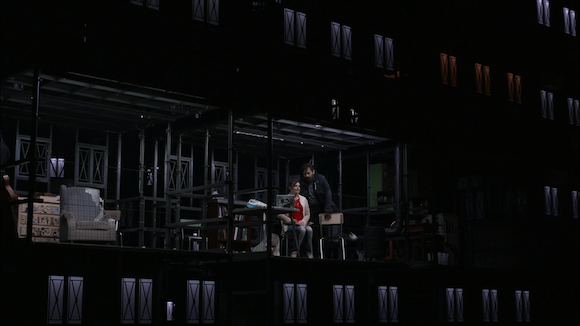
The catalogue is full of La Bohèmes from regional houses sung by serviceable casts.  The version recorded at the Teatro Regio Torino in 2016 is another.  My reason for wanting to look at it is because the production was directed by Àlex Ollé of La Fura dels Baus and I hoped it would prove as insightful as Stefan Herheim’s Oslo production.  It doesn’t really.  He gives the piece a fairly gritty modern setting but I don’t think it speaks to our modern insecurities the way Herheim does.  Rather it plays pretty much as a gritty 19th century setting, which is, admittedly, vastly preferable to Zeffischenk excess or ne0-Broadway tweeness.

act1

Continue reading

A serious take on Les Indes galantes

I’m not really sure that it’s a good idea to take Rameau too seriously, especially a work like Les Indes galantes but that’s what Sidi Larbi Cherkaoui does in his production for the 2016 Münchner Opernfestspiel.  As written, the piece has five separate parts; an allegorical prelude and four scènes, each telling a love story in an “exotic” setting; Turkey, Peru, Persia, among les sauvages of North America.  It’s a spectacle but it uses the exotic settings to poke fun at certain aspects of Western culture in Rameau’s usual irreverent way.  There’s no linking narrative and the characters in each scène (the goddesses Amour and Bellona aside) only appear once.

1.class

Continue reading

Massenet’s Werther

Thackeray thought Goethe’s Sorrows of Young Werther was so boring and idiotic that he wrote a satirical poem about it (you can find it at the bottom of the page).  Massenet’s reaction, alas, was to write a three hour opera based on it.  Add to the implausible and dull plot (altered but slightly from Goethe’s original) Massenet’s overblown romantic music and penchant for any sentimentality he can find (at the end, a children’s chorus sings a Christmas song while Werther is bleeding to death in Charlotte’s arms) and it’s well nigh unbearable.

1.gate

Continue reading

A different take on Tosca

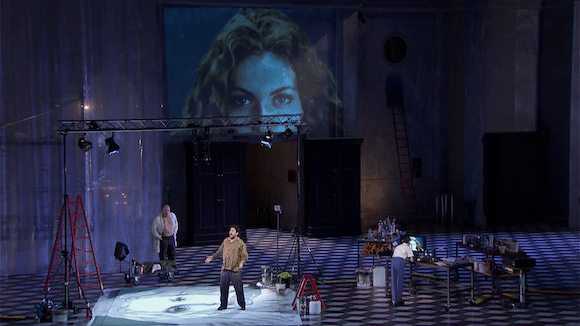
For quite some time I have wondered whether it’s possible to reinterpret Puccini’s Tosca or whether the specificity as to time and place in the libretto makes it effectively impossible?  Indeed I had never even seen it tried.  All this despite the many and obvious anachronisms in the libretto.  All the Toscas I had seen were clearly set in Rome in that one week in 1800 (or at least the implausible version of it that’s contained in the libretto)!  Phillip Himmelmann’s production for the 2017 Baden-Baden Easter Festival breaks the mould in giving it a contemporary, or perhaps near future, setting.

1.church

Continue reading

Magic Flute for kids

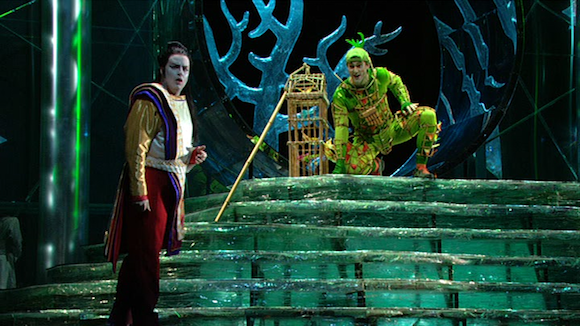
The Met’s abridged version of Mozart’s The Magic Flute, in English, got an HD broadcast in 2006 and a subsequent DVD release.  It’s Julie Taymor’s production and it’s visually spectacular with giant sets, loads of very effective puppets and very good dancers (I wish every opera company used dance as effectively as the Met.  Too expensive I guess).  It’s more something one might expect to see at Bregenz than at the Four Seasons Centre.  Costuming is sometimes a bit weird.  The Three Ladies have removable heads and the chorus of priests look like origami angels but it’s never less than interesting visually. There’s nothing about the cuts (it comes in at about an hour and threequarters) that changes the plot in any way that makes it obviously kid friendly beyond being shorter and there’s no attempt to make it anything other than a pretty fairy tale.  If one wants a Flute with deep meaning this isn’t it.

1.taminopapageno

Continue reading

Zu viel Gluck

The first time I saw a DVD recording of Gluck’s Alceste I put my reaction of utter tedium down to Robert Wilson’s highly stylized and static production.  This time I looked at a production, recorded at Staatsoper Stuttgart in 2006, by Jossi Wieler and Sergio Marabito, who did a rather good job on the rather dreary La Somnambula, expecting rather more.  Actually I think they have some good ideas but they can’t obscure the fact that this is basically a very dull opera.

1.chapel

Continue reading

Nobody vomits on Dolly Parton’s shoes

I’ve tried several times in the past to watch the DVD recording of Mark-Anthony Turnage’s Anna Nicole and never made it past the second scene, which is revolting and, I still think, rather patronising.  This time though I made it all the way through and I think, taken as a whole, this is a pretty impressive piece with a clever libretto and some real musical depth.  It’s also, in the true and technical sense, a tragedy, and a very operatic one at that.

1.chorus

Continue reading

Faccio’s Amleto

Franco Faccio’s 1865 work Amleto disappeared from the opera repertoire after the disastrous opening night of its 1871 revival at La Scala only to be “rediscovered” in recent years and featured at the 2016 Bregenz Festival.  It was Faccio’s second, and last opera, though he enjoyed a career as a conductor, that included eighteen years as Music Director at La Scala before being institutionalized due to the effects of syphilis.  So, one naturally asks, is it any good?  The answer is an emphatic “yes”.  It’s not only good but seems quite advanced for an Italian opera of that date.  It’s closer in spirit to Puccini than bel canto.  Indeed the soliloquy Essere o non essere sounds curiously like E lucevan le stelle.  It’s similar to later Verdi and, indeed, Puccini in that it’s through sung with recitative like passages and set piece arias and ensemble numbers and it’s more conventionally tonal than its contemporary Tristan und Isolde.  Arguably the orchestral writing is more interesting than that for voice (Ophelia’s funeral march is very fine) and certainly the weakest parts are the ensembles.  It’s probably also fair to say that there is no big hummable melody.  Still, Faccio was twenty five when he wrote it and there aren’t many better operas by twenty five year olds.

1.dance

Continue reading

Tell stripped of Romanticism

Damiano Michieletto’s production of Rossini’s Guillaume Tell at the Royal Opera House in 2015 was controversial because of the replacement of the Act 3 scene where Austrian soldiers force Swiss girls to dance with them with something far more explicit.  It is a tough scene to watch but it’s absolutely consistent with a very thoughtful overall approach to the piece.  After all what do occupying troops do with village girls?  The director, rightly I think, sees the piece as being about the brutality of military occupation and colonialism but also recognises that the Tell legend, especially in its Schiller version is overlaid with euphemising Romanticism.  Michieletto’s production both strips away and draws attention to the Romanticisation.  He sets the piece in a roughly contemporary setting.  To me, the civilians look 1950s but Gesler’s men look more modern.  The actual action is played out unsentimentally, indeed brutally, in this time period.  The ballets, one of the principal euphemising agents, are all replaced by more realistic action.  To draw attention to how the legend has been transmitted two devices are introduced.  Tell’s son Jemmy has a comic book version of Schiller which he consults at key points and there’s a silent character; medieval Tell, straight out of the legend with feathered cap etc who appears whenever the morale of actual Tell or the Swiss in general needs a boost.  It sounds a bit corny but it really does the job.

1.comic

Continue reading