Alagna and Gheorghiu in L’elisir d’amore

Shortly after their marriage in 1996 Angela Gheorghiu and Roberto Alagna appeared together in Donizetti’s L’elisir d’amore at Opéra de Lyon.  At the time she was 31 and he was 33 so pretty much ideal for the roles.  The production was directed by Frank Dunlop.  It’s straightforward, set in the 1920s and essentially traditional though there are a few nice touches.  It’s what the recent COC production might have been if the asinine attempts to be “relevant” had been ditched.

1.village

Continue reading

Straightforward Otello from the Met

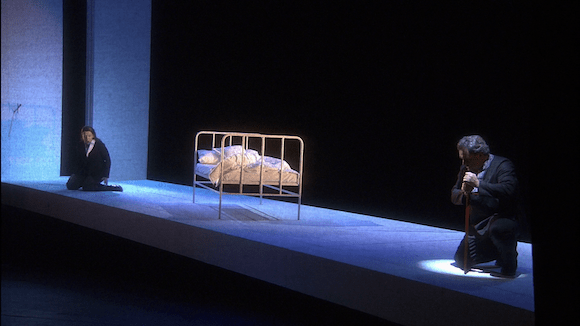
In 2015 the Metropolitan Opera premiered a new production of Verdi’s Otello directed by Bartlett Sher.  It was broadcast in the Met in HD series and subsequently released on Blu-ray and DVD.  It’s a bit hard to judge the production on video because of the video direction.  I don’t think there are any big ideas but it’s decorative enough with arrangements and rearrangements of plexiglass wall/rooms and some effective video projections for things like the storm scene.  Only Act 4 breaks the mould with a sparse stage with just a bed and a few chairs.  I strongly suspect though from the occasional wide angle shot that there was a lot more going on visually than one sees on the video.  Costumes are 19th centuryish and quite decorative.

1.storm

Continue reading

It’s pure madness!

That’s what Laurent Pelly said about the idea of a Frenchman directing a French opera adaptation of a Shakespeare play for an English audience during Shakespeare 400.  Maybe he has a point but I think his 2016 production of Berlioz’ Béatrice et Bénédict probably gets as much as there is to be got out of a curiously uneven work.

1.chorusboxes

Continue reading

Classic Lulu

I’ve been taking another look at the Glyndebourne production of Berg’s Lulu that I first reviewed in April 2011.  I think a reappraisal is in order.  It’s a 1996 production directed by Graham Vick with Andrew Davis conducting and Christine Schäfer in the title role.  When it first appeared it got rave reviews with Gramophone awards and the like.

1.trainer

Continue reading

Never forget, never forgive

It’s the 73rd anniversary of the liberation of Auschwitz by troops of the Red Army and I’ve been watching a recording of Miecyslaw Weinberg’s The Passenger.  The opera was written in 1968 but the political climate in the then Soviet Union meant that, despite the advocacy of Dmitri Shostakovich, it had to wait until 2010 before it was given a fully staged performance. That happened, and was recorded, at the Bregenz festival in a production directed by David Pountney.

1.deck

Continue reading

My armour is transformed into wings

I’m usually a bit leery of watching older recordings of 19th century Italian opera.  The aesthetic is rarely my thing.  But, when I came across a recording of Verdi’s Giovanna d’Arco directed by Werner Herzog I had to take a look.  It was a pretty weird experience.  It would hardly have been odder if Klaus Kinski had sung the title role.  It’s a production from the Teatro Communale di Bologna and it was recorded in 1990.

1.french

Continue reading

Norma with string

I rather like recordings from the Macerata Festival where the performances take place in the enormous amphitheatre of the Arena Sferisterio.  Bellini’s Norma is a good choice for such as setting and the 2016 production directed by Luigi di Gangi and Ugo Giacomazzi makes good use of the space.  It also uses string.  The sets are stringy.  The very scruffy Gauls wear shapeless tunics with lots of string over them.  The slightly smarter Romans also wear string.  And everybody plays with string.  There are more strings than in the Princeton Physics Department. There’s lots of face paint too.  The production also makes use of a spectacular multi-coloured lighting plot but, apart from the visuals, is pretty conventional and straightforward.

1.green

Continue reading

Madama Butterfly at La Scala

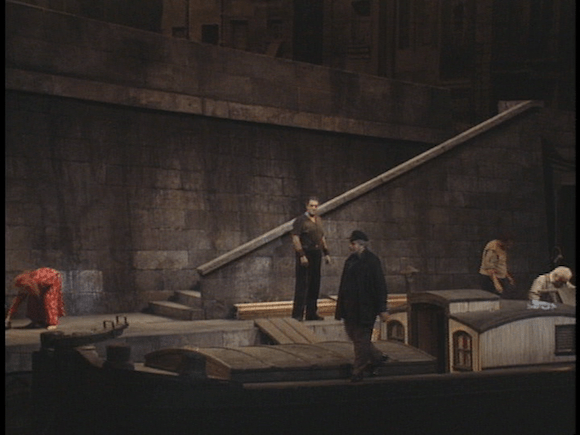
Looking at a (perhaps inadequate) sample of video recordings from La Scala I begin to come to the conclusion that there is a pretty strong pattern in what they do well, and not so well.  1800-1920 Italian classics with strong casts in visually attractive but not overly deep productions seems to be the sweet spot.  Stray far from this and the wheels tend to come off.  Fortunately this week I’ve seen two of the good ones recorded 30 years apart.  A couple of days ago I posted a review of the recent I due Foscari and now I’ve jumped in the Tardis to watch a 1986 recording of Puccini’s Madama Butterfly.  The similarities are striking.

1.garden Continue reading

I due Foscari

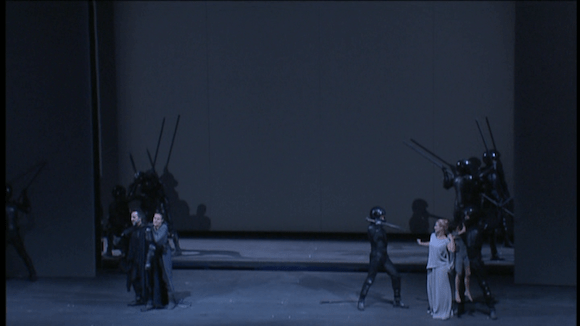
Verdi’s sixth opera, I due Foscari, is probably not well known to many readers so a brief description may be in order.  It’s a rather grim tale of injustice and revenge.  Francesco Foscari is the aged Doge of Venice.  His son, Jacopo, has been stitched up by the family rival Jacopo Loredano and exiled to Crete.  He returns to try and clear his name but is fitted up again.  This time for the murder of one Donato.  Despite torture he refuses to confess and is sentenced to return to exile in Crete.  The first three quarters of the opera is mostly either father or son bemoaning their fate (Francesco has already lost three sons.  Lady Bracknell would be unimpressed) or Lucrezia, Jacopo’s wife, pleading for mercy to anyone who will listen.  Then there’s a final scene where Francesco receives proof of his son’s innocence, closely followed by news of his death, closely followed by news that the Council and Senate are sacking him.  Loredano gloats.  Foscari dies.  Structurally it’s very much a “numbers” opera with a succession of short scenes mostly featuring various combinations of the three Foscaris and the chorus.  There are a lot of quite sophisticated ensemble pieces as well as a couple of solo arias for each of the principals.  It’s musically rather distinguished in fact.  The three Foscari roles are big sings.  Nobody else has much to do.

1.gondoliers

Continue reading