
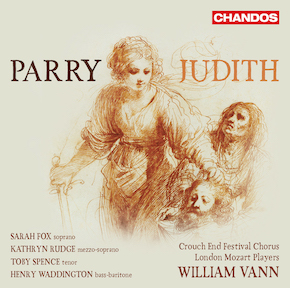
 Hubert Parry’s Judith has been making something of a comeback. A new performing edition by Professor Stephanie Martin was performed at Koerner Hall by the Pax Christi Chorale in May 2015. That seems to have sparked some interest since the piece was transplanted to the Royal Festival Hall in London in April 2019 where rather larger forces presented the piece to generally good reviews. Subsequently the same forces mad a studio recording which has just been released as a hybrid SACD/CD release. If you want to know more googling “Parry Judith” will bring up a small library of articles on the “Judith Project” and how this piece has been unfairly neglected.
Judith’s Saga
Reply
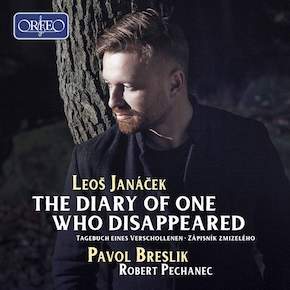 Pavol Breslik headlines on a new recording of Janáček’s Diary of One Who Disappeared; a song cycle about a young man who runs off with a gyosy girl. The piece is given in its original arrangement which, besides tenor and piano, features a mezzo in several of the songs and a brief appearance by a three member female chorus. No doubt this is one reason it’s performed less often than it might be. Breslik is pretty much ideal for this music. Obviosly he’s completely at home in Czech and he sings with clear articulation and has a rather beautiful instrument. He’s well supported by Robert Pechanec on piano plus mezzo Ester Pavlu; who has quite a bright sound for a mezzo but works well enough with Breslik. Dominika Hanko, Zuzanka Marczelová and Mária Kovács make up the chorus.
 I’m intensely interested in the different approaches that composers take to setting text so I was intrigued to read the blurb on a new CD release by American composer Jackson Greenberg. The text is Rilke’s Der Panther and the approach is to take an old (anonymous) recording of an actor reading the poem and provide an orchestral accompaniment for it. It’s quite short; just shy of eight minutes, and the music is an atmospheric variant on largely tonal minimalism. It’s not a big surprise to discover the composer works mainly in film and TV. It’s unusual and worth a listen.
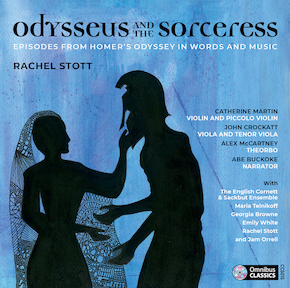 This is a really unusual CD. It combines readings; both in the original Greek and in English translation of some of the best known passages in Homer’s Odyssey with music for period instruments composed by Rachel Stott.
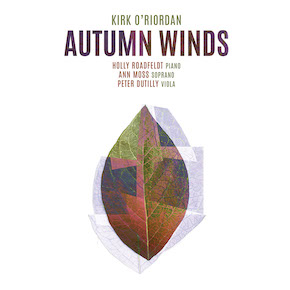 Autumn Winds is a new CD of vocal and chamber music by American composer Kirk O’Riordan. Much of the music is unashamedly beautiful but it doesn’t sound in the least retro. It’s a long way from the neo-Broadway style that drives me nuts.
 2020 started with news of yet another anti-semitic atrocity in the United States. My musical 2020 started with a new recording of that finest of all musical acts of resistance to anti-semitism, Shostakovich’s Symphony no. 13 in B-Flat minor “Babi Yar”. It’s a setting of poems by Yevgeny Yevtushenko for orchestra, bass soloist and men’s chorus and it’s powerful stuff. It’s often performed at consistently high energy and volume and seething with anger. Riccardo Muti treats it rather differently. The recording, featuring bass Alexey Tikhomirov, the Chicago Symphony and the men of their chorus, doesn’t lack drama or intensity but it’s also often intensely lyrical. When require, Tikhomirov and the chorus produce some gorgeously beautiful, even delicate, singing and the orchestra do the same. There’s not much of the blaring brass one associates with the Leningrad recordings of the Shostakovich symphonies. Instead there’s some wonderful playing, especially by the low brass. The motif in the fourth movement, curiously reminiscent of the Fafner scene in Siegfried, features a sort of duet between tuba(?) and timpani to great effect. This is very fine music making.
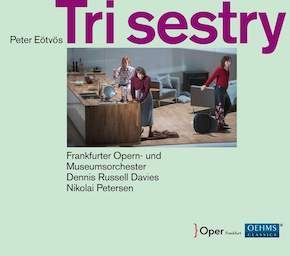 Peter Eötvös’ 1998 opera Tri sestry is based on the Chekhov play and was recorded live at Oper Frankfurt in 2018. It takes fragments of the original Russian play and recombines them in a non-linear way to create a prologue and three “Sequences” from the points of view of Irina, Andrei and Mascha repectively. The recombination is complex enough for the accompanying booklet to contain a table mapping Chekhov’s scene order to Eötvös’. There’s no libretto in the CD package so even flipping between the (fairly detailed) synopsis and the track listing it’s hard to figure out who is singing or about what. No doubt this was much clearer when watching the stage production.
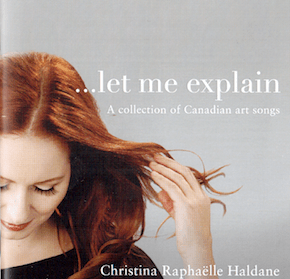 …let me explain is a new CD of Canadian art song (mostly) from soprano Christina Raphaëlle Haldane. The first set consists of three arrangements of Acadian folk songs by by Carl Philippe Gionet. The three are quite different. L’Escaouette is fast, high, rhythmic and very high energy. Tout Passe is much more elegiacal while Wing Tra La is very playful. They are sung quite beautifully with piano accompaniment from the arranger. Ahania’s Lament is a longish piece in which Blake’s text is set by Samy Mousa. It’s a tough sing with a lot of high exposed passages against a minimal accompaniment. It’s a piece that it’s easy to get drawn into. It’s a good vehicle for Haldane’s crystalline upper register. Piano accompaniment by M.Gionet again.
 The latest release on the Chandos label from Sir Andrew Davis consists of three works by Sir Arthur Bliss; The Enchantress, Meditations on a Theme by John Blow and Mary of Magdala.
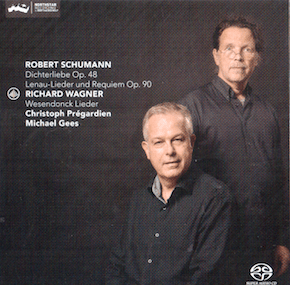 I’ve been listening to Christoph Prégardien and Michael Gees’ new Schumann and Wagner recording for a number of reasons. I was very impressed with
