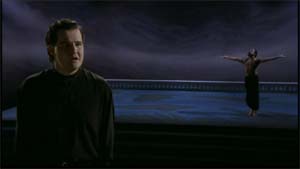
I was really impressed when I first watched the DVD version of Wagner’s Der Fliegende Holländer recorded at Bayreuth in 1985. It’s been some time since I last watched it so another look seemed in order. The production, directed by Harry Kupfer debuted in 1978 to both applause and brickbats. The concept is that the Dutchman exists only in Senta’s imagination. She is fixated on the Dutchman as her route out of the repressed bourgeois environment she is trapped. It’s a tormented, even hysterical, version of Senta that finds a fine interpreter in Lisbeth Baltslev. 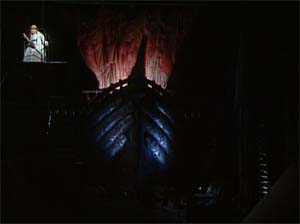 Kupfer reinforces this idea of Senta by having her on stage all the time. During the overture she retreats to a sort of cage at the top of a staircase with her precious picture of the Dutchman which she will hang onto throughout the drama. She will remain in this cage high to one side of the stage watching the action below her throughout the first act.
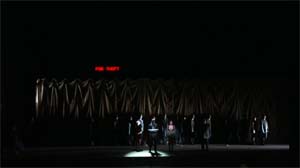
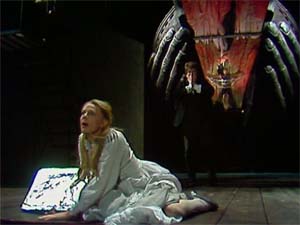
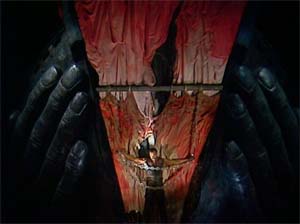 It’s a very strong first act musically and visually The Dutchman’s ship makes a spectacular entrance and the finger like timbers of the bow open up to show the Dutchman chained in a crucifixion pose. Simon Estes as the Dutchman is suitably elemental. His singing and acting have a frightening intensity without ever becoming unmusical. Matti Salminen’s Dahland is perfectly adequate and conveys the grasping bourgeois rather well.
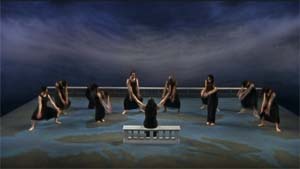
Act 2, of course, opens in the Spinning Hall. Anny Schlemm’s Mary exemplifies the dull conventionality of the place. We are in the world of Strindberg or maybe Babette’s Feast. The intensity of Balslev’s performance cuts right through this. Johohoe! Truft ihr das Schiff im Meere an is as eerie as it is powerful. Against this obsession the rather dull Erik of Robert Schunk is doomed from the start. Things warm up with the arrival of Dahland and the Dutchman. Salminen is in very good voice with Mögst du mein Kind, den fremden Mann willkommen heißen. Senta is pinched looking or frightened almost throughout this scene. 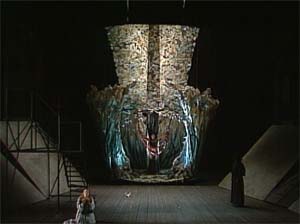 There is great ambiguity while the Dutchman sings Wie aus der Ferne längst versangner Zeiten. The Dutchman of Senta’s imagination sings from the gorgeous fantasy hold of his ship while the shadowy figure who arrived with Dahland is still on stage. Senta is slow to buy into what is happening but she finally dissolves into a state that is more madness than delight.
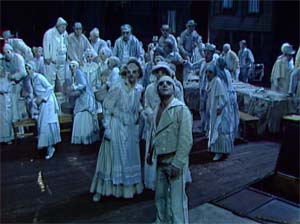 Act 3 opens with Senta watching her own wedding feast from the cage. The townspeople and Dahland’s crew are almost as unnatural as the Dutchman’s. It’s quite chilling and sinister all through until the Dutchman’s crew drive everyone off stage leaving Senta alone for her confrontation with Erik. Then we get the big scene where the Dutchman, chained up again in the infernal version of his ship, thinks that Senta has betrayed him and leaves her.
 This is, obviously, crucial to the plot but it has never really made much sense to me in a normal interpretation. Here it does. This obsessed Senta needs to be “faithful unto death” not to have a happy ending. It’s equally apt that her suicide is just that. There is no hint of redemption for her or the Dutchman. It’s the end. The people turn their backs on her corpse leaving only Erik, in despair, still with her.
So dramatically it works as a piece held together by really intense performances by Balslev and Estes and, lest I forget, Woldemar Nelsson conducts and keeps things moving along briskly. At times the orchestral playing is quite thrilling and the chorus is excellent too.
A couple of other things about the production are worth pointing out. Although the booklet sets the scenes out in the conventional three acts it is actually played through (as I understand Wagner intended and as it was played at the COC a couple of years ago). Scene changes are dynamic and slick. There’s some real stage craft here. It’s also very dark, as I recall most 1970s productions being. This makes on stage detail hard to pick up and, I’m sure, affected the video direction.
This production was directed for video by Brian Large (surprise!) and it seems to have gone straight to video with no TV broadcast. That said it looks like it was directed for the “small screen” which one might expect in 1985. This is problematic given the crucial role of the spectating Senta, as most of the time she is out of shot. Large tries to compensate for this with superpositions, fades and dissolves and is fairly successful. All in all, I think he gives us as good a picture of what Kupfer put on stage as one could reasonably expect.
Picture quality is a bit soft grained as you might expect for the time and it’s 4:3. Sound options are PCM stereo or DTS 5.1 which is a post process of the original stereo capture. It’s very good indeed. There are English, French, German, Spanish and Chinese subtitle options. There’s nothing much in the way of bonus material but the booklet has a full track listing and an informative essay by Erich Rappl.
All in all I think this disc can be highly recommended. It’s a landmark production, well executed on stage and captured for DVD remarkably well for its era.
If you want a preview the whole thing is available in ten minute chunks on Youtube but the quality is a bit off putting.


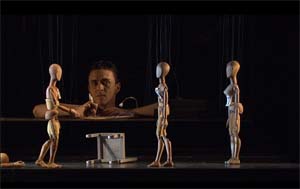 The director, Thomas Reichert, came up with the ingenious idea of combining the two singspiels and performing them with puppets in the Salzburger Marionettentheater.
 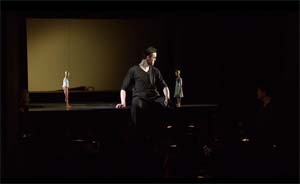 The work breaks into three parts; a largely spoken prologue based on Der Schauspieldirektor where Frank (Alfred Kleinheinz) and Buff (Radu Cojocariu) audition the puppets for the roles in Bastien und Bastienne. The puppetry in this section is quite wonderful. The decision is made to split cast Bastienne which sets up the soprano rivalry for the final part of extracts from Der Schauspieldirektor. In between we get the performance of Bastien und Bastienne with Cojocariu singing the magician Colas on stage with the puppets while Bernhard Berchtold, Evmorfia Metaxaki and Aleksandra Zamojska sing from the pit.
 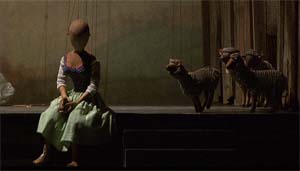 It’s charming complete with puppet sheep. The finale well exploits the difference in voice between the fuller, more mature Zamojska and the brilliant coloratura of Metaxaki. It’s lots of fun with some good gags and excellent singing from the young cast, especially Cojocariu. The orchestra is the Junge Philharmonie Salzburg conducted by Elisabeth Fuchs.
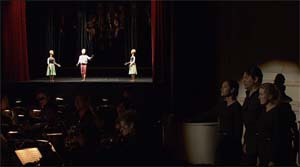 The video direction is by Stefan Aglassinger. He does a good job of producing a coherent video which is not easy because the action takes place on stage, in the pit and around the auditorium. It was filmed in HD and the picture is an excellent 16:9. Sound options are PCM stereo and DTS 5.1. There are English, French, German and Spanish subtitles. The disc includes a reasonably interesting “Making of” documentary.